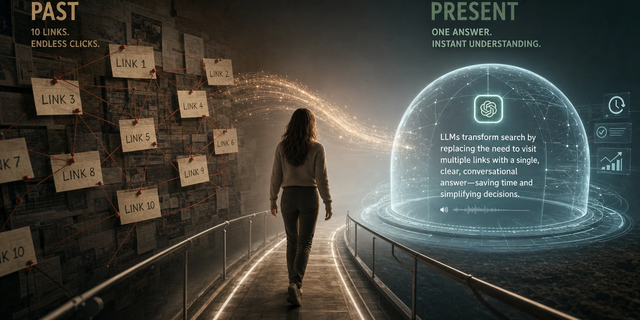
An answer engine is what a search engine becomes when it stops handing back a list and starts composing a reply. You ask in ordinary words; instead of ten links to sort through, a single passage comes back, written as though somebody had already done the reading on your behalf. ChatGPT, Perplexity, Google's AI Overviews and the assistants living in phones all work this way. Underneath it is less magical than it looks: fan the question out into several searches, retrieve passages from whatever comes back, and generate prose that stitches the findings together.
The difference sounds procedural and is not. A list of links leaves the judgement with you — you see whose answer it is, you notice the domain, you register that the first result is an advertisement and the third is a trade body with an interest of its own. An answer engine makes those calls silently and hands you the conclusion. The sources it weighed are invisible unless it chooses to name them, the ones it discarded are invisible always, and the confident register of the reply is identical whether it drew on three careful sources or one assured blog post.
Two properties follow from that and are worth holding onto. The first is that the answers are unstable: ask the same question twice and the wording, the emphasis and occasionally the substance will shift, because generation is probabilistic and the passages retrieved differ from run to run. The second is that the web these systems read was built for a different economy. Pages were written to be clicked; an answer engine reads them and returns nothing, which removes the traffic that paid for writing them. Nobody has yet explained convincingly what funds the next decade of the material this all depends on.
The human translation is the difference between a library and an oracle. In a library you can see the shelf, notice which books are old, and form a view about who is worth believing before you believe them. An oracle gives you a sentence. It is faster, it is usually right, and it quietly relocates a judgement you used to make yourself. That may well be a trade worth making. It is worth at least noticing that it was made.