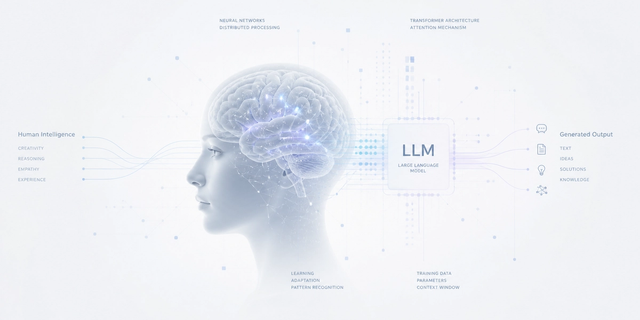
A large language model is a neural network trained to predict the next token in a sequence of text. Given the phrase 'the sky is', it assigns probabilities to what comes next — 'blue' scores higher than 'Tuesday', though both are technically possible. Do this at enormous scale, across hundreds of billions of parameters trained on vast quantities of written text, and something unexpected emerges: the model develops what looks very much like understanding. It can translate, summarise, reason, write code, and hold a coherent conversation — not because it was explicitly taught any of these things, but because they all reduce, at some level, to patterns in language.
The 'large' matters more than it might seem. Smaller language models trained the same way on the same data perform modestly. At a certain scale — nobody knows exactly where the threshold sits — capabilities appear that were not directly trained for. This is sometimes called emergence, and it is one of the genuinely surprising and still poorly understood properties of these systems. GPT-4, Claude, Gemini, and their successors are all large language models. So is the autocomplete on your phone, just much, much smaller.
Understanding what an LLM is changes how you read claims about AI. When a language model says something confidently incorrect, that is not a malfunction — it is doing exactly what it was trained to do, predicting plausible text, and plausible text is sometimes wrong. The model has no memory of previous conversations by default, no knowledge of the world after its training cutoff, and no mechanism for verifying whether what it says is true. These are not bugs to be patched; they are properties of the architecture.
The term gets used loosely in public conversation to mean almost anything AI-related. It is worth keeping the definition precise because the precision matters. A large language model is a specific kind of system with specific strengths and specific failure modes. The organisations and people who get the most from these tools are almost always the ones who understand what they actually are, rather than what the marketing suggests they might be.