An AI agent is a program designed to accomplish a goal by taking a sequence of actions, not just answering a single question. Where a chatbot responds to one input at a time, an agent perceives its environment, decides what to do next, acts, observes the result, and adjusts — repeating that loop until the goal is reached. The defining characteristic is autonomy over multiple steps, combined with the ability to use external tools: searching the web, writing and running code, querying databases, sending messages.
Modern AI agents are typically built on top of large language models, which provide the reasoning layer — the capacity to interpret instructions, plan a sequence of steps, and decide which tool to use at each point. But the model is only the brain; the agent is the whole system, including its connections to the outside world. An agent without tools is just a chatbot that thinks it has more to do.
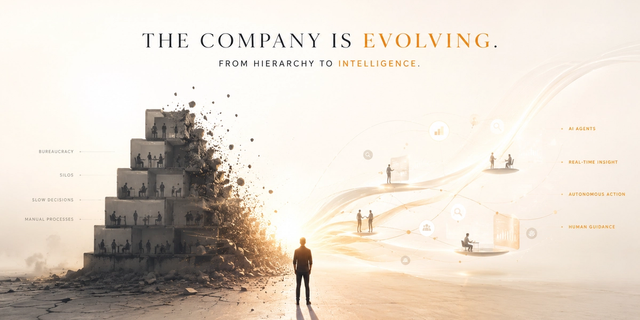
In organisational contexts, agents are increasingly deployed in layers. Sensing agents monitor the external environment for signals. Interpretation agents assess what those signals mean for the business. Decision agents weigh the options. Orchestration agents coordinate the response across other systems. A learning loop runs continuously through all of it, asking after each cycle whether the system performed as intended. Human oversight sits above the stack, validating decisions that cross defined thresholds of risk or novelty.
The honest thing to say is that we are early. Current AI agents are impressive in controlled conditions and brittle in others. They make things up, they get stuck, they sometimes take actions their designers did not anticipate. What is already clear is the shape of the shift: from software that answers questions to software that pursues goals. That is a meaningful difference, and it compounds.