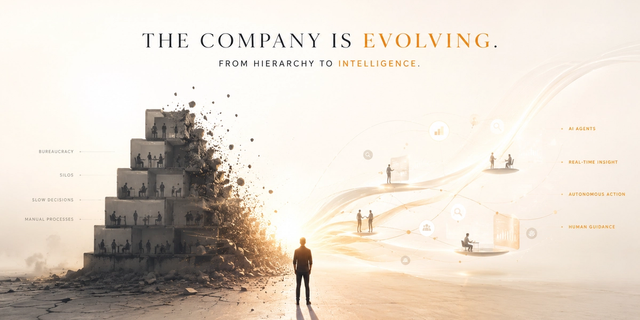
The term borrows its logic from mathematics. A singularity is a point where the normal rules break down — where the equations that described everything up to that moment stop holding. Applied to organisations, the singularity refers to the moment when AI agents become capable enough, cheap enough, and integrated enough that the fundamental logic of how companies are structured — the logic that gave us org charts, management layers, and weekly status meetings — simply stops applying.
The concept is not about a single dramatic moment of replacement. It describes a threshold: below it, AI makes organisations more efficient while leaving their structure intact; above it, AI makes the existing organisational form obsolete. On one side of the line, a traditional company runs faster because it uses AI tools. On the other, something new — a smaller group of humans working alongside intelligent agents, organised not around hierarchy but around layers of specialised capability with human judgment at the top.
What makes it singular rather than merely transformative is the self-reinforcing nature of the change. An AI-native organisation that also learns gets better at what it does every time it operates. It compounds. A traditional organisation slotting AI tools into existing workflows does not compound in the same way — it improves incrementally. The gap between the two grows faster than incremental adoption can close.
The honest caveat is that no one knows when this threshold gets crossed for any given industry, company, or function. What is knowable is the direction of travel, and the principle that tends to hold for discontinuous transitions: the organisations that thrive are rarely the ones that saw it coming the clearest, but the ones that built the capacity to adapt fastest. The singularity, in this reading, is less a date on a calendar and more a test of institutional character.