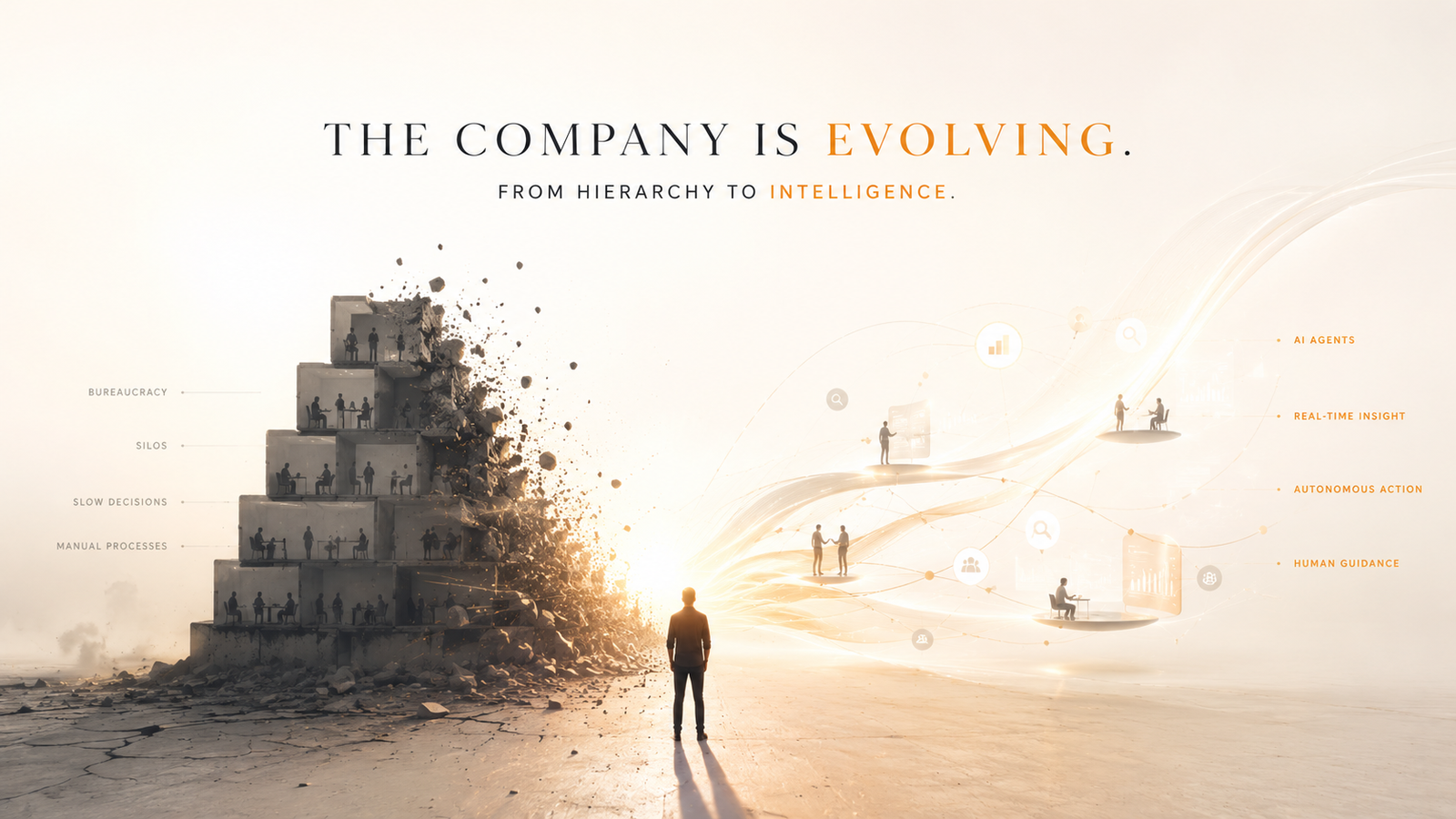

For nearly a century, companies were built around one fundamental idea. That idea just broke. Here's what replaces it.
Back in 1937, an economist named Ronald Coase sat down and asked a question nobody had bothered to ask before: why do companies exist? His answer won him the Nobel Prize and quietly shaped every organization you've ever worked for.
A Theory That Ran the World for 80 Years
His logic went like this: big companies grow because doing things internally is cheaper than contracting everything out. You hire staff, you put them on payroll, you can tell them what to do, and the whole machine runs cheaper than a market of strangers negotiating contracts every five minutes. He called these "transaction costsMechane definition: The hidden cost of doing business through markets rather than inside a single organisation — every negotiation, contract, and handshake that makes buying from a stranger more expensive than hiring a colleague. Link opens the full glossary entry." and "coordination costs." In simple terms, it's just easier to have people under one roof.
That insight held for almost a century. It gave us org charts, management layers, weekly status meetings, and the particular joy of waiting three weeks for sign-off on a decision that took ten minutes to make.
Then something happened. AI got very, very good at coordination. And Coase's logic quietly stopped working.
Building the Feature Is Cheaper Than the Meeting
There's a line floating around tech circles that captures the shift perfectly: building the feature is cheaper than having the meeting about the feature. Think about what that actually means. The entire reason we built big organizations with multiple approval layers was to reduce the cost of getting things done. But today, a small team with the right AI tools can prototype, test, and ship something in the time it takes a traditional company to schedule its first stakeholder alignment call.
Consider something as routine as building a webpage. Inside most companies, this triggers a cascade: design review, brand approval, privacy check, IT security sign-off, legal clearance. Each step involves real people, real schedules, and real delays. Meanwhile, someone working from home can spin up a fully functional, brand-aware version in an afternoon for practically nothing.
This is where the old model cracks. If coordination costs were the whole reason for large, hierarchical companies, and AI has just made coordination almost free, then the organizational logic of the past hundred years starts to unravel pretty fast.
Some researchers and thinkers working at the intersection of AI and business have a name for the moment when this unraveling hits an irreversible tipping point: the organizational singularityMechane definition: The tipping point at which AI agents stop accelerating existing company workflows and begin changing what a company fundamentally is — fewer people, more intelligence, organised around learning rather than hierarchy. Link opens the full glossary entry.. It's the point at which AI agents don't just help companies run faster, they fundamentally change what a company even is.
What an AI-Native Company Actually Looks Like
The traditional company is organized around hierarchy. Information flows up, decisions flow down, and most of the middle layer exists to translate between the two. The new model is organized around intelligence instead. Think of it less like a pyramid and more like a nervous system.
In an AI-native organization, there are distinct layers of intelligent agentsMechane definition: A software program that perceives its environment, makes decisions, and takes actions to achieve a goal — able to plan, use tools, and act across multiple steps without constant human instruction. Link opens the full glossary entry., each with a clear job. Sensing agents keep an eye on the outside world, picking up signals like a competitor launching a new service or a regulation changing. Interpretation agents take that raw signal and figure out what it means for the business. Decision agents weigh the options. Orchestration agents coordinate the response. And through all of it, a learning loop runs continuously, asking: how do we do this better next time?
Here's a concrete example. A retail company hears that a rival has just announced same-day delivery. In a traditional company, this kicks off weeks of executive meetings, consultants, and PowerPoint decks before anyone agrees on a response. In an AI-native company, sensing agents flag the news within minutes, interpretation agents assess the competitive threat level, and decision agents propose three or four response options, ranked by projected impact, by the end of the day. A senior human reviews the options, picks one, and the orchestration layer gets moving.
What used to take months now takes hours. And crucially, the humans involved are doing the genuinely human part of the job: exercising judgment, not just shuffling information.
One important clarification: companies don't disappear in this model. There's still a need for a legal entity, a board, a fiduciary structure. Think of it as the shell remaining, but what's inside the shell is changing dramatically. Instead of hundreds of employees coordinating information, you have a smaller group of humans working alongside a fleet of intelligent agents.
What Happens to the People?
Some jobs will change a lot. Middle management, as it currently exists, does roughly one thing: take information from the people doing the work and package it up for the executives above them. That function gets largely handled by agents, and handled faster and more accurately than any human could manage.
But here's the bigger picture. The same analysis that suggested companies could run with a fraction of their current headcount also points to something else: five times as many companies being created. The tools that let a giant corporation run leaner also let a tiny team build something that would have required a hundred people five years ago. We're already seeing early signs of this, with entry-level hiring actually climbing in some sectors as new ventures spin up everywhere.
"The future isn't 75% unemployment. It's five times as many companies, each doing things that simply weren't possible before."
For people currently in middle management, the shift isn't necessarily a cliff. The most interesting version of this transition involves something much older than AI: apprenticeship. When agents handle the data-gathering and report-collating, a mid-level manager can stop being a human relay station and start learning directly from senior leaders. Working alongside a CFO on a real strategic problem, for instance, rather than spending the week assembling a spreadsheet that an agent could produce in thirty seconds. That's a much better deal, even if it takes some adjustment to get there.
The coalface workers, the people doing operational tasks, will find their agents doing most of the repetitive lifting, leaving them to handle the genuinely tricky bits: exception handling, judgment calls, relationship management, the things that resist automation precisely because they require a human touch. That is, on balance, a more interesting day than the alternative.
Don't Fix the Old Ship. Build a New One.
So how does a company actually make this transition? The instinct is to take the existing organization and slot AI into it. Add a chatbot here. Automate a form there. Wire a large language modelMechane definition: The technology underlying most AI assistants — trained on vast quantities of text to predict the next word, and in doing so acquiring a broad capacity for language, reasoning, and knowledge. Link opens the full glossary entry. into the customer service queue. And then, predictably, it doesn't really work. The reason is almost embarrassingly simple: you can't run an AI-native workflow inside a structure built for human-native workflows. It's like filming a TV show the same way you'd broadcast radio. The medium has changed; the approach has to change with it.
The advice from people who've studied this closely, and tried it themselves in their own companies, comes back to a consistent principle: new things have to grow at the edge, not in the center. You don't replace the existing organization because it's your revenue engine and you can't afford to break it. Instead, you build a small, separate, AI-native unit alongside it.
Take three to five people who are genuinely excited about this, give them the freedom to build without all the legacy constraints, and pick one workflow to rebuild from scratch in the new way. Invoice processing. Customer onboarding. Competitive research. Something concrete, something you understand well. Build it in the new way, run it in parallel with the old version, and watch what happens. Nestle did this with Nespresso in the 1970s, keeping it separate from the main business for years before it became one of their highest-performing lines. Amazon did it with AWS. Apple did it repeatedly, with small internal teams that had orders to disrupt a new industry without anyone else in the company knowing about it.
The pattern holds because of something basic about human organizations: anything genuinely new gets attacked by the existing structure. Budget committees, brand teams, legal departments, well-meaning managers who see risk everywhere. The only reliable way to get something new off the ground is to put it somewhere the antibodies can't reach it.
Once that small unit hits a rhythm, once agents start learning and improving on their own without constant human hand-holding, you've found your proof of concept. Then you can start thinking about what else to move over.
The Part Nobody Talks About
There's a wrinkle in all of this that deserves some attention: how do you trust agents you can't always monitor?
The answer emerging from people working on this is something like a passport system for AI agents. Each agent operates with a defined set of rules about what it's allowed to do, what data it can access, and what decisions it can make without human sign-off. Separate oversight agents watch the others and flag anything that looks off. If something goes wrong, the agent can be stopped, rolled back, and restarted. It's a governance layer built into the architecture, rather than bolted on afterwards as an afterthought.
Handing operational control to AI agents without clear constraints is the kind of thing that makes lawyers go pale. Doing it with thoughtful guardrails is a different proposition entirely.
The most honest framing of where this is all heading is probably this: the companies that thrive in the next few years won't be the biggest or the most established. They'll be the fastest learners. If an organization can sense what's changing, interpret it correctly, decide quickly, and keep getting better at all three, the size of the org chart matters much less than it used to. That's a pretty good deal for anyone willing to take it seriously.
The disruption, as someone famously put it, is here. It's just not evenly distributed yet.
Disclaimer: This article is intended for general informational and educational purposes. It reflects the author's perspective on emerging trends in AI and organizational design. The views expressed are speculative in nature and should not be taken as professional business, legal, or strategic advice. Readers are encouraged to consult qualified experts before making decisions about organizational transformation.