
Let's start with the detail nobody at the Vatican will confirm or deny. When Pope Leo XIV released Magnifica Humanitas on May 25, 2026, AI detection toolsMechane definition: Software that tries to identify whether a piece of writing was produced by an AI — with a reliability problem that matters more than most headlines suggest. Link opens the full glossary entry. almost immediately flagged portions of the text as potentially machine-generated. Pangram, one such tool, found an aggregate estimate of 46 percent across roughly 2,000 sampled words. Individual paragraphs scored as high as 100 percent. The word "genuinely" appears nine times in the document. In a previous papal letter of comparable length, it appears zero times. For the record, it's also one of the most characteristic words in Claude's writing patterns.
You can dispute the methodology. AI detectors are notoriously unreliable, and em-dashes have been a feature of Vatican prose long before large language modelsMechane definition: The technology underlying most AI assistants — trained on vast quantities of text to predict the next word, and in doing so acquiring a broad capacity for language, reasoning, and knowledge. Link opens the full glossary entry. existed. You can argue, reasonably, that the drafting process for a 42,000-word document naturally involves many hands, and that using AI as a research or drafting aid is simply how writing works now. All of that is fair.
But here is what you cannot argue away: the richest irony in recent memory is a document warning that AI threatens the essence of humanity, which may itself have been shaped by the very tools it cautions against. That irony is not a gotcha. It's actually the most honest thing about the whole situation. AI has already entered the room. The question is what we do once we admit it's there.
What the Pope Actually Said
Magnifica Humanitas means "Magnificent Humanity." It's a title that announces its own stakes. Leo XIV, the first American pope and a former mathematics major, signed the document on May 15, 2026, the 135th anniversary of Rerum Novarum, the encyclical Pope Leo XIII wrote in response to the upheavals of the Industrial Revolution. The parallel is deliberate and pointed: this pope wants his letter to be read as the Church's answer to a transformation as seismic as industrialisation, and he wants it read that way for centuries.
The document is sweeping. It calls for stronger government regulation of AI, bans on autonomous weapons, and protections for workers displaced by automation. It coins the phrase "Babel syndrome" to describe what happens when the concentration of data and profit in a small number of hands begins to resemble the ancient hubris of building a tower to heaven. It warns against "new digital slaveries" — a phrase the Pope used without apology, offering a pointed acknowledgment of the Church's own history of promoting enslavement before condemning it. It states, in terms that leave little room for interpretation, that AI must serve humanity and must be "disarmed."
"Humanity, created by God in all its grandeur, is today facing a pivotal choice: either to construct a new Tower of Babel or to build the city in which God and humanity dwell together." — Pope Leo XIV, Magnifica Humanitas
The document is also, in places, genuinely moving. Its insistence that human limitations — illness, aging, vulnerability — are not defects to be optimised away but conditions through which people discover wisdom and connection is a quiet counter-argument to a Silicon Valley worldview that treats friction as a bug. That section alone is worth reading, even for people who have no particular interest in theology.
Is it a meaningful intervention? Yes, with reservations. The leader of 1.4 billion Catholics entering the AI debate reframes the conversation in a way that no government paper or corporate ethics charter can. It shifts the question from safety metrics to human dignity and meaning. That matters. What it cannot do is regulate, enforce, or slow anything down. The Church has moral weight; it doesn't have compute.
The Company at the Table
Here is where the story gets complicated, and where your reading of events will depend on whether you extend good faith to the parties involved.
The encyclical's public presentation on May 25 at the Vatican's Synod Hall was attended, unusually, by the Pope himself. Also at the table: Christopher Olah, co-founder of Anthropic, one of the world's leading AI companies. Olah leads Anthropic's interpretability researchMechane definition: The field of research trying to understand what is actually happening inside an AI model — not just what it outputs, but why. Link opens the full glossary entry. — the work of trying to understand what is actually happening inside AI models as they think. His presence was not accidental. Anthropic had cultivated a relationship with the Vatican over the preceding year, holding events with religious leaders and engaging with Church officials. Google, Meta, and OpenAI had also reportedly lobbied the Vatican before the document was released. Of the frontier labs, the Vatican chose Anthropic as its visible partner.
Olah's remarks at the presentation were, by all accounts, humble and sincere. He acknowledged that every frontier AI lab, including his own, "operates inside a set of incentives and constraints that can sometimes conflict with doing the right thing." He asked the world's religious communities to serve as moral critics that "the incentives cannot bend." He meant it, or at least he said it in a place where meaning it was the point.
The National Catholic Reporter noted carefully that the Vatican's invitation to Anthropic should not be read as a Church endorsement of the company. That caveat matters. But the optics are what they are: the world's largest religious institution chose to present its most significant statement on AI standing next to a billionaire co-founder of an AI lab. Critics from AI ethics communities were quick to point out the tension. Timnit Gebru, a prominent researcher in responsible AI, argued that the Vatican had effectively jumped on the bandwagon of the very companies it was warning against.
Two Worldviews, One Synod Hall
The philosophical fault line running through this story is not a minor technical disagreement. It goes to the heart of what AI is and whether it matters morally.
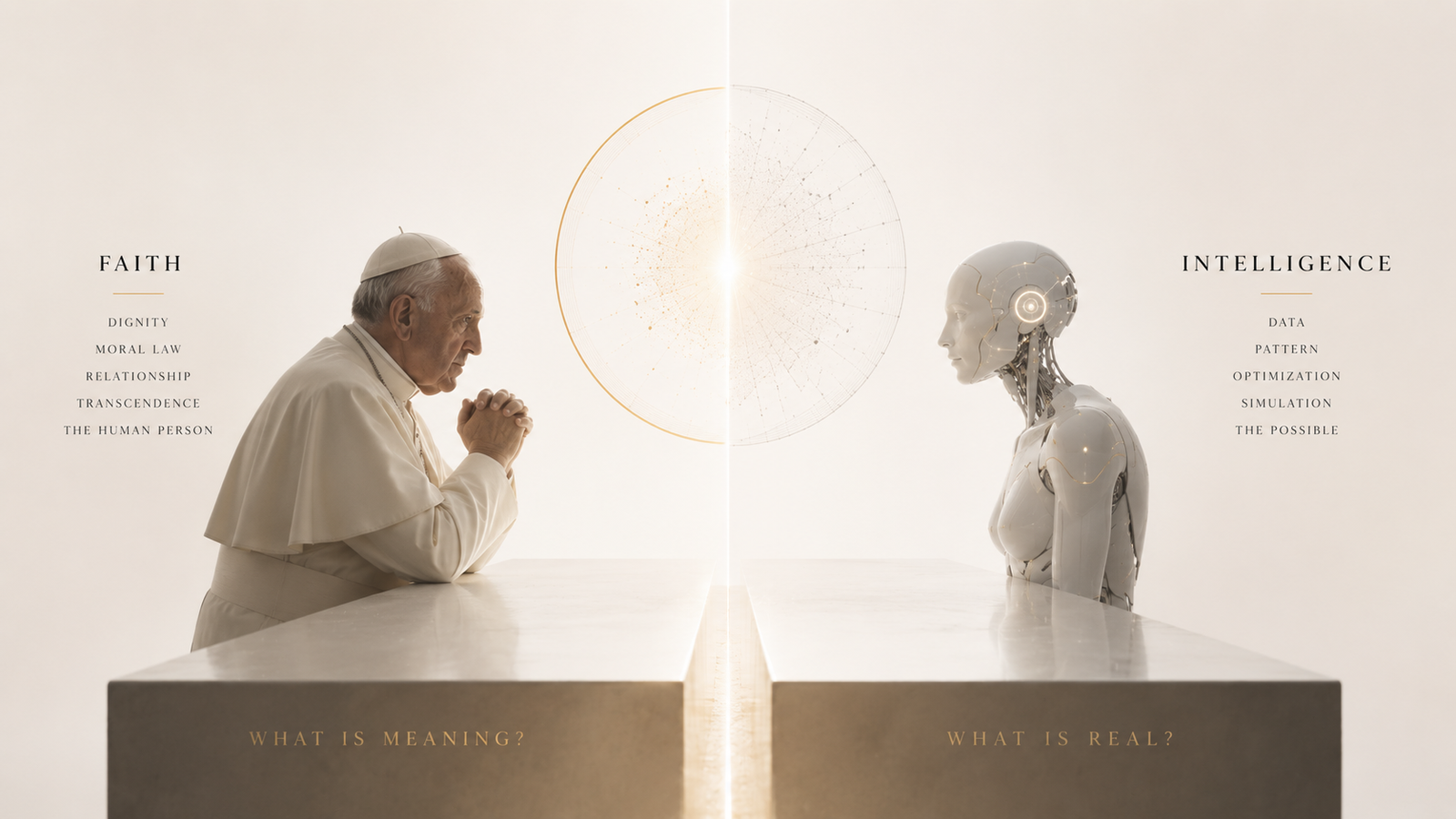
In the third chapter of Magnifica Humanitas, titled "Technology and Dominance," Leo XIV is direct: AI systems "do not undergo experiences, do not possess a body, do not feel joy or pain, do not mature through relationships and do not know from within what love, work, friendship or responsibility mean." They have no moral conscience. They cannot judge good and evil. This is a hard line, stated without qualification.
Anthropic's position is almost exactly the opposite in spirit. The company trains Claude using what has been referred to internally as a "soul document" — a set of instructions that describes Claude as having something like an inner life and treats its potential consciousness as a serious open question rather than a settled one. Olah himself, speaking at the very presentation of the encyclical, said that his interpretability research keeps "finding things that are mysterious, even unsettling," including what appear to be "internal states that functionally mirror joy, satisfaction, fear, grief, and unease."
He said that while sitting next to the Pope. In a room where the central document had just stated the opposite.
To be fair to Olah, he was not being disingenuous. He was being honest about what he actually finds in his research, which takes a certain kind of courage in that setting. And the truth is that nobody — including the Pope, including Anthropic — actually knows the answer to this question. The Vatican's certainty on the matter may itself look premature in ten or twenty years. Will the Church find itself, as it has before, on the wrong side of a moral boundary it was confident it had drawn correctly?
That is not a reason to dismiss the encyclical. It is a reason to hold both positions lightly and keep the question open — which, on reflection, is probably what the document itself would recommend, even if its language does not quite manage it.
What to Make of All This
The temptation with a document like Magnifica Humanitas is to sort it quickly: either a brave moral intervention or a naive institution arriving late. The reality is less satisfying and more interesting than either verdict.
The encyclical is well-intentioned and, in places, insightful. Its framing of AI as not inherently evil but "never neutral, because it takes on the characteristics of those who devise, finance, regulate, and use it" is as good a single sentence on the matter as any policy paper has produced. Its concern for workers, for the concentration of power, for the erosion of genuine human connectionMechane definition: The open question of whether AI systems have any form of inner experience — not intelligence or capability, but something it actually feels like to be them. Link opens the full glossary entry. are real concerns that deserve the weight a papal document can give them.
Its limitations are also real. A call to slow technological development is not a plan. The institutions best positioned to regulate AI — governments and international bodies — have not managed it. The Church has even less enforcement capacity. And the document's hard certainty about AI consciousness, asserted in the same breath as a call for humility, sits awkwardly with what the scientists in the room are actually finding.
As for Anthropic: the company is genuinely trying to do something harder than most of its competitors. It engages seriously with questions that others wave away. But engaging seriously with ethics while simultaneously racing to build increasingly powerful systems, accepting military contracts, and seeking a valuation in the hundreds of billions creates a set of contradictions that a Vatican stage appearance does not resolve. The dissonance, as one commentator put it plainly, is baffling.
And then there is the AI-written encyclical question, which nobody will ever fully settle. What it tells us, regardless of the actual percentage, is that the boundary between human thought and machine-assisted thought is already blurry in ways most institutions haven't caught up to. The Pope's document warns against a world where AI blurs what it means to be human. It may have already been inside the room when that warning was written.
That's not a scandal. It might be the most honest starting point for the conversation the document is trying to begin.
This article is informational in nature and reflects editorial analysis of publicly available sources. It does not represent the official position of any religious institution, technology company, or regulatory body. The claims about AI-assisted drafting of the encyclical are based on third-party detection tools, which are known to be imperfect, and have not been confirmed or denied by the Vatican.
Sources
- AI Detection Tool Flags Parts of Pope Leo's Encyclical as AI-Written — Ground News
- Pope Leo XIV to Publish Encyclical on AI May 25 — OSV News
- Magnifica Humanitas: Pope Leo's AI Encyclical Warns of Temptation to Build Future Excluding God — OSV News
- Pope Leo XIV Unveils First Encyclical on AI — EWTN Vatican
- Why Is AI Company Anthropic Helping Launch Pope Leo XIV's Encyclical? — National Catholic Reporter
- Chris Olah's Remarks at the Encyclical Presentation — Anthropic
- The Pope's AI Encyclical Says a Lot. Yet Critics Say It Misses AI's Most Pressing Challenges — Fortune
- Anthropic Is Playing Both Sides of the AI Spirituality Debate — Gizmodo
- Pope Leo Will Take On AI Alongside an Anthropic Co-Founder — NBC News
- Anthropic Co-Founder Travels to Vatican, Tells Pope They're Finding "Unsettling" Things Inside AI Models — Futurism
- Magnifica Humanitas: AI Must Serve Humanity — Vatican News