
Let me start with the one thing in all of this that I cannot argue my way out of, because it already happened.
For roughly fifty years, some of the best minds in science tried to solve a problem called protein folding. Proteins are the small machines that run your body. They build tissue, fight infection, carry oxygen, switch genes on and off. And a protein's job is decided almost entirely by its shape, by the way a long chain folds itself into a specific three-dimensional knot. Get the shape, and you understand the function. Understand the function, and you start to understand disease itself.
The trouble was that working out the shape was agonisingly slow. Scientists used techniques with names like X-ray crystallography, and a single protein structure could take months, sometimes years, sometimes a whole career. Out of the millions of proteins known to exist, only a tiny fraction had ever been mapped. It was one of those problems the field had quietly accepted might never fully yield.
Then, in 2020, an AI system called AlphaFoldMechane definition: The AI system that solved protein folding — predicting a protein's 3D shape from its sequence, a problem that resisted biology for fifty years. Link opens the full glossary entry., built by DeepMind, solved it. Not chipped away at it. Solved it, to an accuracy that rivalled the slow physical methods. Within a few years it had predicted the structure of around two hundred million proteins, very nearly every one known to science, and the team gave the database away for free. In 2024 the work won the Nobel Prize in Chemistry.
It is the foundation of everything I am about to say. A problem that resisted half a century of human effort was not gradually worn down. It was largely dissolved, by a machine that learned the grammar of folding. You can be skeptical about a great many claims in this field, and you should be. But you cannot be skeptical about AlphaFold. It is not a promise. It is a fact, sitting in the past tense, with a Nobel Prize on it.
The bottleneck moved
Here is the second thing that genuinely moved me, and it follows directly from the first.
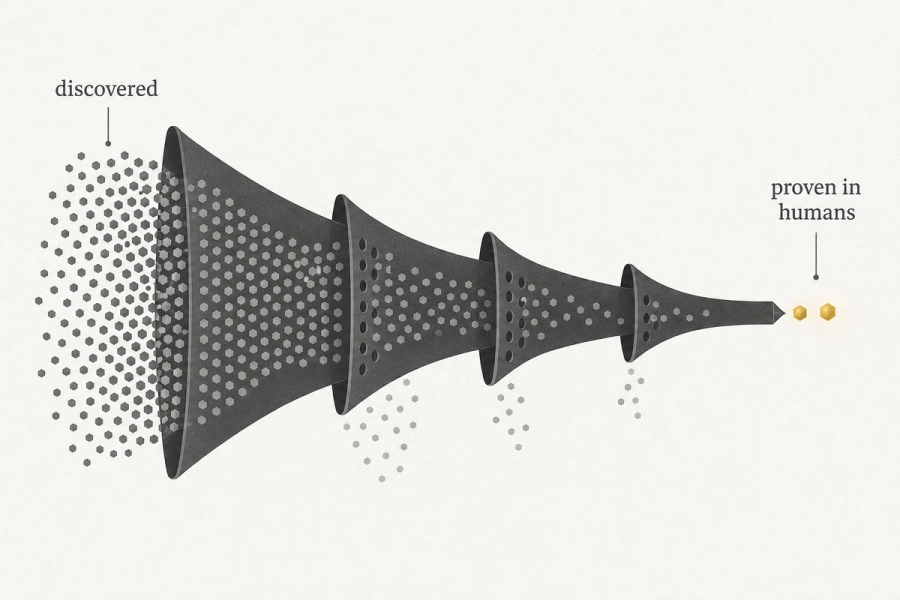
Designing a new drug has always been brutally slow and expensive. The usual figures are something like ten years and well over a billion dollars to bring a single medicine to market, and most candidates die somewhere along the way. Demis Hassabis, who runs DeepMind and shared that Nobel, has said publicly that AI could compress the discovery part of that from years down to months, perhaps even weeks. He has gone further, in the kind of sentence scientists of his standing almost never say out loud, and suggested AI might help cure most disease within a decade or two.
Now, that is a claim from an interested party. Hassabis runs a company built on exactly this premise. The honest counterweight is that, as of this writing, his drug-design venture has not yet put a single medicine into a human being. So take the timeline as ambition, not schedule.
But something real is underneath the salesmanship. In 2025, the first drug both discovered and designed using generative AIMechane definition: Using AI to find and design new medicines — compressing the slowest, most expensive early stages of making a drug from years into months. Link opens the full glossary entry. posted positive results from a mid-stage human trial, for a serious lung disease, published in a respectable medical journal. One drug. Early-stage. A small study whose own authors asked for caution. And yet the thing actually happened: a molecule dreamed up by software improved real patients' lungs in a real trial.
What strikes me is not either fact alone. It is that they are the same story told at two stages.
AlphaFold compressed the time it takes to understand biology. AI-designed drugs are compressing the time it takes to act on that understanding.
The slow, human, decades-long steps of medicine are being handed, one by one, to something that does not work at human speed. When the bottleneck in a process moves like that, you are usually watching the early minutes of a much longer film.
Why I don't care about living forever
Which brings me to the phrase this article is named against.
The fashionable idea in this whole field is something called longevity escape velocityMechane definition: The point at which medical progress adds more than a year of life expectancy for each year lived — after which ageing stops being the thing that ends you. Link opens the full glossary entry.. The notion is that medicine might one day improve faster than your body declines, adding more than a year of life expectancy for every year that passes, so that your remaining lifespan stops shrinking. Its advocates are confident and specific. Aubrey de Grey, who coined the term, puts a serious chance of it arriving in the mid-2030s. Ray Kurzweil lands in a similar window. To be clear, even they do not mean immortality. You could still die in a car, or of something we haven't cracked. They mean aging becoming, in effect, a managed condition rather than a sentence.
And against them stands a sober wall of gerontologists who think this is, to use the technical term, wishful. The most cited of them, S. Jay Olshansky, published an analysis in 2024 showing that in the world's longest-lived countries, gains in life expectancy are slowing down, not speeding up. His argument is bracing: most of the spectacular gains of the last century came from stopping people dying young, from sanitation and vaccines and antibiotics, and that well is nearly dry. What is left is aging itself, which is not one problem but a tangle of dozens, and may not yield the way infectious disease did.
So who is right? Honestly, nobody knows, and anyone who tells you they do is selling something. The credible range runs from "perhaps fifteen years" at the bold end to "several decades" in the middle to "not in any lifetime now being lived" at the cautious end. That is a range wide enough to drive a truck through, and I think the wide range is the only honest answer.
But here is my actual point. I find the whole escape-velocity conversation to be the wrong dream. It is the sensationalist headline, the part built for clicks, the part that makes a reasonable person fold their arms. And while everyone argues about whether we can defeat death, they are walking straight past the thing that is genuinely within reach, and that matters far more to almost everyone alive.
The miracle isn't that we might never die. It's that the things we'd long since filed under "incurable" may not stay that way.
Diabetes. Alzheimer's. Parkinson's. The diseases we taught ourselves to call chronic, the ones a doctor manages rather than cures, the ones you are told to live with. My hope, the one that makes my pulse rise, is not that a healthy person reaches a hundred and fifty. It is that the diabetic child stops being a patient for life. That the Alzheimer's which took someone's mother does not come for their daughter. That a category of human suffering we had accepted as a permanent fixture of the world quietly stops being permanent.
That is not a promise nobody can verify. It is a hope nobody can dismiss. And it is the right place to point, because if the tools that gave us AlphaFold and the first AI-designed drug do even a fraction of what they appear capable of, that is where they will bite first. Not at the far frontier of immortality. At the long, miserable middle of chronic disease.

The part we are not ready for
I could end there, on the warm note, and it would be a tidier article. But it would not be an honest one, because there is a shadow inside this good news, and ignoring it would be a kind of lie.
Here is what unsettles me, and I want to be honest about it even though I am not sure I have earned the right to be this certain.
Humanity, for as long as there has been a humanity, has defined itself through its suffering. We became who we are by braving illness, by enduring adversity, by powering through circumstances that should have broken us. The struggle was the chisel, and we are the shape it left. Strip out most disease, lift the weight we have carried since the beginning, and I think we face something stranger than a medical revolution. I think we face a crisis of meaning.
What is a human being for, when the thing it was forged against is gone? We have built everything around a body that breaks on schedule. Our stories, our religions, our sense of a life as a thing with a beginning and an urgent middle and an end. Take the schedule away, even partially, and we will not simply be happier. For a while, I suspect, we will be lost. Aimless in a way we have never had the luxury of being.
I want to be careful here, because the consolation that suffering makes us whole is one of the oldest and most beautiful stories we tell. It is also exactly the story you would expect a species to invent when it had no choice in the matter. For all of history, suffering was non-negotiable. So we did the human thing and made meaning out of it, the way you might decorate a cell you could never leave. Which raises a possibility I cannot shake: that meaning-through-suffering was never the deep truth of us at all. Just the best story available to creatures who could not get out.
And if that is right, then what is coming is not a loss. It is a release. We break out of a prison so old we had stopped seeing the bars, into a kind of freedom no human has ever lived inside. There will be a chaos era first, I have no doubt. A period of vertigo and disorientation and genuine, colossal disruption while we learn to be a species that is not defined by its wounds. Yes, at the start the treatments will reach the wealthy before everyone else, the way new things always do. But if AI drives the cost down as fast as it has driven everything else, that gap closes faster than the cynics expect. The harder gap is not financial. It is the one inside us.
And then, on the far side of the vertigo, I think something opens that we cannot really picture from where we stand. Not a return to the old golden ages the poets wrote about, but something past them. A deeper calm. A profounder understanding. The next phase of what it means to be human, glimpsed only dimly from inside the current one.
So no, I do not think we are about to live forever, and I find the people promising it slightly exhausting.
I think something quieter and far larger is happening. The incurable is becoming curable. A machine solved a problem we could not, and handed us the beginnings of tools we are only starting to understand. The dream worth having is not escape velocity. It is the end of the word incurable, and the strange, luminous, disorienting freedom that waits on the other side of it.
We are standing at the edge of that, right now, in our own lifetimes, mostly without noticing. If that is not mind-bending, I genuinely do not know what is.
Sources & further reading
- Jumper, Evans, Pritzel et al., "Highly accurate protein structure prediction with AlphaFold," Nature 596, 583–589 (2021). nature.com/articles/s41586-021-03819-2
- The Royal Swedish Academy of Sciences, "The Nobel Prize in Chemistry 2024" — press release, awarded to David Baker, Demis Hassabis and John Jumper (9 October 2024). nobelprize.org/prizes/chemistry/2024/press-release
- Xu, Ren, Wang et al., "A generative AI-discovered TNIK inhibitor for idiopathic pulmonary fibrosis: a randomized phase 2a trial," Nature Medicine (3 June 2025) — the rentosertib trial. nature.com/articles/s41591-025-03743-2
- Demis Hassabis, interview on CBS 60 Minutes (April 2025), on compressing drug discovery "from years to maybe months or even weeks" and the prospect of curing disease within a decade. Reported account & quotes
- Olshansky, Willcox, Demetrius & Beltrán-Sánchez, "Implausibility of radical life extension in humans in the twenty-first century," Nature Aging 4, 1635–1642 (7 October 2024). nature.com/articles/s43587-024-00702-3
- World Health Organization, "Global immunization efforts have saved at least 154 million lives over the past 50 years" (24 April 2024); underlying study in The Lancet. who.int
- On longevity escape velocity and its timelines (Aubrey de Grey, Ray Kurzweil) — advocate-side positions, presented as such: overview at Wikipedia: Longevity escape velocity; de Grey's mid-2030s estimate at Longevity.Technology.