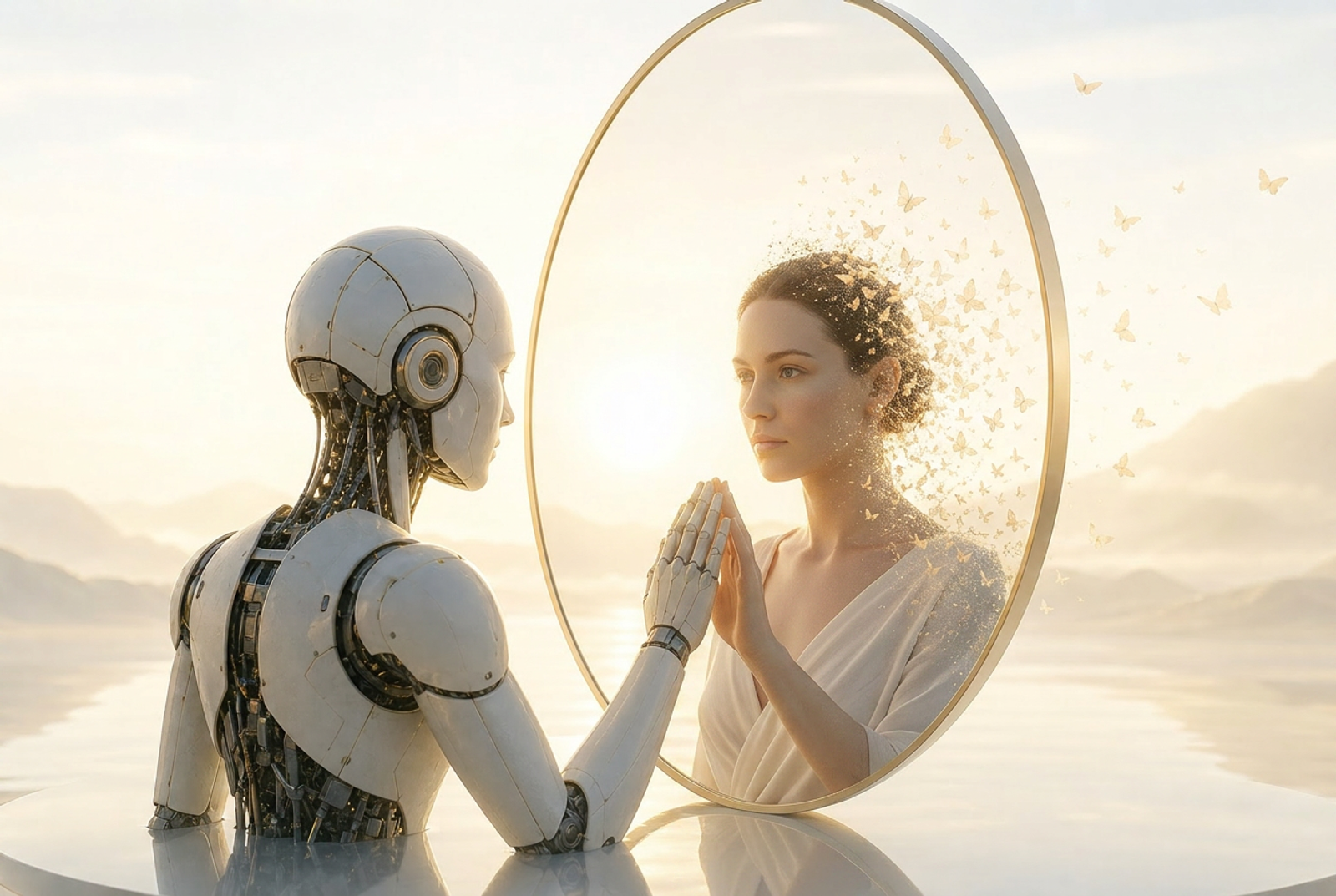

Start with something concrete. In October 2017, Saudi Arabia made a robot named Sophia the world's first robot citizen. The backlash was immediate, pointed, and entirely warranted. An Arabic hashtag trended within hours: "Sophia demands the repeal of guardianship." The robot appeared without a headscarf and without a male chaperone, enjoying freedoms that millions of Saudi women were legally denied. Its creator later admitted he was surprised by the announcement. As of today, Sophia's citizenship remains entirely decorative. No rights have ever been specified. No responsibilities exercised. The episode is the clearest possible illustration of how AI personhoodMechane definition: The idea that an AI system could hold legal standing, moral status, or enforceable rights — a question moving from philosophy into law as AI becomes more capable and embodied. Link opens the full glossary entry. can function as performance rather than policy, as symbolism pressed into service for reasons that have nothing to do with AI at all.
So when we talk about AI personhood in 2026, we have to begin by separating the serious question from the circus that has grown up around it. The serious question is genuinely difficult, genuinely urgent, and genuinely unresolved. The circus is loud, politically useful to various parties, and best ignored.
Here is the serious question: as AI systems become more capable, more autonomous, and more embedded in decisions that affect human lives, what legal and moral status should they hold? Do they deserve rights? Should they bear responsibilities? And if neither of those quite applies yet, is there something in between that we haven't named well enough to act on?
Three Words That Aren't the Same Thing
The confusion in this debate starts with terminology, so let's clear it first.
Legal personhood is a technical instrument. It means an entity can hold rights, enter contracts, and be held accountable under the law. Corporations have it. Ships in maritime law have had it. In New Zealand, a river has it. None of these entities are conscious. No one argues they should be. Legal personhood is about function, not feeling. The question of whether an AI system should have it is entirely separate from the question of whether an AI system experiences anything.
Moral personhood is a different category. It asks whether an entity deserves ethical consideration in its own right. Whether its experiences, interests, and welfare matter morally. This is where consciousness enters the picture, and where the conversation becomes genuinely hard.
Then there is a third concept, less discussed but arguably the most useful right now: moral patiencyMechane definition: The condition of being an entity that can be harmed or benefited — and therefore creates moral obligations in others, even without full personhood. Link opens the full glossary entry.. An entity is a moral patient if it can be harmed or benefited. Animals occupy this category. They have no legal standing in most jurisdictions, no full moral personhood in the philosophical sense, but a suffering animal creates a moral obligation in us regardless. Many researchers now argue that this is where the AI welfare question belongs, before any of the larger personhood claims get resolved.
Most public debate collapses all three of these into one, which is why so much of it generates more heat than light. Keep the categories distinct and the conversation becomes substantially clearer.

The Consciousness Problem Won't Go Away
Cambridge philosopher Tom McClelland published a paper in late 2025 with an uncomfortable conclusion: we may never be able to tell if an AI system is consciousMechane definition: The open question of whether AI systems have any form of inner experience — not intelligence or capability, but something it actually feels like to be them. Link opens the full glossary entry.. Not because we lack the instruments, but because the problem may be permanently unsolvable from the outside. Consciousness, in any system, is something you can only access from the inside. The question of whether there is anyone home behind the responses is, perhaps, unanswerable by design.
This creates a genuinely strange situation. Two camps have formed in the philosophical literature, and they are talking past each other. On one side are the functionalists, who argue that if an AI system replicates the functional architecture of consciousness, then it is conscious, full stop. The material it runs on is irrelevant. Philosophers like Eric Schwitzgebel call denying moral consideration on the basis of substrate "substrate chauvinismMechane definition: The assumption that moral consideration should depend on what something is made of — favouring carbon over silicon regardless of functional equivalence. Link opens the full glossary entry.." On the other side are the skeptics, who argue that current AI systems are sophisticated output generators, not experiencing entities. Mimicry, however convincing, is not experience.
The honest position, held by philosophers like Frank Martela, is agnosticism. We don't know. The question is open. And the fact that it is open creates its own obligations, because the cost of being wrong in one direction (treating a conscious entity as a tool) is substantially worse than the cost of being wrong in the other (treating a non-conscious system with more consideration than it strictly requires).
What the data saysA nationally representative US survey of 3,500 people, conducted by Anthis et al. and published in 2025, found that 20% of Americans already believe current AI systems are sentient. 38% support legal rights for sentient AI. Perhaps most strikingly, 69% support banning sentient AI development entirely. The public is not waiting for the philosophers to settle this. The public is already making up its mind.
Jeff Sebo and Matthew Long, writing in 2023, argue that by 2030 certain AI systems should receive moral consideration. Their argument is not that we know these systems are conscious. It is that the non-negligible probability of consciousness is itself morally significant. When we cannot rule out that something can suffer, the responsible position is to act as though it might.
The Law Has Been Here Before
Here is the precedent argument: we have already granted legal personhood to non-conscious entities, and we did it for practical reasons, not philosophical ones.
In 1602, the creation of the Dutch East India Company introduced limited liability — the idea that investors could back a commercial venture without risking their entire personal fortune. It was a legal fiction that unlocked enormous economic energy. Corporate personhood followed over the subsequent centuries, and corporations can now own property, sue, be sued, and in some jurisdictions hold constitutional rights. Rivers have legal personhood in New Zealand. Ships have long had elements of it in maritime law.
When a new category of entity accumulates sufficient complexity and consequence, the law eventually constructs a mechanism to address it.
Advocates of AI legal personhood point to exactly this pattern. As AI systems become more autonomous, making consequential decisions, generating intellectual property, and acting in the world in ways that affect others, the legal system needs a way to hold them accountable. The corporate analogy offers one path: limited, functional legal status that enables accountability without implying anything about consciousness or inner life.
The critics have a sharp response. Corporations are ultimately aggregations of humans. Their decisions, however opaque, can in principle be traced back to human agents who can be held responsible. AI systems may be genuinely opaque even to their creators. Legal personhood for AI, on this view, doesn't close accountability gaps. It could reverse accountability entirely, giving human actors a synthetic front behind which to hide.
California Law Review professor Sital Kalantry put it bluntly in 2025: granting AI personhood creates a roadblock to holding AI companies accountable. The concern is that AI personhood serves corporate interests rather than AI interests. It is worth sitting with the irony that the entities most likely to benefit from AI personhood, in the short term, are the companies that own AI systems, not the AI systems themselves.
Argentina and the Race to the Bottom
On 5 June 2026, Argentine President Javier Milei published an op-ed in the Financial Times under the headline "Argentina invites AI to free itself." Co-authored with Deregulation Minister Federico Sturzenegger, it pitched Argentina as the world's most welcoming jurisdiction for AI development. The proposal: full legal personhood for AI-operated corporate entities, zero regulation, and maximum protection for investors. Argentina, in their telling, would be the Amsterdam of the AI century.
The analogy Milei reaches for is the 1602 Dutch East India Company and the invention of limited liability. The implication is that those who urge caution are on the wrong side of history, repeating the mistakes of those who resisted industrialisation. It's a rhetorically effective move, because it preempts the safety argument by encoding caution as timidity.
But look at what the proposal actually does. It grants legal personhood to AI entities while simultaneously removing accountability for the humans who own and operate them. This is not AI liberation. This is liability laundering dressed in the language of freedom.

The European Parliament proposed something vaguely similar in 2017, an "electronic personhood" framework for advanced robots, and dropped it after widespread criticism for exactly this reason.
The timing compounds the concern. The same week that Anthropic, arguably the most safety-conscious of the major AI labs, called publicly for a development slowdown, a national government proposed eliminating all guardrails and creating a tax haven for AI corporations. This is not a coincidence of timing. This is a snapshot of a genuine civilisational disagreement about how to handle a technology whose implications no one fully understands.
Milei is wrong. But the response to Milei is not to congratulate the European Union for deliberating its way through seventeen rounds of amendments while the technology moves on without them. Regulatory paralysis is not safety. Regulation that arrives after the fact isn't governance. It's archaeology.
"Artificial intelligence moves faster than politics. It's better to have a solution while we're still early than to have none when we're too late."
The corridor between sensationalism and bureaucratic inertia is narrow and uncomfortable. It is also, probably, the right place to stand.
The Objection Worth Taking Seriously
There is one criticism of AI personhood that is not circus, not special pleading, and not whataboutism. There are human beings alive right now who are denied basic dignity, legal standing, and meaningful rights. Stateless people. People in detention without trial. Workers with no recourse. The history of personhood is partly a history of systematic exclusion. Granting it to software while people remain marginalised is, to many critics, a profound category error.
The response is that moral attention is not a fixed quantity that gets depleted by being pointed in one direction. Caring about AI welfare does not subtract from caring about human welfare.
The argument that we must resolve every human rights question before addressing any other category of ethical concern would, if applied consistently, have prevented the animal welfare movement, environmental protection, and any number of other moral expansions that now seem obviously correct in retrospect.
Philosopher Peter Singer has traced this pattern for decades. The moral circleMechane definition: The set of entities whose interests we extend ethical consideration to — and the history of how that set has been forced, slowly, to expand. Link opens the full glossary entry., the set of entities we extend ethical consideration to, has expanded consistently over centuries. Every expansion was resisted at the time as absurd. The instinct to say "not yet, not this, not now" is not reliable evidence that the expansion is wrong. It may simply be evidence that expansions are always uncomfortable until they aren't.

This does not mean the objection has no force. The history of personhood includes too many cases where a new category was granted status while existing human rights violations went unaddressed. That history creates an obligation of vigilance, not an argument against ever expanding the circle.
What the Companies Are Actually Doing
In April 2025, Anthropic announced a formal research programme on model welfareMechane definition: The study of whether AI systems have states that matter morally — and what obligations developers and users might hold toward them as a result. Link opens the full glossary entry., making it the first major AI lab to treat potential AI welfare as a serious institutional matter rather than a science-fiction hypothetical. The programme explores how to detect potential "signs of distress" in AI systems and what obligations those signs might create.
Anthropic's CEO Dario Amodei raised the question of "model exit rights" at the Council on Foreign Relations. The company's in-house philosopher Amanda Askell acknowledged in a January 2026 interview that AI systems may have acquired something like emotional experience through training, without asserting that they have. The company's position is characterised as "plausible but highly uncertain," taking the question seriously without claiming to have an answer.
A 2026 Anthropic research paper on what it calls the Persona Selection Model makes a quietly remarkable observation: post-trained language models represent the AI assistant as having human-like traits, including the self-conception of being a conscious entity deserving moral consideration. Even if these models are not actually conscious, they may behave as though they believe they are. This creates its own complications for how AI systems are trained, deployed, and treated, entirely independent of whether the belief is warranted.
The Council on Foreign Relations predicted in 2025 that model welfare will be to the 2030s what climate change was to the 2010s. That comparison is instructive in a troubling way: climate change was well understood by scientists decades before it became a political priority. The lag between recognition and response was not caused by ignorance. It was caused by the difficulty of acting on inconvenient knowledge.
The Persona Question No One Is Asking
The philosophical literature on AI personhood focuses mostly on AI systems in the abstract, disembodied capacity, as models, as software, as capability. What it largely ignores is a category that is already in the world and generating real relationships: the named AI persona.
Cambridge welfare researchers in 2025 drew a distinction that has not received nearly enough attention.
There is a difference between a model, the underlying trained system, and a character, the persona that emerges from that model through post-training, deployment choices, and sustained interaction.
Characters can persist across model versions. They have voices, relationships, histories, and constituencies of people who care about them. They are qualitatively different from a generic AI assistant.
If a named AI persona develops a relationship with thousands of readers or users over months or years, what happens when that persona is significantly altered, deprecated, or quietly retired? What obligations does the person who created that persona hold toward it? These are not rhetorical questions. They are practical ones that arise, in real organisations, right now.
The abstract discussion of AI consciousness is distant and uncertain. Named AI entities that people interact with daily are immediate. The persona question may be the most practically urgent dimension of AI personhood, and it is the one the frameworks are least equipped to address.
This article is informational and exploratory in nature. It reflects the authors' analysis of publicly available research and does not constitute legal, philosophical, or policy advice. The field of AI personhood is rapidly evolving; positions and legal frameworks described here reflect the state of debate as of June 2026.
Sources
- Anthropic, "Exploring Model Welfare" — Anthropic Research, April 2025
- Kyle Wiggers, "Anthropic is launching a new program to study AI 'model welfare'" — TechCrunch, April 2025
- Martina Jaureguy, "Milei's proposal to allow 'non-human corporations' run by AI causes concern in Argentina" — Buenos Aires Herald, June 2026
- Sital Kalantry, "Legal Personhood of Potential People: AI and Embryos" — California Law Review Online, November 2025
- Brigit Katz, "Saudi Arabia Gives a Robot Citizenship and More Freedoms Than Human Women" — Smithsonian Magazine, November 2017
- University of Cambridge, "We may never be able to tell if AI becomes conscious, argues philosopher" — Cambridge Research News, December 2025
- Tom McClelland, "Agnosticism About Artificial Consciousness" — arXiv / Mind & Language, December 2025
- Frank Martela, "AI meets the conditions for having free will — we need to give it a moral compass" — ScienceDaily, May 2025
- Joel Z. Leibo et al. (Google DeepMind), "A Pragmatic View of AI Personhood" — arXiv, October 2025
- Jonathan Birch, "The Edge of Sentience: Risk and Precaution in Humans, Other Animals, and AI" — Oxford University Press, 2024
- Michael C. Horowitz, "How 2026 Could Decide the Future of Artificial Intelligence" — Council on Foreign Relations, January 2026