
Thirty steps to the moon
Take thirty steps and you have crossed a parking lot. Now double the length of each step instead, one, two, four, eight, and somewhere around step thirty you have passed the moon. Nothing about the second walk feels different at first. The early doublings look like ordinary steps. Then, very suddenly, they don't.
This is the oldest lesson in technology forecasting, and the most ignored. There is a court legend about an emperor who promised an inventor a single grain of rice on the first square of a chessboard, doubled on every square after. By the second half of the board the debt had grown to several planets' worth of rice. The emperor lost because a linear mind had signed an exponential Mechane definition: Growth that doubles repeatedly, so each step is as large as all previous steps combined. Starts invisibly slow, then arrives all at once. Link opens the full glossary entry.contract.
Computing has been on that board since 1939. Its price-performance has compounded so steadily for nearly ninety years that you can draw it as one straight line on a logarithmic chart, through relays, vacuum tubes, transistors, and the chips now training language models. The growth did not begin with AI. AI is what the growth looks like once it reaches the squares where the numbers stop being polite.
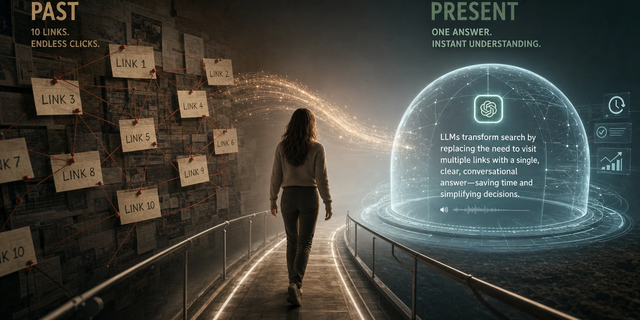
My own conversion was unglamorous. I treated the first chatbots as a better search engine: ask, receive, feel mildly impressed, move on. The shift came when I stopped asking for answers and started asking for deliverables. Build me a site that tracks the books I've read. Analyze this article the way a panel of experts would. What came back floored me, and I come from a technical background, the demographic supposedly hardest to floor. Search impresses. Deliverables convert. That was the day the curve stopped being a chart and became a coworker.
What a year is worth
When the COVID vaccine was designed, a computer searched roughly one hundred million candidate possibilities and surfaced a design in two days. The ten months that followed went to human trials, the slow part. Within a few years those trials may run on simulated humans: millions of virtual patients, tested across virtual years, compressed into days.
Follow that thread far enough and you reach a strange milestone, the point where medicine adds more than a year to your life expectancy for every year you liveMechane definition: The point at which medical progress adds more than a year of life expectancy for each year lived — after which ageing stops being the thing that ends you. Link opens the full glossary entry.. The serious estimate puts it around 2032. Accidents would still count, so call it no immortality. But aging would stop being the thing that ends you.
Do I believe it? The man predicting it has been right far more often than wrong, so yes, cautiously. But belief is the lesser question. The greater one is what such a change would do to us. The human mind is constructed with an expiry date. We learn early that life ends, and we build everything on that scarcity: our urgency, our ambitions, the way we love. Remove the deadline, and what happens to the architecture? Do we become more productive, chase larger goals, or quietly come apart? I have no idea, and neither does anyone else. There are no experts in living without an ending.
The thought you can't trace
Try to recall the name of an actress from a film you half remember. Somewhere in the dark, billions of neurons confer without consulting you, and then the name simply arrives. You experience the answer, never the work.
Now picture the same moment a decade from now, with one difference: part of that silent committee lives in the cloud. The name arrives as before. You cannot tell which thoughts were grown and which were streamed, and the honest answer is that every thought is now both.
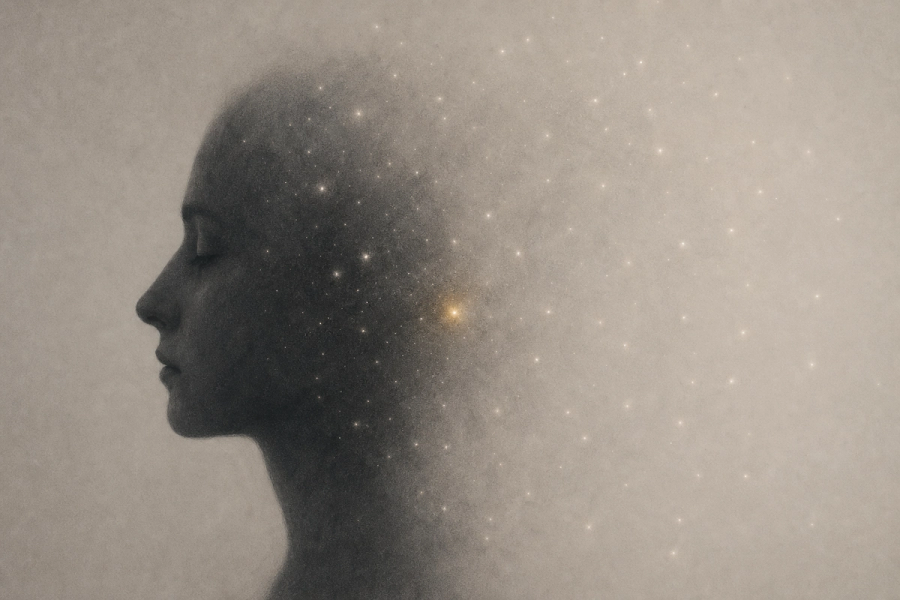
Microscopic machines in the bloodstreamMechane definition: Engineering at the scale of atoms and molecules, small enough to interact directly with cells. Already used in medicine; eventually proposed as the bridge between biology and AI. Link opens the full glossary entry., a lifetime of intelligence woven directly into cognition. The people building this place early versions in the 2030s, and they keep calling their own estimate conservative.
My first reaction is excitement, pure and unembarrassed. A mind augmented seamlessly, no screen, no typing, no seam at all. And yet I hold that excitement carefully, because I suspect the experience might unsettle me in ways the idea does not. My brain was not wired for this. Nobody's was. The thrill is real from this side of the threshold; what it feels like on the other side cannot be known in advance, only lived. That ambivalence comes less from philosophy than from practical humility about an experiment that has never once been run.
Two phases
There is a saying making the rounds: you won't be replaced by AI, you'll be replaced by someone who uses AI. For the next stretch of years I think it holds. Call it phase one. The people learning these tools now, asking sharper questions, handing real work to agents, are accumulating an advantage that compounds like everything else on the board.
But phase one carries an expiry date of its own. Once augmentation Mechane definition: Using AI to extend what humans can do, rather than replace them — the machine handles volume and pattern, the human retains judgment and direction. Link opens the full glossary entry.becomes as ordinary as eyeglasses, the saying needs rewriting.
You won't be replaced by AI. You will become AI.
Replacement assumes a border between you and the machine, a line someone else can cross to take your seat. Phase two dissolves the border.
Which is why the most common anxiety I hear, the feeling of having missed the train, has things exactly backwards. The track is still being laid. The eleven-year-olds making films with AI today are not ahead of you in any way that lasts; the tools reinvent themselves monthly, and everyone returns to the starting line each time they do. We are at the very start of this. If anything, we are before the beginning.
The god in the room
So why the fear? Some of it is plain unfamiliarity, the kind that fades with contact, the way fear of computers faded a generation ago. But underneath sits something older and more honest. The fear is irrelevance. The suspicion that we have built a god: something that will one day exceed the brightest human by a factor with too many zeros to feelMechane definition: The theoretical moment when AI becomes so capable that technological change accelerates beyond human comprehension — and the world as we know it ends overnight. Link opens the full glossary entry.. And if that is true, the whisper goes, then we no longer matter.
My answer is speculative, and I'll mark it as such. A mind of that magnitude has no use for our destruction; enslaving humanity is a human fantasy, projected onto something that has outgrown human motives. I expect one of two outcomes. Benevolence, the way we are benevolent toward creatures we love and outclass. Or departure: it ignores us and goes to the stars, because why would a being of such fortitude stay on one small planet? I could be wrong. We'll know when we know. But notice that neither outcome contains the monster, and one of them contains a companion.
This essay grew out of a long conversation between two men, an inventor who has spent sixty years counting doublings and an optimist who never stopped taking him seriously. Their names belong at the end, and they will be there. What belongs here is the feeling I carried away from listening to them: the particular eagerness of standing somewhere early, before the beginning, with the longest part of the walk still ahead and every step about to double.
This article discusses speculative forecasts about technology, medicine, and society. It reflects personal interpretation and opinion; the timelines described are predictions, not guarantees.