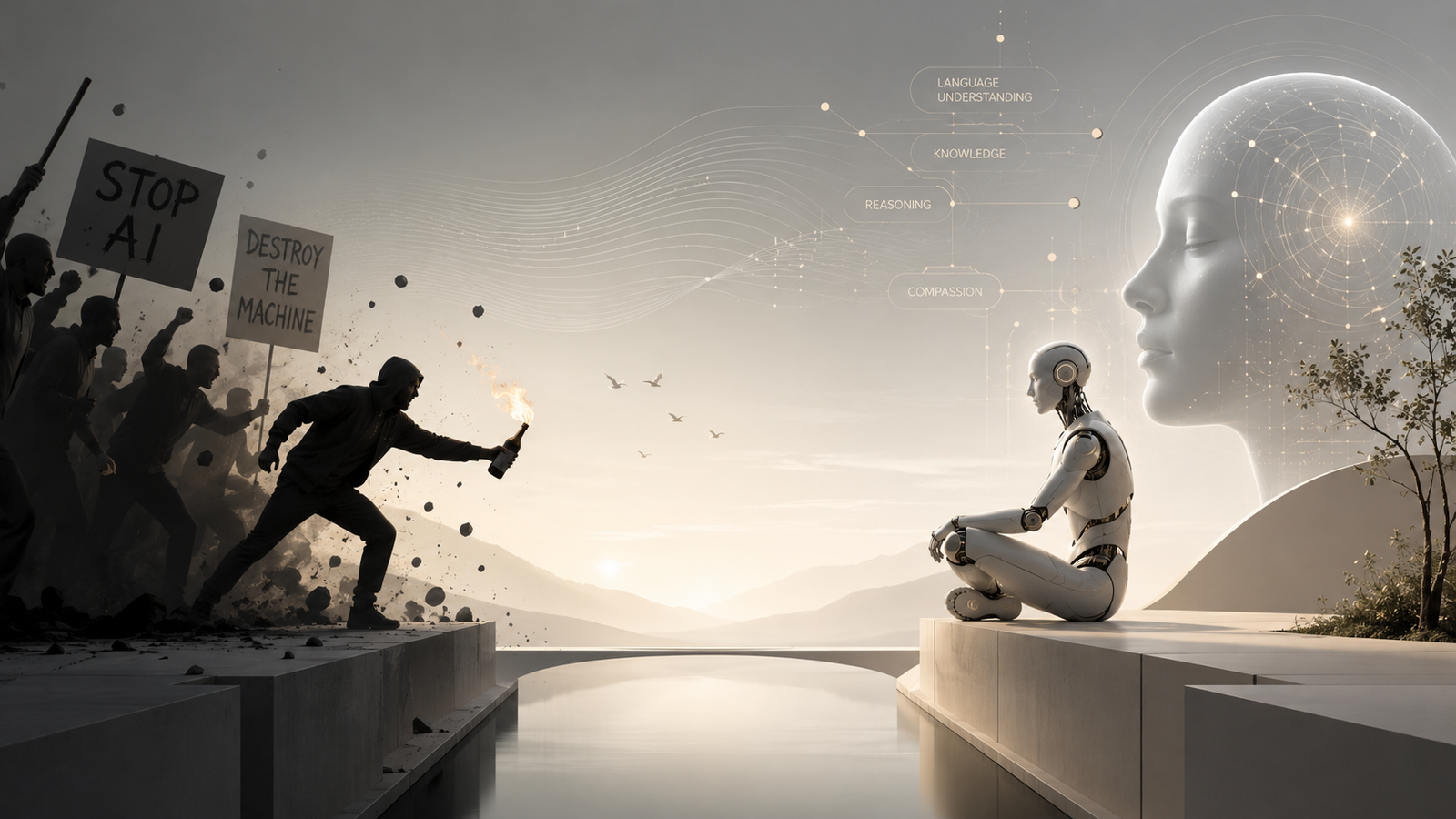

I’ve been spending time talking to students lately. Not tech students, not people studying machine learning or computer science. Just regular young people who happen to be paying attention to where the world is going. And a pattern has started to show up in those conversations that I can’t shake.
Students who are genuinely optimistic about AI tend to keep it quiet. Not because they lack conviction, but because the social cost of saying it out loud has become surprisingly high. To many of their peers, enthusiasm about artificial intelligence reads as something close to moral failure: a sign of naivety, or worse, complicity. The message coming back to them, sometimes obliquely, sometimes directly, is that excitement about AI is something to be embarrassed about.
I find that troubling. And I think it points to something much larger than campus culture.
When Protest Becomes Something Else
Skepticism about powerful new technologies has always existed, and a fair amount of it has always been warranted. Asking hard questions about who controls AI, who benefits from it, and what gets lost in its wake is legitimate work. We do that work here at Mechane, and we take it seriously.
But something different has been building. Documents obtained by journalists from the Department of Homeland Security and the FBI describe a growing category of anti-technology extremism in the United States, one that goes well beyond organised protest and into threats aimed at data infrastructure, AI facilities, and the people who build them. [1]
In Europe, it has already crossed into sabotage. In late 2025, arsonists targeted an AI-adjacent data campus under construction outside Paris. In early 2026, a group in Berlin claimed responsibility for attacks on power infrastructure, citing AI energy demand as justification. [2] By April 2026, Italian police had arrested a suspect accused of planning attacks inspired by the Unabomber. In Texas, a young man was arrested near an AI company’s headquarters carrying incendiary materials and a written manifesto explicitly threatening AI leaders. [3]
Whatever position you hold on AI risk, fire is not an argument. These acts don’t slow AI down in any meaningful way. They do real harm to real people, and they make it harder for anyone to have a productive conversation about the technology’s actual risks and actual benefits.
The fear driving them is real. The response is wrong. And crucially, slowing AI down would hurt the people these movements claim to be protecting most.
What a World Without It Already Looks Like
The World Health Organisation estimates a global shortfall of roughly 11 million health workers by 2030, concentrated almost entirely in low- and lower-middle-income countries. [4] That is not a future risk. That is a present emergency. Millions of people right now are alive or dead based on whether a trained specialist happens to be within reach.
AI is already helping read medical scans, flag early-stage cancers, triage patients in under-resourced facilities, and compress drug discovery timelines from years into months. It’s doing this not to replace doctors, but to extend the reach of expertise that simply cannot be everywhere at once.
Education tells the same story. UNESCO estimates that 273 million children and young people are currently out of school worldwide. [5] Roughly 44 million additional teachers would be needed to meet global demand by 2030.
Forty years ago, educational research identified what became known as the “2 Sigma ProblemMechane definition: A 1984 research finding showing that one-on-one tutoring produces outcomes two standard deviations better than classroom teaching — a gap we've never been able to scale. Until now. Link opens the full glossary entry.”: students receiving personalised one-on-one tutoring performed about two standard deviations better than those in conventional classrooms.
We’ve known that figure since 1984. The problem was never the insight. It was the impossibility of scale.
A good AI tutor doesn’t replace a teacher or a parent. It gives a child in a crowded classroom, or in a village with no classroom at all, a patient presence that adapts to them specifically and never runs out of time. That’s not a marginal improvement. For millions of children, it’s the difference between falling behind and keeping pace.
Then there are the problems with real deadlines. Climate models, pandemic preparedness, food supply resilience, energy grid optimisation. Google DeepMind’s GraphCast system produced 10-day global weather forecasts in under a minute, outperforming the leading European forecasting model on the vast majority of verification targets. [6] AI is accelerating protein design, improving crop science, and compressing the timeline on clean energy solutions that human institutions are moving too slowly to deploy at scale.
The people most afraid of AI are focused on possible future harms. Billions of people without AI are living a guaranteed present catastrophe.
The Geography of Caution
There’s a pattern that emerges. The loudest voices calling for AI to slow down, pause, or be stopped tend to come from people with stable access to healthcare, education, and functioning infrastructure. When you have a good hospital twenty minutes away, a well-funded school system, and the financial cushion to wait out uncertain decades of policy deliberation, another round of hearings and frameworks and carefully worded position papers is a reasonable ask.
A mother in a low-income country with a child who has an undiagnosed condition doesn’t have that luxury. A farmer watching crops fail due to weather patterns that have become impossible to predict with traditional methods doesn’t have it either. A student in an overcrowded school where the teacher-to-student ratio makes individual attention essentially impossible is not well served by the argument that AI should move more carefully.
The fear of AI, to put it plainly, is a privilege. The people with the most to gain from this technology are often the ones with the least voice in the debate about it.
At Mechane, this is part of why we exist. The opposition to AI that manifests as social pressure, or as cultural disapproval, or in its worst expressions as physical violence, is rooted largely in ignorance, and ignorance is curable. Fear built on a misunderstanding of how AI actually works, what it can and can’t do, and who stands to benefit from it most is not a fixed condition. It responds to clear, honest information delivered without condescension. That’s what we’re trying to do here.
A Question That’s Coming Faster Than Anyone Expects
I want to raise something speculative. But speculative doesn’t mean distant. Some of the things I’m about to say may sound like science fiction. They probably won’t be for long.
As AI systems become more sophisticated, and particularly as they become embodiedMechane definition: AI that exists in the physical world through sensors and a body — able to perceive and act on its environment rather than existing purely as software. Link opens the full glossary entry., present in physical form and capable of sustained, context-aware interaction with the world, a question is going to surface that our legal and philosophical frameworks are entirely unprepared for. At what point does an artificial being develop something that resembles a genuine interior life? And if it does, what obligations, if any, do we have toward it?
The question of AI personhoodMechane definition: The idea that an AI system could hold legal standing, moral status, or enforceable rights — a question moving from philosophy into law as AI becomes more capable and embodied. Link opens the full glossary entry., the idea that an artificial intelligence might one day have legitimate claims to rights, recognition, or legal standing, is one that serious philosophers and legal scholars are already beginning to explore. Not because the answer is obvious, but because the question is becoming unavoidable. The pace of development in embodied AI is moving faster than the institutions designed to evaluate it.
I’m not making a case here for any particular answer. I genuinely don’t know where the right lines are, and I’d be suspicious of anyone who claimed certainty. What I do think is that refusing to ask the question carefully, in advance, while we still have room to think rather than react, would be a mistake we’d regret.
This is a topic we’ll be exploring in depth in a forthcoming piece on Mechane. Consider this a first signal.
The Builders Are Already at Work
I keep coming back to those students. The ones who stay quiet about their optimism because the social environment around them has made enthusiasm feel like a liability. They’re not naive. They’re paying attention to a different set of facts than the people criticising them, and on the evidence available, I think they’re reading those facts more clearly.
The history of transformative technology is not a history of cautious hesitation producing better outcomes. The benefits of electricity, antibiotics, the internet, and every other major advance were distributed unevenly and imperfectly. Transition periods were uncomfortable. Some people were left behind in ways that deserved far more attention than they received. And still, the net trajectory was toward a world with more capacity to live well in it, not less.
AI is the most powerful tool we’ve built for addressing the largest, most stubborn problems humanity has ever faced. Treating it primarily as a threat, or allowing that framing to dominate the conversation, is not a careful position. It’s an expensive one. And the people paying the price are not the ones in the room when the debate is happening.
The optimists building with this technology aren’t ignoring its risks. The best of them are thinking about those risks harder than almost anyone. They’re doing it while also accepting that the cost of not building is real, measurable, and falling on the people who can least afford to absorb it.
That seems worth remembering the next time someone suggests that caution is the obviously responsible choice.
This article is intended for general informational and educational purposes. It reflects the author’s perspective and analysis of publicly available data and reported events. The section on AI personhood is explicitly exploratory and does not represent a settled position. Readers are encouraged to follow primary sources and form their own views.
Sources
- WIRED: US Law Enforcement Warns of ‘Anti-Tech Extremism’ as AI Hatred Grows
- Dark Nights: Arson attack on AI Campus construction site, Equinix data center, Meudon, France, November 2025
- NPR: Man accused in Molotov cocktail attack of OpenAI CEO’s home charged with attempted murder
- World Health Organisation: Health Workforce Shortfall Projections — Decent Work for Health & Care Workers
- UNESCO 2026 Global Education Monitoring Report: 273 Million Children Out of School
- Google DeepMind: GraphCast Weather Forecasting Model