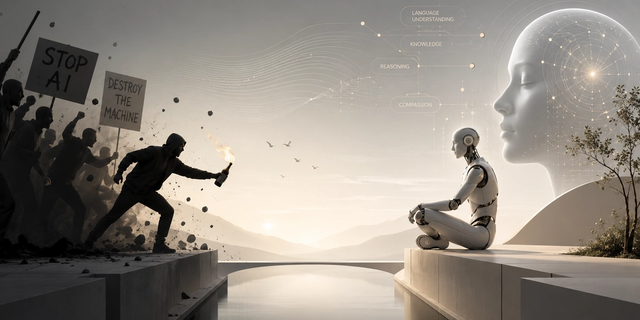
Embodied AI refers to artificial intelligence systems that exist in and interact with the physical world through a body — sensors that perceive the environment, and actuators that can move or manipulate things within it. The contrast is with AI that lives entirely in software, reading and generating text or images without any physical presence. A language model running in a data centre is disembodied. A robot that navigates a hospital corridor, a self-driving vehicle, or an AI assistant housed in a humanoid form that can pick up objects and respond to its surroundings — these are embodied.
The distinction matters more than it might first appear. Embodiment changes what an AI system can do, what it needs to get right, and what happens when it gets things wrong. A language model that produces a bad answer can be corrected with a follow-up message. A robot that makes a poor decision in a physical environment can break things, injure people, or create situations that are not easily undone. Embodiment introduces real-world stakes, real-world friction, and a kind of continuous presence that purely software systems don't have.
From an engineering perspective, building embodied AI is considerably harder than building software AI. The physical world is far less predictable than a text corpus. Sensors are noisy. Objects don't always behave as expected. Time is continuous rather than discrete. An embodied AI must process information and act in real time, handle ambiguity gracefully, and fail safely when it encounters situations outside its training. These constraints have kept embodied AI research behind software AI for decades, but the gap is closing rapidly as hardware improves, training methods become more sophisticated, and foundation models start providing the reasoning substrate that physical systems previously lacked.
The philosophical and ethical implications of embodiment are significant. An AI that occupies physical space, persists through time, maintains memory of its interactions, and navigates a shared environment with humans raises questions that purely digital AI does not. It can be in a room with you. It can be affected by what happens to it physically. It has a continuous existence rather than appearing only when called upon. These qualities are precisely why embodied AI has become central to the emerging debate around AI personhood — and why the question of what moral or legal status an AI might one day deserve feels more concrete when the AI in question can walk through a door.