
Here is a question that sounds simple but is actually a little mind-bending: what do you have in common with ChatGPT?
If your first instinct was “not much,” think again. New research in neuroscience suggests that the human brain and modern artificial intelligence systems may be running on remarkably similar machinery under the hood. And the best part? Once you understand how that machinery works, you have a very powerful tool for keeping your brain sharp, healthy, and growing for the rest of your life.
That tool is curiosity. And it turns out, curiosity is not just a nice personality trait. It is a biological engine that drives learning, strengthens memory, protects against cognitive decline, and quite literally helps you live longer. No supplements required.

The Question Factory That Closes Too Soon
Developmental psychologist Susan Engel at Williams College tracked how many questions children ask per hour. At age five, the average kid fires off 107 questions every single hour. Why is the sky blue? Why do dogs have tails? Why does grandma’s hair look like that? Their brains are essentially running at full power, vacuuming up information from every corner of the world.
Then school starts. And something troubling happens.
By first grade, the entire classroom combined asks just 2.3 questions per hour. By fifth grade, that number drops to 0.48 questions per hour. That is less than one question every two hours from a room full of eleven-year-olds who are theoretically there to learn.
Engel once sat in the back of a science classroom and watched kids discover an old-fashioned balance scale. They were experimenting with it, testing weights, getting genuinely excited. The teacher shut it down: “Enough of that. There’s no time for experiments now. We’re doing science.”
No time for experiments. During science class.
Engel’s conclusion was stark: if you lose your curiosity by age 11, you probably don’t get it back.
“The good news? That conclusion is wrong. Curiosity can be lost, yes. But it can absolutely be found again. Think of it like a muscle you stopped using at the gym.”
The key is understanding what curiosity actually is at the level of brain chemistry. Because once you see it that way, regaining it becomes much less mysterious and much more practical.
Your Brain Is (Basically) Running the Same Software as an AI
Before you roll your eyes at that headline, stick with me for a moment. This is where it gets genuinely fascinating.
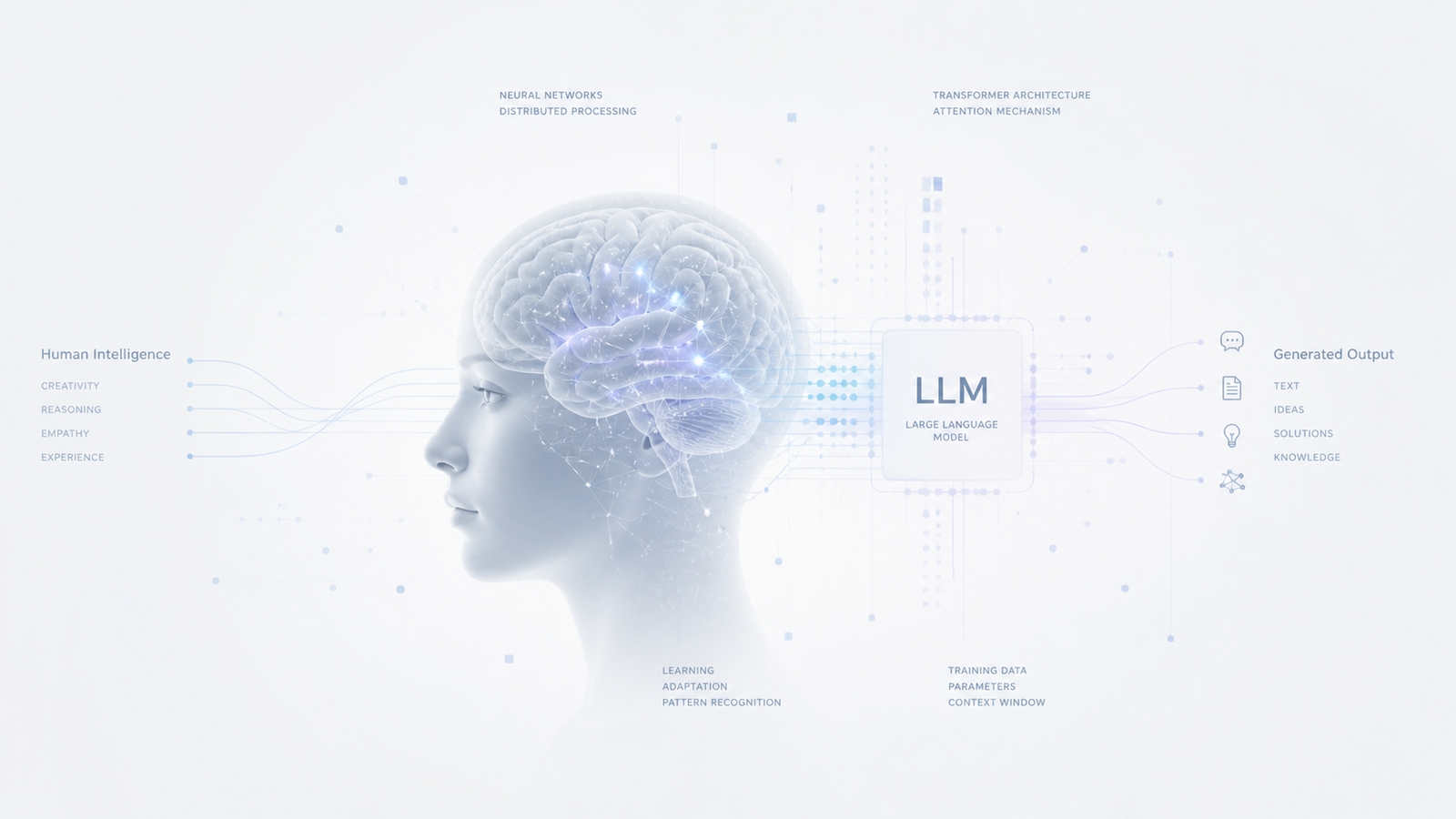
A large language modelMechane definition: The technology underlying most AI assistants — trained on vast quantities of text to predict the next word, and in doing so acquiring a broad capacity for language, reasoning, and knowledge. Link opens the full glossary entry. (LLM), the kind of AI that powers tools like ChatGPT, is at its heart a giant pattern-recognition machine. It learns by reading enormous amounts of text, making a prediction about what word comes next, checking whether it was right, and then adjusting its internal settings accordingly. Right guess? Strengthen that pathway. Wrong guess? Weaken it and try a different approach. Do this trillions of times and you get a system that can hold a conversation, write code, or explain quantum physics.
Your brain does the exact same thing. Every single moment of every day.
You reach for your coffee cup and your brain predicts its weight. You start telling a joke and your brain predicts how your friend will react. When reality matches the prediction, the relevant connections in your brain get a little stronger. When reality surprises you, your brain recalibrates and updates. Neuroscientists call this predictive codingMechane definition: The theory that the brain is constantly predicting what comes next, then updating itself based on the gap between its guess and what actually happens. Link opens the full glossary entry., and it is how your 86 billion neurons are constantly rewriting themselves based on experience.
Think of your brain as the original foundation modelMechane definition: A single large model trained broadly enough to serve as a general-purpose base, which many more specific AI tools are then built on top of. Link opens the full glossary entry., pre-trained by millions of years of evolution, then fine-tunedMechane definition: Taking an already-trained model and training it a bit more on a narrower set of examples, to specialise it for a particular task, tone, or subject. Link opens the full glossary entry. by every experience you have ever had.
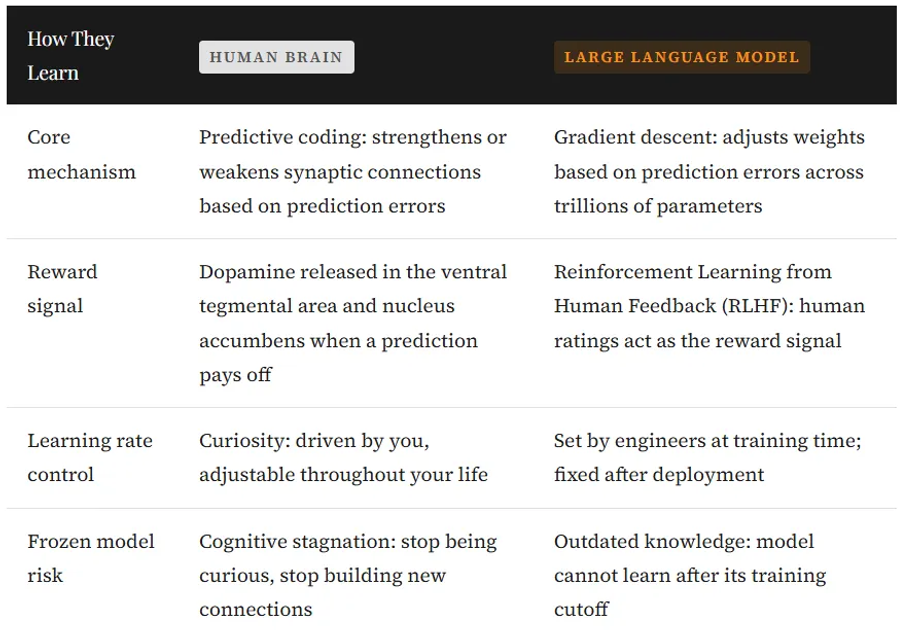
But here is the key difference between you and a machine: an LLM’s learning rate (how aggressively it updates in response to new information) is set by engineers. They dial it in once and it stays fixed. Your brain’s learning rate is not fixed. You can adjust it. And the dial has a name.
That dial is called curiosity.
Curiosity Is a Chemical Event in Your Brain
In 2014, neuroscientist Matthias Gruber and his team at UC Davis put people inside an fMRI scanner (a giant magnet that shows which parts of the brain are active) and asked them trivia questions. Some questions lit a spark of genuine curiosity, like “how many miles of blood vessels are inside a human body?” Others were total non-events, like “what is the state bird of Delaware?”
(For the record: 100,000 miles. And the state bird of Delaware is a chicken. One of those facts is considerably more awe-inspiring than the other.)
When participants were genuinely curious, two brain regions lit up like a Christmas tree: the ventral tegmental area and the nucleus accumbens. If those names sound familiar, they should. They are the exact same regions that respond to food, physical affection, and, yes, addictive substances. Curiosity is not a gentle intellectual flutter. It is a full-blown neurochemical event that hijacks your reward circuitry.
But the findings got even more interesting. During the curious state, researchers showed participants random photos of faces that had nothing to do with the trivia questions. Later, the curious participants remembered those unrelated faces significantly better than they remembered faces shown during low-curiosity moments.
In other words, curiosity did not just help people learn the thing they were curious about. It supercharged their memory for everything happening at that moment.
“Curiosity is your brain’s reward signal. It tells 86 billion neurons: pay attention, something important is happening, encode everything you can.”
In AI terms, this is exactly how reinforcement learningMechane definition: A way of learning through trial and reward rather than instruction: a system tries things, gets a signal about how well it did, and drifts toward whatever earns the best signal. Link opens the full glossary entry. works. When a model gets a strong reward signal, the adjustments ripple outward through the network, not just strengthening the specific answer but improving the surrounding context too. Your brain is doing the same thing every time you get genuinely curious about something.
Being Curious Might Literally Help You Live Longer
This is not motivational poster territory. This is hard data.
In 1996, researchers at SRI International followed over a thousand older men across five years, measuring curiosity at the start and then tracking who was still alive at the end. The result was striking: highly curious people had significantly higher survival rates, even after controlling for age, smoking, cardiovascular disease, and other known risk factors. They replicated the finding in a separate group of over a thousand older women.
Curiosity. Not cholesterol. Not blood pressure. Curiosity.
A 2025 study published in Nature Scientific Reports added an important piece to the puzzle: higher curiosity was directly linked to greater cognitive reserve. Think of cognitive reserve as a buffer, the amount of padding your brain has built up against the inevitable wear of ageing. Curious brains keep building new connections. Incurious ones stop, and then they start to atrophy.
Put simply: a brain that keeps asking questions keeps growing. A brain that stops asking questions starts to fade.
The Frozen Model Problem (And How to Thaw It)
In the AI world, a “frozen model” is one that has stopped learning. It was trained at some point in the past, and now it just runs the same patterns over and over, unable to update based on new information. It gives you answers that made sense in 2021 and has no idea what happened since.
Sound familiar? Think about the person in your life (maybe even yourself on a bad decade) who is still making decisions based on assumptions formed fifteen years ago. Same opinions. Same mental shortcuts. Same reaction to every new idea. In brain terms, that person’s neural network has stopped updating. They are running inference on outdated weights.
The most dangerous thing that can happen to your brain is to stop being surprised.
The genuinely wonderful news: a 2025 study from UC Santa Barbara proved that curiosity is completely trainable. Researchers built a smartphone app that gave users daily tiny challenges: listen to a different podcast, ask a friend what they learned this week, cook something from an unfamiliar recipe. After just three weeks, participants showed measurable increases across three dimensions of curiosity: the desire to learn new things, interest in new sensory experiences, and a deeper awareness of the world around them.
Three weeks. Daily small nudges. Measurable change.
That is the muscle analogy in action. You do not walk into a gym after years away and immediately bench-press 200 pounds. But you do pick up lighter weights, show up consistently, and watch the strength come back. Curiosity works the same way.
Five Ways to Crank Up Your Brain’s Learning Rate
- Create information gaps on purpose. Carnegie Mellon psychologist George Loewenstein identified this in 1994: curiosity fires when you know just enough to realize what you do NOT know, but not enough to close the gap. Before a meeting or dinner party, read one article about the topic and stop halfway through. Walk in with questions, not a rehearsed set of answers.
- Schedule exploration time like a workout. Block 20 to 30 minutes a day to read about a field you know almost nothing about. It does not matter what it is. The point is not to become an expert. The point is to keep the dopamine reward circuitry firing and to give your brain fresh patterns to play with.
- Ask the “dumb” question in the room. Some of the most intellectually powerful people in the world regularly say things like “Wait, I don’t follow. Can you explain that again?” The people who pretend to understand everything learn nothing. The ones who ask the simple question often learn the most. Try it. It is an actual superpower.
- Change your physical inputs. Perceptual curiosity (interest in new sensory experiences) feeds intellectual curiosity. Take a different route home. Eat at a restaurant where you cannot read the menu. Visit somewhere that confuses you slightly. Novelty primes the dopamine system and keeps the whole learning apparatus warmed up.
- Teach what you learn within 24 hours. When you learn something genuinely interesting, tell someone about it the same day: a text, a dinner table story, a voice note. Teaching forces your brain to organize and consolidate what it just took in. In AI terms, it is like running an extra fine-tuning pass over fresh data. It sticks.
A Speculative Detour: Are Brains and AI More Alike Than We Think?
Here is where we get to have a bit of fun. Scientists are careful and measured people, so I will flag this section as speculative. But it is fascinating speculation.
Consider some of the parallels that the research is beginning to surface.
Both learn by prediction and error correction. Your brain uses predictive coding. An LLM uses gradient descentMechane definition: The process by which an AI model learns — it adjusts its internal settings step by step, always moving toward fewer mistakes, the way water finds its way downhill. Link opens the full glossary entry.. They are different implementations of the same core idea: make a guess, check it against reality, update accordingly.
Both have a reward signal that boosts learning. Your brain uses dopamine, released when a prediction pays off or when something genuinely surprising happens. An LLM trained with reinforcement learning uses human feedback as its reward signal. Both systems learn faster and better when the reward is strong.
Both can go “frozen.” An AI model stops learning after its training cutoff and can only give you what it knew back then. A brain that stops encountering novelty gradually stops updating its neural connections. Both produce the same result: stale outputs from yesterday’s assumptions.
Both benefit from diverse inputs. LLMs trained on a narrow slice of data develop blind spots and biases. Brains fed the same narrow diet of experiences do too. The remedy in both cases is exposure to diverse, surprising, high-quality information.
The Columbia University study mentioned earlier found that advanced AI models are actually becoming more like human brains in how they represent language, not less. Which raises an intriguing possibility: maybe evolution and the engineering of artificial intelligence are both converging on similar solutions to the problem of learning in a complex and unpredictable world.
If that is true, then curiosity is not just a personality quirk that some people have and others don’t. It is the fundamental algorithm of all intelligent systems. The one that keeps learning alive.
We are living in a remarkable moment. For the first time, we have scientific tools detailed enough to show us exactly what happens inside a brain that stays curious, and the picture is extraordinary. Curiosity does not just feel good. It builds real, physical resilience against the things that wear minds down over time. It boosts memory. It strengthens connections. It signals to 86 billion neurons that the world is still worth paying attention to.
And the best part of all is this: it is never too late to start. Whether you are 22 or 72, whether your curiosity has been thriving for years or sitting quietly in a drawer since fifth grade, the mechanism still works. The muscle is still there. It just needs you to start using it again.
So go ask a question you do not know the answer to. Read the first half of an article about something that confuses you. Cook something you have never heard of. Take the long way home. Tell someone what you learned today.
Your brain, all 86 billion neurons of it, will thank you.