
Every time a powerful new technology arrives, a chorus of worried voices appears right alongside it. When the printing press showed up in the 1400s, scribes worried about their livelihoods. When the steam engine rumbled into existence, handloom weavers held protests in the streets. And when the first spreadsheet software landed on personal computers, accountants across the world held their breath, certain that their profession was about to vanish.
Spoiler alert: none of those professions vanished. In fact, in almost every single case, the number of people working in those fields grew substantially after the technology arrived. So here we are again, with a new technology and a familiar panic. This time, the villain of the story is artificial intelligence, and the prediction is as dramatic as ever: AI is going to take everyone’s jobs and leave humanity shuffling around with nothing to do.
There is just one small problem with this prediction. It is not supported by history, it is not supported by economics, and it is not supported by the data we are currently seeing. Let us take a calm, clear-eyed look at why the AI job apocalypse is, to put it plainly, a complete fantasy.
The Fixed-Pie Mistake
At the heart of most AI doom narratives is a basic economic misunderstanding. The argument goes like this: there is a certain amount of work that needs doing in the world. If AI does more of it, humans get to do less of it. Simple math, right?
Wrong. And economists have a wonderfully blunt name for this error: the lump-of-labor fallacyMechane definition: The mistaken belief that there is a fixed amount of work in an economy — so if a machine does more of it, humans must do less. Link opens the full glossary entry.. The word “lump” here means “fixed amount,” and the fallacy is the mistaken belief that the total amount of work available in an economy is a fixed, unchanging number that gets divided up among whoever is competing for it.
The total amount of work available in an economy is not a pie that gets sliced thinner every time a new tool shows up. It is a pie that keeps getting bigger.
Think about it this way. A hundred years ago, almost nobody had a personal computer. There was no such thing as a web developer, a social media manager, a podcast producer, an app store reviewer, or a cloud architect. These jobs simply did not exist. Were they somehow lurking in a fixed pool of “available work,” waiting to be discovered? No. New technology created entirely new categories of human need, and those new needs generated entirely new categories of work. The pool grew. And then it grew again.
The people who argue that AI will create mass permanent unemployment are essentially assuming that humanity has reached the outer limit of its ambitions. That we have thought all the thoughts worth thinking, built all the products worth building, and solved all the problems worth solving. If you believe that, well, you probably have not spent much time looking at the state of cancer research, mental healthcare, climate science, or the roughly four billion people on Earth who still lack access to basic banking services.
Jevons’ Paradox: More Efficiency, More Demand
In the 1860s, a British economist named William Stanley Jevons noticed something counterintuitive. Engineers had just invented a much more efficient steam engine, one that used significantly less coal to do the same amount of work. Common sense would suggest that coal consumption would therefore drop, right? Less waste equals less usage.
Instead, coal consumption exploded. The more efficient engines made it cheaper and easier to run all kinds of machinery, so people ran a lot more of it. More factories opened. More ships sailed. More things were built. The efficiency gain created so much new economic activity that total coal use shot upward, not downward. [1]
Jevons' Paradox in Action: Efficiency Drives More Demand, Not Less
This insight, now known as Jevons’ ParadoxMechane definition: Making something more efficient tends to increase how much of it gets used, not decrease it — because lower cost unlocks new demand. Link opens the full glossary entry., is one of the most reliably observed patterns in economic history. Make something cheaper and more efficient, and rather than reducing its footprint, you tend to explode its usage. The same logic applies directly to AI. As AI makes cognitive tasks faster and cheaper, the response will not be “great, let us all work fewer hours and call it a day.” The response will be to tackle bigger, more complex, more ambitious problems than we ever dared attempt before. More demand for intelligence means more need for the humans who can direct, oversee, challenge, and build on top of it.
The Farmer Who Did Not Become Obsolete
Let us go back in time to one of the most dramatic job disruptions in modern history, one that makes the current AI moment look quite modest by comparison.
In the early twentieth century, roughly one in three American workers was employed in agriculture. Farming was not just an industry; it was the backbone of the entire economy. Then came the tractor, the combine harvester, and a wave of mechanisation that automated enormous chunks of farm labour. By the early 2000s, the share of Americans working in agriculture had dropped from around 33 percent to roughly 2 percent. [2]
US Agricultural Employment vs. Total Workers (1900 to 2020)
Now here is what did NOT happen: those former farm workers did not spend the rest of their lives unemployed. They did not wander the countryside in despair. Their children and grandchildren became nurses, teachers, engineers, electricians, factory supervisors, lorry drivers, and eventually software developers. Entire new industries were born to absorb them. The family that left the fields in 1930 had grandchildren who were writing code by 1990.
The tractor did not eliminate human labour. It liberated human labour from backbreaking repetition and pointed it toward higher things. The same story is about to repeat itself with AI, and if history is any guide, the sequel is going to be even better than the original.
The workers who were displaced by mechanisation did not sit around waiting for the “tractor era jobs” to return. They adapted, moved, retrained, and found entirely new opportunities that nobody had even imagined before the disruption began. And crucially, society as a whole became dramatically wealthier and more productive as a result. That is not a coincidence. That is the pattern.
The Historical Track Record Is Overwhelming
The farming story is not a one-off exception. Every major technological revolution in recorded history has followed a strikingly similar arc.
- The Steam Engine (1760s onwards)
Textile workers panicked. The Luddite movement literally smashed machinery in protest. Within two generations, industrial manufacturing had created far more jobs than the cottage industries it replaced, and wages across the working class rose substantially. - Electrification (Early 1900s)
At the turn of the twentieth century, fewer than 10 percent of American homes had electricity. By 1930, electricity powered nearly 80 percent of manufacturing output, and labour productivity doubled for decades. Far from shrinking the workforce, electrification created the consumer economy, with washing machines, refrigerators, and automobiles all generating enormous new industries and millions of fresh jobs. [3] - The Spreadsheet (1980s)
When VisiCalc and later Excel arrived, people genuinely feared for accountants and bookkeepers. The result? The number of financial analysts and accounting professionals grew enormously. Cheaper, faster calculation did not replace number-crunchers. It made the work more valuable and created entirely new fields of financial analysis that had never previously been practical to pursue. - The Internet (1990s onwards)
Travel agents did decline. But the overall employment-to-population ratio barely shifted. The people who left travel agencies found work in the vast new ecosystem the internet created, from e-commerce logistics to digital marketing to software development, roles that had not even been named yet when the first websites went live.
In every single case, the pattern is the same. Short-term disruption, reallocation of labour, and then a much larger and more diverse economy on the other side. The size of the pie did not stay the same. It grew. And the people inside that economy became, on average, more productive and better paid.
The Economy Is Not a Museum
Here is perhaps the most important idea in this entire piece, and it deserves its own moment of appreciation: the economy is not a museum.
A museum preserves things as they are. It locks exhibits behind glass and makes sure nothing changes. If you are a museum curator and someone invents a better way to display ancient artefacts, you might worry that your job is threatened, because the exhibit is fixed and finite.
But the economy does not work like that. It is a living, churning, endlessly creative machine that is constantly inventing new things to want, new problems to solve, and new categories of work to fill. When AI makes existing cognitive tasks cheaper, it does not simply subtract those tasks from the pile. It frees up human energy to chase entirely new frontiers that were previously too expensive, too slow, or too complex to attempt.
“The economy is not a museum of yesterday’s roles. It is a creative allocation machine, enabling new jobs, new goals, and new inventions, all the time.”
Consider what areas of human ambition are still dramatically underserved. Personalised medicine that actually works for each individual patient. Mental health support at meaningful scale. Clean energy infrastructure built out across the entire planet. Space exploration that does not require the GDP of a small nation. Education tailored to each child’s unique learning style. The list is not shrinking. It is growing faster than our current capacity to address it.
AI does not close those frontiers. It opens them wider.
What the Actual Data Shows Right Now
Enough history. What is happening in the real world, today, with AI and employment? The short answer is: far less drama than the headlines would have you believe.
Multiple independent research teams, including economists at the National Bureau of Economic Research, the Federal Reserve Bank of Atlanta, and the Yale Budget Lab, have looked carefully at the numbers. Their findings are remarkably consistent. In the overwhelming majority of companies that have adopted AI, there has been essentially no measurable change in total employment. [4]
How Companies Report AI's Impact on Their Workforce (2025 surveys)
Among the small minority of companies that did report workforce changes linked to AI, the numbers were almost perfectly balanced between those who gained jobs and those who lost them. The Yale Budget Lab, reviewing a broad sweep of available evidence, concluded that while anxiety about AI’s effects on employment is widespread, the actual data so far points to stability rather than disruption at any meaningful scale. [4]
There is an early, partial exception worth mentioning. Some researchers have spotted a softening in certain entry-level knowledge-work roles in sectors with high AI exposure. This is real and worth paying attention to. But even here, the same research also found an uptick in entry-level roles where AI acts as a helper rather than a replacement. And crucially, young workers who left those roles appear to have found employment elsewhere, with broader employment ratios holding relatively steady overall.
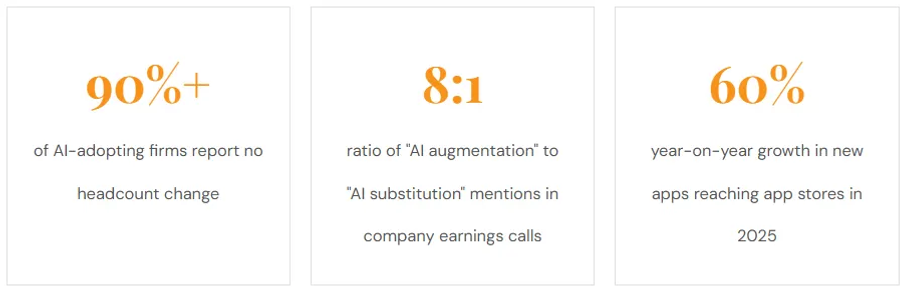
That last statistic deserves a moment. New business formation is surging, and new apps are hitting the market at a pace that would have seemed impossible five years ago. That is not what a job apocalypse looks like. That is what a creative explosion looks like.
AI Is a Colleague, Not a Replacement
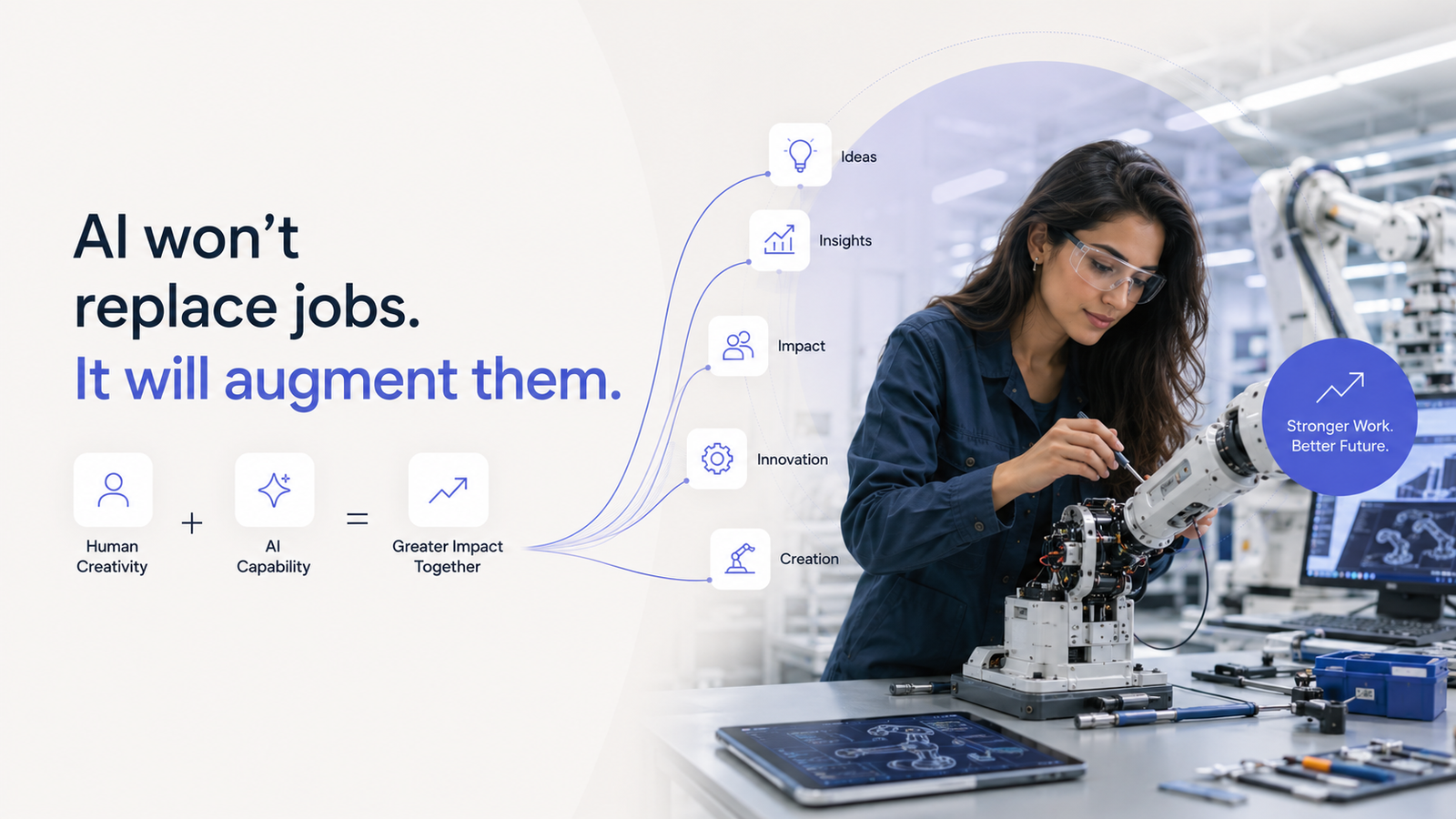
One of the most encouraging details in all this data is where corporate leaders actually say they plan to deploy AI. Company executives, the people making real hiring and investment decisions with real money on the line, mention AI as a tool for augmentingMechane definition: Using AI to extend what humans can do, rather than replace them — the machine handles volume and pattern, the human retains judgment and direction. Link opens the full glossary entry. their existing workers about eight times more often than they mention it as a reason to reduce headcount. [5]
Software engineers are a perfect example of this. You might expect that AI-assisted coding tools would reduce demand for programmers. The opposite appears to be happening. Demand for software engineers has been ticking upward since the start of 2025, not downward. When individual developers can accomplish more, businesses find it worthwhile to hire more developers to pursue projects that previously seemed out of reach. More capability unlocks more ambition. More ambition generates more demand for capable people.
Product managers tell a similar story. Open positions in product management are at their highest level since 2022. If AI were genuinely substituting for human thinking, you would expect demand for the people who direct and shape products to fall. Instead, it is rising. The reason is simple: when AI handles more of the routine cognitive load, the premium on genuinely creative human judgment actually goes up, not down.
The Jobs That Have Not Been Invented Yet
Here is a thought experiment. Imagine travelling back to the year 1990 and trying to explain to someone what a “UX researcher,” a “DevOps engineer,” a “data scientist,” or a “growth hacker” does for a living. These are not obscure or minor occupations. They represent millions of jobs today. But in 1990, they did not exist, and the words to describe them had barely been coined. Nobody was sitting around worrying about the coming shortage of cloud security architects, because the cloud itself was still science fiction.
Share of Jobs in 2025 That Did Not Exist in Earlier Decades
The history of employment since 1940 shows that the overwhelming majority of the jobs that exist in any given decade did not exist in the decade before the transformative technology of that era arrived. The doomer argument requires you to believe that this pattern, which has held true without interruption for more than a century, will suddenly stop the moment AI gets involved. That is an extraordinary claim, and it comes with approximately zero extraordinary evidence to back it up.
And yes, the transition period involves real pain for real people, and that deserves genuine empathy and practical support. Retraining programmes, updated education curricula, and thoughtful safety nets are all genuinely important. Acknowledging that disruption is uncomfortable is not the same thing as predicting civilisational collapse. The first is compassionate. The second is just bad history.
Doomerism Is Short-Sighted, And Here Is Why
The people who insist that AI will create permanent mass unemployment are, at bottom, making a claim about human nature. They are saying that once AI takes over a set of tasks, humans will simply… stop. Stop wanting things. Stop imagining things. Stop finding new problems to solve and new goals to chase.
This is not realism. It is a fundamental misread of what humans are and how we behave. People who argue for technological unemploymentMechane definition: The theory that technology permanently destroys more jobs than it creates — a prediction made confidently before every major technological wave, and wrong every time so far. Link opens the full glossary entry. have been making the same prediction, with the same confidence, for at least two hundred years. The printing press was going to destroy the scribal class. The mechanised loom was going to end textile work. Electricity was going to make manual labour redundant. The computer was going to make office workers obsolete. Each time, the specific prediction came with genuine disruption attached. And each time, the broader prediction of mass permanent unemployment turned out to be spectacularly wrong.
Doomerism is not just inaccurate. It actively gets in the way of sensible thinking. It directs energy toward fear rather than toward the genuinely important work of managing transitions well, designing good retraining programmes, and building an education system that prepares people for the jobs that are coming rather than the jobs that are leaving.
The doomers look at one frame of the film and call it the whole movie. They see tasks being automated and stop the clock right there, ignoring every single historical instance where that same story continued to a far more positive ending. That is not analytical rigour. That is an incomplete argument dressed up as prophecy.
A Future Worth Believing In
Step back from the noise for a moment. Look at what is actually being built right now, all around us.
AI tools are helping researchers identify potential treatments for diseases that have stumped medicine for decades. They are helping small business owners compete with organisations fifty times their size. They are helping students who could never afford a private tutor get personalised educational support for the first time. They are helping engineers design clean energy systems that were previously too computationally complex to model. They are helping writers, artists, and musicians explore creative territory they had only ever imagined in the abstract.
This is not the preamble to a catastrophe. This is the opening chapter of something genuinely extraordinary.
Yes, there will be jobs that fade and transform. There will be a period of rebalancing as the labour market adjusts to new possibilities, as it always has before. Some of that rebalancing will be uncomfortable, and it matters enormously that we approach it with compassion and practical support for the people navigating it. None of that makes the overall trajectory anything other than deeply positive.
The generations who grew up in the age of the tractor, and then the age of electricity, and then the age of the computer, did not inherit a diminished world. They inherited a world of abundance that their great-grandparents could not have imagined. The generation growing up in the age of AI deserves the same expectation of extraordinary possibility. Because the evidence, history, economics, and current data all point in the same direction.
The future is not something to be feared into a defensive crouch. It is something to be built, deliberately and hopefully, by people who understand that human ambition has never once, in all of recorded history, reached its final limit. We have always found a new horizon to chase. This time will be no different. And this time, we will have better tools than ever before to chase it with.
Let the fearful shout as loudly as they like. The builders are already at work.
Sources
- Jevons, W.S. (1865). The Coal Question. Wikipedia overview: https://en.wikipedia.org/wiki/Jevons_paradox
- US Department of Agriculture, Economic Research Service. Agricultural employment historical data: https://www.ers.usda.gov/topics/farm-economy/farm-labor/
- US Energy Information Administration. History of electrification and manufacturing productivity: https://www.eia.gov/electricity/data.php
- Yale Budget Lab. “Tracking the Impact of AI on the Labor Market,” April 2026: https://budgetlab.yale.edu/research/tracking-impact-ai-labor-market
- David George, Andreessen Horowitz. “The AI Job Apocalypse Is a Complete Fantasy,” May 2026: https://www.a16z.news/p/the-ai-job-apocalypse-is-a-complete
Disclaimer: This article is intended for general informational and educational purposes only. It represents the author’s perspective and analysis of publicly available research and historical data. It does not constitute professional economic, career, or technology advisory guidance. Readers are encouraged to consult relevant specialists for decisions relating to career planning, business strategy, or workforce management.