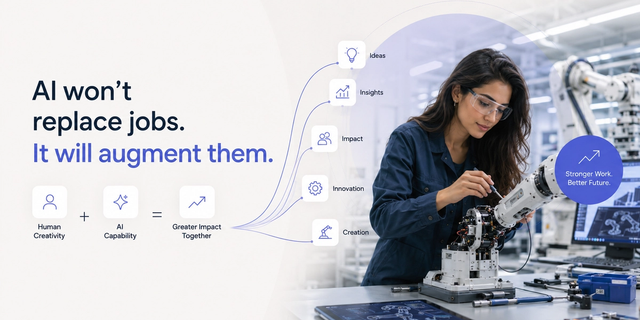
Augmentation, in the context of AI, refers to using AI to extend and enhance what a human worker can do — rather than to replace the worker entirely. The distinction matters enormously and is often collapsed in public debate. Automation asks: can a machine do this task instead of a human? Augmentation asks a different question: can a machine help a human do this task better, faster, or at greater scale than they could alone? The two framings lead to different design choices, different organisational structures, and very different economic outcomes.
In practice, most current AI deployment sits closer to the augmentation end of the spectrum. A radiologist using AI to flag potential anomalies in scans is augmented — the AI handles high-volume pattern recognition, the clinician applies judgment, context, and accountability. A software engineer using an AI coding assistant writes more code, ships faster, and tackles more complex problems than before — the AI generates suggestions, the engineer evaluates, refines, and integrates them. The human role shifts rather than disappears: less time on routine execution, more on judgment, direction, and quality.
The augmentation frame predicts a specific labour market pattern: as AI raises individual productivity, demand for the augmented role tends to grow rather than contract. When developers can accomplish more, organisations find it worthwhile to hire more developers to pursue projects previously out of reach. This is not a given — it depends on whether the market for the output is itself expandable. But across most knowledge-work domains, the evidence so far aligns with the augmentation prediction rather than the replacement one.
The boundary between augmentation and automation is not fixed. A task that is augmented today — where the human still provides essential judgment — can become fully automated tomorrow as capability improves. What that means for any particular role depends on which parts of the role are judgment-heavy and which are routine. The roles that have historically survived and grown alongside new technology are those where human judgment, accountability, and relationship remain irreducibly part of the value. The question worth asking of any role is not whether AI can do parts of it, but which parts it cannot.