Predictive coding is the idea that your brain is not a passive recorder of the world but an active guessing machine. At every moment it is forming expectations about what it is about to see, hear, and feel, then comparing those expectations against what actually arrives. When the guess is right, little changes. When reality delivers a surprise, the brain pays attention and adjusts. The weight of an object you lift, the next word in a sentence, the way a friend will react to a joke: all of it is predicted first and corrected after.
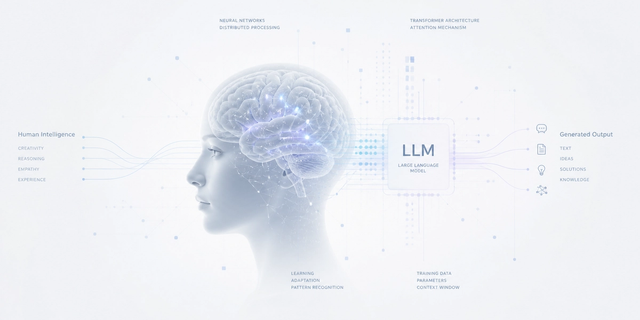
The reason the theory has gained ground is that it explains something otherwise puzzling: why surprise feels significant. A prediction error is the brain's signal that its model of the world was incomplete, and that signal is what drives learning. This is also why the comparison to artificial intelligence keeps coming up. A language model learns by predicting the next word, checking whether it was right, and nudging its internal settings when it was wrong. The mechanism is not identical, but the shape of it is strikingly similar.
It is worth being careful here. Predictive coding is a leading framework in neuroscience, not a settled law, and the brain almost certainly does more than this one trick. Calling the brain a prediction machine is a useful lens, not a complete portrait. The honest version of the claim is that prediction and error correction appear to be a deep part of how learning works, in biological brains and in artificial ones, which is interesting enough without overstating it.
For a person, the practical takeaway is quietly encouraging. If your brain learns most when its predictions are violated, then surprise is not an interruption to understanding but the raw material of it. The moments where you are slightly wrong, slightly confused, slightly caught off guard are the moments your mind is most able to grow. Comfort, by the same logic, teaches you very little.