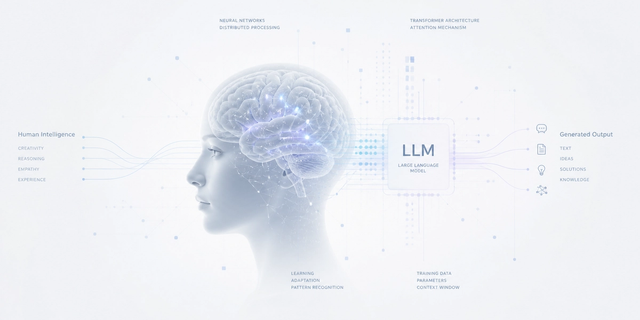
A foundation model is a single, large model trained on a vast and varied body of material, built to serve as a general-purpose starting point rather than a finished tool. The name is deliberate: it is meant to be the foundation that many more specific applications are built on top of. The same underlying model might power a chatbot, a coding assistant, and a summarising tool, each one a specialised storey raised on the same broad base.
What makes the idea powerful is generality. Because the model has absorbed so much during its initial training, it arrives with a wide range of latent capabilities that were never explicitly programmed, and which can be drawn out and sharpened afterwards through fine-tuning or careful prompting. This is a genuine shift from older software, which had to be built deliberately for each task. A foundation model is more like a broadly educated graduate than a purpose-built machine.
That same breadth is also the worry. Whatever a foundation model absorbs, including the gaps, biases, and errors in its training material, becomes the inherited foundation for everything built on it. A flaw at the base can quietly propagate into hundreds of downstream applications, and because so much now rests on a handful of these models, a small number of design choices end up shaping a great deal of what people encounter. Concentrating so much capability in so few places is one of the live debates about where this technology is heading.
If you want the human analogy, think of a foundation model as a broad general education rather than a single skill. Years of wide, unfocused learning give a person a base they can later specialise in countless directions, as a doctor, a teacher, a builder. The strength is the range of what becomes possible from one shared starting point. The vulnerability is that whatever was missing or mistaken in that early foundation tends to follow you, quietly, into everything you build on top of it.