Superposition is what a quantum particle does before it's measured: it occupies several possible states at the same time. In the double-slit experiment, a single particle fired alone passes through both slits and interferes with itself, building up a wave pattern over many runs. It behaves as though it took every available path at once.
The crucial subtlety is what superposition is not. It isn't that the particle is really in one place and we simply don't know which — that would just be ignorance. It's that the particle has no single definite position to be ignorant about, until a measurement forces it to commit. The possibilities are real, and measurement collapses them into one.
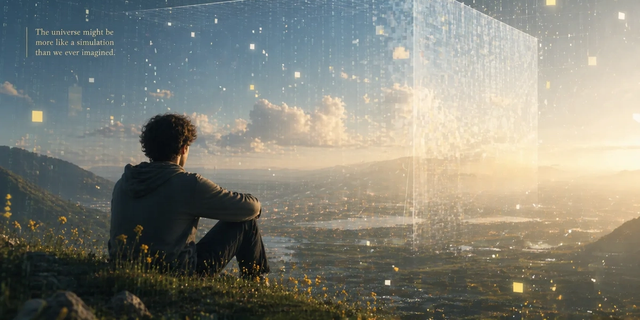
This is the mechanism behind the article's "rendered on demand" metaphor. An unobserved particle is more like unresolved potential than a fixed thing. The moment any interaction records its state, the spread of possibilities resolves into something specific. No consciousness required — a detector is enough.
For a person, the strange part is the loss of a comfortable middle ground. We're used to "I don't know yet, but there's a fact of the matter." Superposition removes the fact of the matter until the looking happens. The answer isn't hidden. It hasn't been decided.