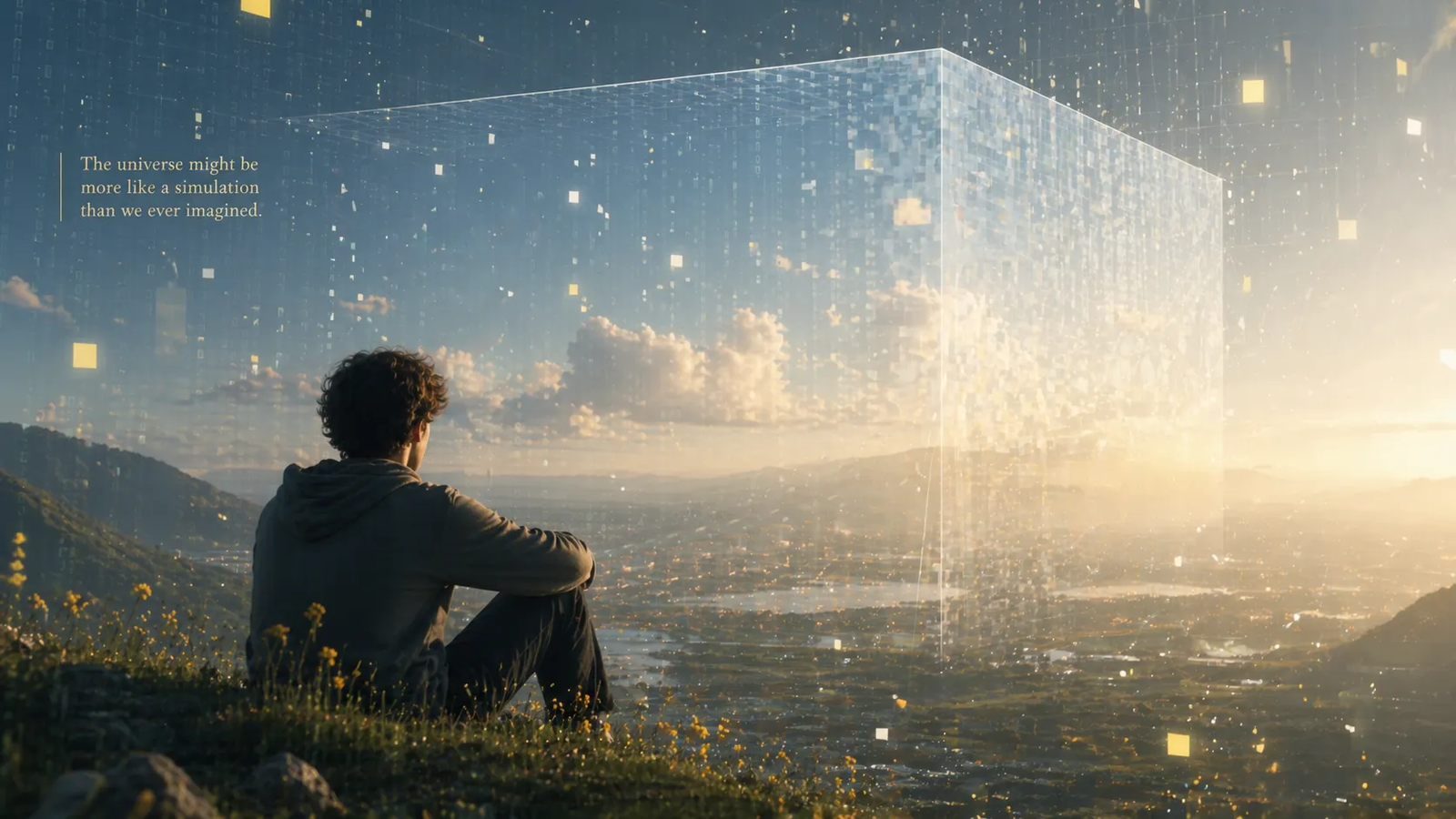

What if I told you there is a serious scientific argument, backed by a Nobel Prize in Physics, that the universe you are sitting inside right now might be more like a video game than a physical place? Not a metaphor. Not science fiction. An actual, peer-reviewed, experimentally verified idea that has left some of the brightest minds in history staring at the ceiling at 3 a.m.
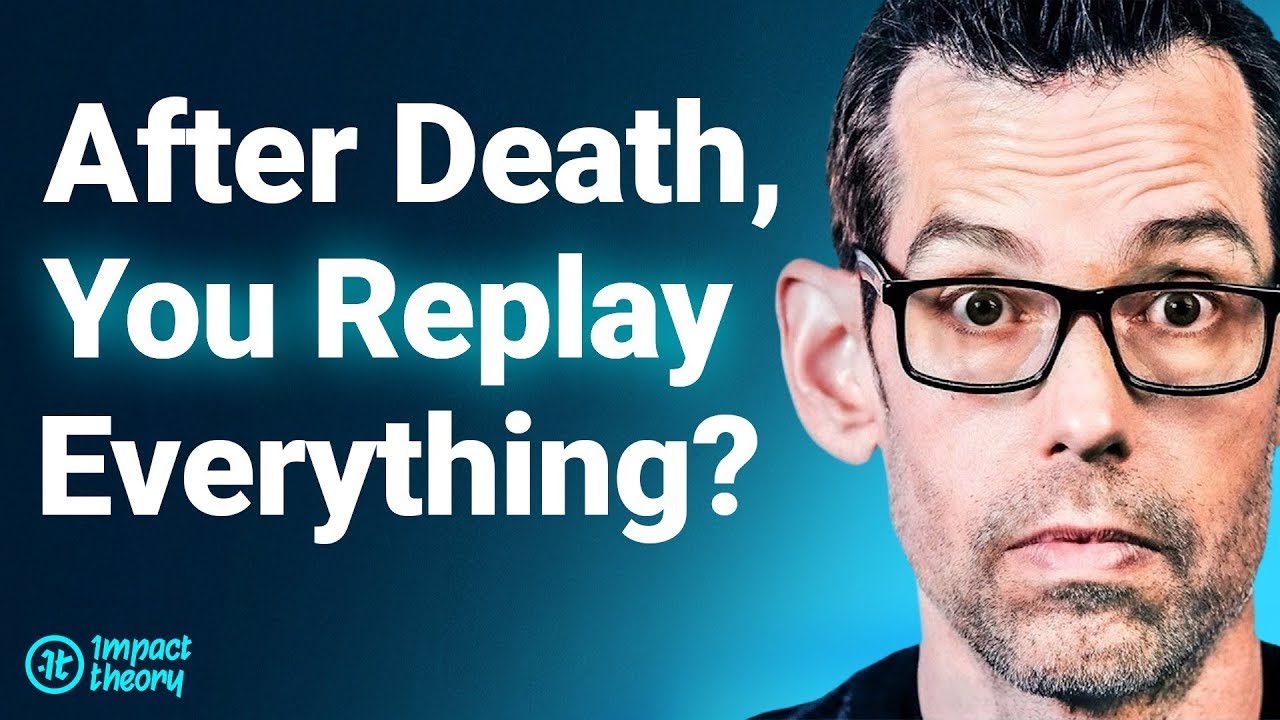
That is precisely what Tom Bilyeu explores in his fascinating YouTube video, “Nobel Prize Just Given for Proving the Universe isn’t Real”. Bilyeu, known for founding Impact Theory and interviewing some of the world’s sharpest thinkers, argues that recent discoveries in quantum physics do not just bend the rules of reality. They might shatter the whole rulebook entirely.
Grab a coffee, take a seat, and get comfortable. Things are about to get gloriously weird.
The Two Rules We All Assume Are True
Before anything can be questioned, we need to understand what is being questioned. Our everyday experience of the world rests on two assumptions so obvious that most people never even notice they are making them.
The first is localityMechane definition: The assumption that something can only be affected by its immediate surroundings — that to influence anything far away, you have to cross the distance. Reality, it turns out, doesn't fully obey this. Link opens the full glossary entry.. This is the idea that things can only be influenced by other things close to them. Your coffee gets cold because the air around it is cool, not because of something happening on the other side of the planet. If you want to affect something across town, you have to travel there, or send a message that takes time and energy to arrive. Distance is a real barrier. Objects are self-contained, independent things that interact only with their immediate surroundings. Simple. Obvious. We do not even think about it.
The second is realismMechane definition: The assumption that objects have definite properties whether or not anyone observes them — that the moon is up there even when no one glances at it. Quantum experiments make this harder to defend. Link opens the full glossary entry.. This is the idea that objects exist in a definite state whether or not anyone is looking at them. The chair in the other room does not vanish when you leave. The moon is up there tonight whether you glance at it or not. Reality is continuous, objective, and permanent. It does not need you to observe it in order to exist.
Together, these two ideas form the bedrock of how human beings understand everything. And according to decades of increasingly airtight experiments, both of them are wrong.
A Game Engine Taught a Founder About Reality
One of the more unusual moments in Bilyeu’s video comes when he describes building his first video game. When you design a game world, you face a fundamental engineering decision: do all the objects in the world exist fully, permanently, in complete detail at all times, whether or not a player is anywhere near them? Or do you only render and calculate what a player is actually looking at in a given moment?
Every serious game engine picks the second option, and for good reason. Keeping every single object in a vast game world fully real and fully tracked at all times would require so much processing power that it would melt your hardware. The computational cost is simply too enormous. So instead, objects that are not being observed exist only as potential, as a kind of mathematical probability waiting to be resolved into something concrete the moment a player needs to see or interact with them.
Think of it like a stage play where the stagehands only build the next scene while the audience is watching the current one. Nothing exists in full detail until it needs to.
Here is the thing that Bilyeu found so striking. In that same game engine, distance is an illusion. Two objects that appear to be on opposite ends of a vast game world are, underneath the visual display, just two pieces of data sitting next to each other in the same memory, being processed by the same chips. The separation you see on screen is a representation. The actual computation happens in one place. Locality, in a game, is something you deliberately simulate to make the world feel believable.
As it turns out, our universe seems to work the same way.
The Particle That Could Not Make Up Its Mind
To understand why physicists started losing sleep over this, we need to talk about one of the most famous experiments in the history of science: the double-slit experiment.
Back in 1801, a British scientist named Thomas Young fired a beam of light at a barrier with two narrow slits cut into it. Behind the barrier was a screen. His question was simple: is light a wave or a particle? If particles, you would get two distinct bands on the screen, one behind each slit. If waves, you would get an interference pattern, a series of alternating light and dark stripes, like the overlapping ripples when you drop two pebbles into a pond at the same time.
The result? Interference pattern. Waves win. Einstein later complicated matters by proving that light also comes in individual packets called photons, winning the Nobel Prize for the effort. So physicists were stuck with a genuine paradox: light seemed to be both a wave and a particle depending on how you looked at it.
Then came the brain-melting follow-up. What happens if you fire photons one at a time through the two slits? No group, no beam, just a single particle, alone, with nothing else around it. Surely the interference pattern would vanish, because you need waves overlapping to create it. A lone particle should just go through one slit and leave a single mark.
It does not. Even when fired one at a time, the interference pattern slowly builds up on the screen. Which means each individual particle, somehow, passed through both slits at the same time and interfered with itself.
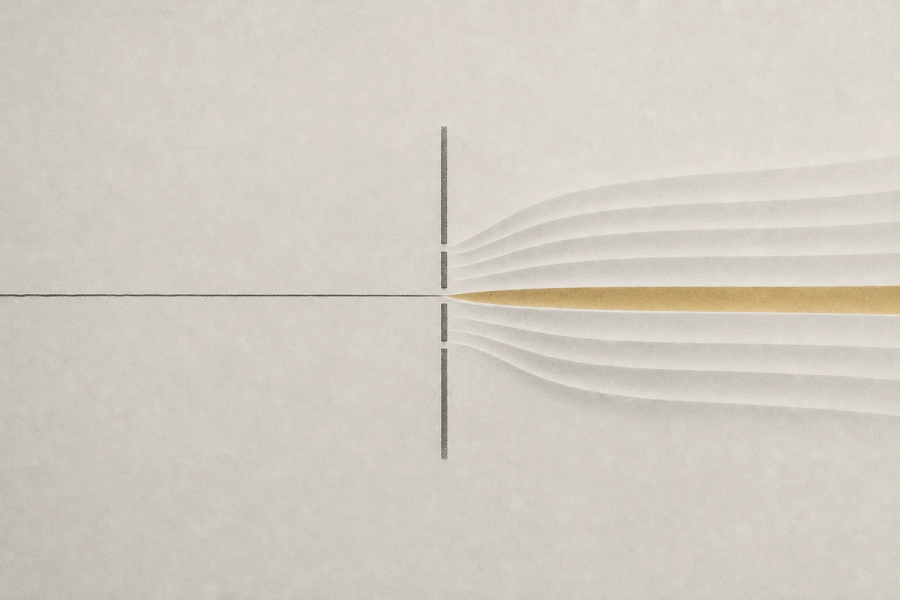
This is called superpositionMechane definition: The state in which a quantum particle holds multiple possibilities at once — not secretly being in one place we haven't checked, but genuinely having no single definite state until something measures it. Link opens the full glossary entry.: a quantum particle does not have a definite location until something measures it. It exists as a spread-out wave of probability, potentially here and potentially there simultaneously, until the universe is forced to commit to one answer.
Naturally, scientists asked the obvious question: if we just watch which slit the particle actually goes through, will that tell us what is really happening?
So they set up a detector. The moment the detector was switched on, the interference pattern completely disappeared. Two clean bands, just like you would expect from ordinary particles. Switch the detector off, the interference pattern comes back. Switch it on, it vanishes again. This has been replicated thousands of times in labs all over the world. The result is always the same.
The universe appears to only “commit” to a definite state when information about that state is captured. It is not even about conscious observation. You do not need a human being with eyes and intentions. Any physical interaction that records which path the particle took causes the wave of probability to collapse into something specific. The moment the information exists somewhere in the system, the particle gets rendered as real.
“It’s like the toys in Toy Story. They act like lifeless objects when humans are around, but jump to life when no one is watching.”
The Experiment That Reached Backwards Through Time
If the double-slit result made you uncomfortable, what comes next might make you question everything you ate for breakfast this morning.
In the 1970s, physicist John Archibald Wheeler proposed a variation called the delayed-choice experiment. The idea was this: what if you wait until after the particle has already passed through the slits before deciding whether to observe it?
Think about what that is actually asking. The particle has already made its journey. It has already done whatever it was going to do, wave or particle. It is finished. Now, after the fact, you flip a coin and decide whether you were watching. Does that change anything?
In 2007, physicists in France ran this experiment with enough precision to get a definitive answer. The result was, in a word, impossible. When researchers chose to observe the particle after it had already passed through the slits, it retroactively behaved like a particle on its way through. When they chose not to observe, it retroactively behaved like a wave. The decision made after the event changed what the event had been.
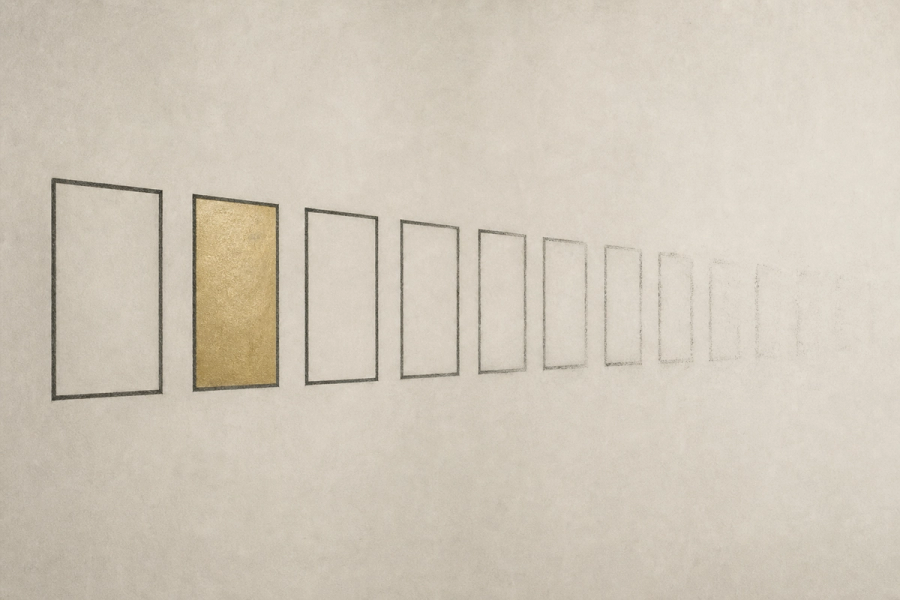
The present, somehow, reached back and rewrote the past.
There is no mechanical, locally real explanation for this. The only framework in which it makes intuitive sense is a computational one. A simulation does not have a fixed, permanent past. It has mathematical probabilities that only get resolved into concrete history when the current state of the system requires it. If you are measuring something right now, the simulation has to figure out what the consistent past must have been to produce this present. It writes that history on demand. Our universe, it seems, does exactly this.
The Nobel Prize That Changed Everything
Now we get to the big one. The piece of evidence that moved this from philosophical curiosity to verified scientific fact.
In 1935, Einstein and colleagues Boris Podolsky and Nathan Rosen published a thought experiment designed to prove that quantum mechanics was incomplete. Their argument went like this: quantum theory predicts that two particles can become “entangledMechane definition: When two particles become linked so that measuring one immediately tells you about the other, however far apart they are — not by sending a signal, but by behaving as a single system that distance can't divide. Link opens the full glossary entry.,” meaning their properties are permanently linked. Measure one, and you instantly know something about the other, regardless of how far apart they are. If one is spinning one way, the other must be spinning the opposite direction.
Einstein thought this was absurd. For it to work, either the particles had some kind of hidden pre-agreed instructions baked into them from the start, or measuring one somehow sent information to the other faster than the speed of light, which his own theory of special relativity expressly forbids. He concluded there must be hidden variables. Reality had to be locally real. The alternative was too insane.
In 1964, physicist John Bell figured out how to actually test this. He proved that if hidden variables existed, measurements of entangled particle pairs could only correlate up to a specific statistical ceiling. If experiments found correlations above that ceiling, hidden variables were dead. Reality was not locally real. Einstein was wrong.
The experiments began. John Clauser tested it in 1972. Alain Aspect closed the major loopholes in the 1980s. Anton Zeilinger eventually used light from stars hundreds of light-years away to set measurement parameters, making any possible pre-existing conspiracy absurdly implausible. Every single time, the correlations exceeded Bell’s ceiling. Every time, the universe failed to behave the way a locally real place would behave.
In October 2022, Aspect, Clauser, and Zeilinger were awarded the Nobel Prize in Physics for this body of work. Scientific American ran the headline: “The Universe is Not Locally Real.” That is not poetry. That is the official conclusion of the most rigorous experimental physics of the last fifty years.
What the Nobel experiments proved is that entangled particles on opposite sides of the universe are not two separate objects sending signals to each other. They are one system, processed together, with the appearance of distance being nothing more than a representation. Just like objects in a game engine that look far apart on screen but are actually adjacent data structures being handled by the same processor.
“No one can say definitively that our universe is a simulation. But we can say that it behaves exactly like a simulation.”
Philosopher Nick Bostrom and the Statistics That Should Terrify You
Back in 2003, long before any of these Nobel results were in, Oxford philosopher Nick Bostrom published an argument from pure probabilityMechane definition: The argument, formalised by Nick Bostrom, that if advanced civilisations can run realistic simulations of conscious minds, then most conscious minds are probably inside one rather than in base reality. Link opens the full glossary entry.. Computing power has roughly doubled every two years for decades. If that trend continues, even if it slows dramatically, future civilizations will eventually be capable of running detailed simulations of entire worlds, complete with conscious inhabitants who have no idea they are simulated.
If that is even possible, Bostrom argued, then one of three things must be true. Either virtually every civilization destroys itself before reaching that capability, through war, pandemic, runaway AI, or some other catastrophe. Or virtually every civilization that reaches that capability chooses, for some universal reason, never to run any simulations at all. Or we are almost certainly living in a simulation right now.
Here is the brutal math behind option three. If even a single civilization survives and runs a modest number of simulations, the number of simulated conscious minds it creates will vastly outnumber the minds living in whatever base reality started the whole chain. Add in the probability that simulated civilizations within those simulations go on to create their own simulations, and the ratio becomes staggering. The number of simulated realities piles up like compound interest. The chance that any given conscious mind exists in the one original base reality approaches zero.
Elon Musk has publicly stated the odds of living in base reality are about one in a billion. That is not an eccentric celebrity opinion. That is the straightforward output of Bostrom’s logic.
What makes this especially wild is that Bostrom laid out his argument on probability alone, years before the Nobel Prize confirmed that the universe operates on exactly the computational principles a simulation would require. The philosophy and the physics arrived at the same place from completely different directions.
So What Does Any of This Mean?
Here is where it gets genuinely exciting rather than just unsettling.
Either we live inside a simulation built by some intelligence operating at a level far above our own, or the universe is so fundamentally computational in its nature that the distinction between a simulation and raw reality simply dissolves. At the base layer, reality does not appear to be made of matter and energy in the way we were taught. It appears to be made of mathematics, calculation, and information processing. As Bilyeu puts it, at some point, does the difference even matter?
Before Einstein’s discoveries, the entire atomic age would have seemed like pure magic. Nuclear power, medical imaging, GPS satellites, all of it would have been indistinguishable from sorcery to people living just a couple of generations earlier. But then the framework changed, and the magic became engineering.
If the universe is computational at its core, then the question becomes: what things that currently seem impossible might turn out to be just another engineering problem once we understand the rules better? What is the atomic age of a simulation-aware civilization going to look like?
That question alone is worth sitting with for a while.
Go Ahead and Let Your Brain Wander
Remember, this is a thought experiment. Nobody is asking you to sell your house and go live in a cave contemplating the Matrix. But if you walk away from this article and spend even five minutes genuinely asking yourself what it would mean if every object you see is being rendered on demand, if distance is an illusion, if your past is only as fixed as the last time someone observed it, then this article has done its job.
The universe has just revealed itself to be far stranger, far more mysterious, and frankly far more interesting than any of us were taught in school. That is not a reason for existential dread. It is a reason to be absolutely delighted to be alive and conscious inside whatever this extraordinary, improbable, possibly-rendered-on-demand thing we call reality actually turns out to be.
So go all in. Let the discomfort turn into wonder. Sit with the strange feeling that the ground beneath your feet might be code. Enjoy it. Because if this is a simulation, whoever built it went to extraordinary lengths to make it beautiful.
And that is not nothing.