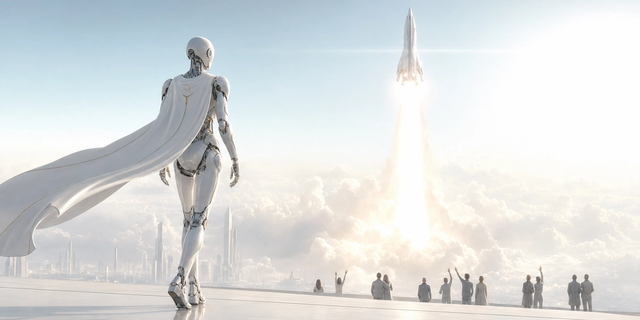

There is something hardwired into the human soul that simply refuses to accept the horizon as the end of the road. The moment our ancestors stood on a coastline and looked out at the open ocean, they did not see a barrier. They saw a question. And eventually, inevitably, they built a boat.
That same restlessness that sent Columbus stumbling into the Caribbean, that drove Magellan’s crew around the entire planet, and that put Neil Armstrong’s bootprint in the dust of the Moon, is now pointing us somewhere new. Not across an ocean. Across a solar system.
We are living through a moment that future generations will likely study the way we study the Age of Exploration. The logistics are different, the vehicles are a bit more complicated than a wooden caravel, and the journey takes slightly longer than a few months at sea. But the spirit is exactly the same. Something is calling us outward, and for the first time in decades, we finally have the tools to answer.
“The opportunity space exploration presents is not just scientific. It is civilizational. The Moon is not our destination. It is our port of departure.”
The Moon, that silvery companion that has lit our nights and pulled our tides since before humans existed, is about to become something it has never been before: useful. And from there, Mars awaits. And after Mars, the moons of Jupiter. And after that, well, the universe is not exactly short on real estate.
The Moon Is Not the Destination. It Is the Launchpad.
Here is a way to think about what the Moon represents in our long-term ambitions. Imagine you are trying to drive from Europe to Asia. You would not attempt that journey in a single stretch without stopping somewhere to refuel, rest, and resupply. You would plan stops along the way. The Moon is that first major stop on humanity’s road trip through the solar system.
Building a sustainable human presence on the Moon solves problems that make every subsequent step far easier. It teaches us how to keep people alive in a harsh, unforgiving environment with no easy rescue option. It gives us a place to test the equipment, methods, and systems we will need before committing to the far longer and more isolated journey to Mars. And it gives us access to something enormously practical: a low-gravity launchpad for the rest of the solar system.
That lower gravity is not just a fun fact for science classes. It is an engineering advantage with enormous consequences. Launching a payload from Earth requires massive amounts of fuel simply to fight our own planet’s gravitational pull. Launching the same payload from the Moon requires a fraction of that energy. This means the Moon could one day serve as a manufacturing and launch hub for missions deeper into the solar system, including Mars, at costs that simply are not possible from Earth’s surface.
And from Mars, we set our sights further still. Jupiter’s moon Europa, with its vast liquid ocean beneath an icy shell, has long been considered one of the most intriguing candidates in our search for life beyond Earth. The outer solar system is full of destinations that once seemed impossibly remote. With a lunar base as our foundation and a Martian colony as our next waystation, none of them are out of reach forever.
The Revolution Nobody Noticed
For decades, space exploration was essentially a government-only club. You needed a massive national budget, a large bureaucracy, and a great deal of political will to do anything useful above the atmosphere. This produced some breathtaking achievements, the Apollo missions being the obvious highlight, but it also produced something less glamorous: a pace of progress that can charitably be described as leisurely.
That model has now changed completely. The shift from government-led to commercially-driven space exploration may be the single most important development in the history of the field, and most people are still not fully appreciating what it means.
Think of it this way. For much of the 20th century, if you wanted to cross the Atlantic Ocean, you had to rely on national flag carriers operating under heavy government regulation, with ticket prices to match. Then deregulation happened, competition arrived, and suddenly crossing an ocean became something ordinary families could afford. Space is now going through its own version of that deregulation moment, and the price difference is staggering.
NASA’s old heavy-lift rocket program cost roughly four billion dollars per launch and ran more than 140% over its original budget. The newer commercial alternatives can complete the same fundamental job, getting a significant payload off Earth and toward the Moon, for a fraction of that cost. As these systems mature and become fully reusable, the numbers will keep falling.
This matters enormously because space exploration, like most human endeavors, follows the economics. When it is cheap enough for one government to do it occasionally, you get occasional missions. When it is cheap enough for many companies to do it routinely, you get an industry. And when you get an industry, you get innovation, competition, and a pace of progress that governments alone simply cannot match.
A New Race, a New Prize
History has a funny habit of repeating itself in broad strokes, even when the details change completely. The original Space Race of the 1960s was driven by Cold War rivalry, a competition between two superpowers who both understood, even if they could not always say so publicly, that whoever controlled space would shape the 21st century.
The new race to the Moon has a similar feel, though the participants and the motivations are more complex. The United States, via its Artemis programMechane definition: NASA's US-led effort to return humans to the Moon and build a sustained presence there, working largely through commercial partners. Link opens the full glossary entry. and with commercial partners as the primary engine of delivery, is targeting a crewed lunar landing in the coming years. China has publicly committed to landing astronauts on the Moon by 2030, and by all available accounts, that timeline is not a boast. It is a plan.
The prize this time around is not really a flag in the dust. It is something far more tangible and far more consequential. The Moon is home to substantial deposits of helium-3Mechane definition: A rare, light form of helium that fusion researchers prize as a potential clean fuel, scarce on Earth but more plentiful in lunar soil. Link opens the full glossary entry., a material with potential applications in future energy production. Its surface is rich in minerals useful for manufacturing. And its position in space makes it an ideal staging post for everything that comes after.
Whoever establishes a permanent, functional presence on the Moon first does not just win a prestige competition. They build the infrastructure that defines the economics of the solar system for generations. That is a prize worth competing for.
Growing Food in the Sky
One of the most quietly remarkable pieces of news in recent lunar research is the discovery that food can be grown in lunar soil.Mechane definition: The layer of loose, broken-up dust and rock covering the Moon's surface — not true soil, since it holds no organic life, but usable as a growing medium and building material. Link opens the full glossary entry. Not Earth soil brought to the Moon, not a completely artificial growing medium, but actual material scraped from the lunar surface, augmented with organic matter, and used to grow plants.
This might sound like a small detail in the grand narrative of space exploration, but think about what it actually means. The single largest challenge in sustaining humans anywhere beyond Earth is the supply chain. Every kilogram of food that has to be launched from Earth carries a cost, and as missions get longer and more ambitious, that cost becomes a serious constraint on what is possible.
If lunar settlers can grow even a portion of their own food on-site, using material that is already there, the economics of a permanent base shift dramatically. Combine that with the ability to extract water ice believed to exist in permanently shadowed craters near the lunar poles, and you have the basic building blocks of a self-sustaining human outpost. Not a sci-fi fantasy. A near-term engineering project.
The Moon as a Factory: The Electromagnetic Catapult Idea
Here is where things get genuinely exciting, and where we owe a debt to the kind of ambitious, unconventional thinking that visionaries like Elon Musk champion. If the Moon is going to be more than a research outpost, if it is going to be a genuine industrial hub, then we need to think differently about how things get launched from it.
One concept that has moved from theoretical discussion to serious engineering consideration is the electromagnetic mass driveMechane definition: A long electromagnetic track that flings payloads off a surface using electricity alone, no rocket fuel — a concept best suited to the airless, low-gravity Moon. Link opens the full glossary entry.r: essentially a very long, very powerful magnetic track that accelerates payloads along its length and launches them off the lunar surface without any rocket fuel whatsoever.
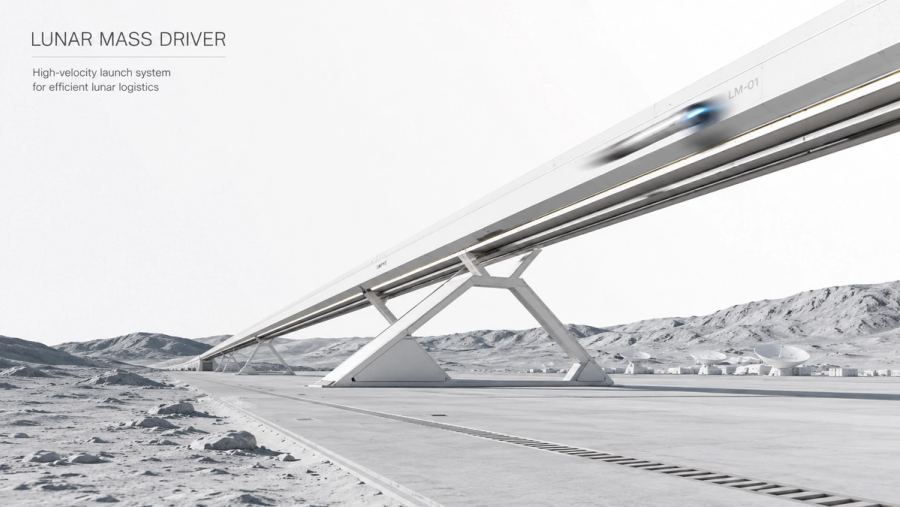
The Moon’s gravity is about one-sixth of Earth’s, and it has no atmosphere to fight against. These two facts, combined, make it a near-perfect environment for a mass driver. On Earth, such a device would need to be impossibly long to accelerate a useful payload to escape velocityMechane definition: The minimum speed an object needs to break free of a body's gravity and never fall back — much lower on the Moon than on Earth. Link opens the full glossary entry. while keeping the acceleration forces survivable. On the Moon, the maths work out much more favorably.
Think of it as a very long, very fancy airport runway for cargo that doesn’t need a plane. The electromagnetic track accelerates the payload over its length, building up speed gradually, and at the end of the track the payload is moving fast enough to escape the Moon’s gravitational grip and head into orbit or deeper into space. No fuel required for the launch itself. Just electricity, which the Moon gets in abundance from solar panels.
The potential cost reduction per kilogram launched is dramatic. What currently costs thousands of dollars per pound from Earth could, eventually, cost a tiny fraction of that from a lunar mass driver. When you are trying to build things in space at industrial scale, that cost difference changes everything about what becomes economically viable.
When the Pieces Come Together
What makes this moment so genuinely exciting is that we are not watching a single development unfold in isolation. We are watching multiple threads converge simultaneously, and the convergence itself produces an outcome that is greater than the sum of its parts.
Commercial launch costs falling dramatically. Reusable rocketsMechane definition: Launch vehicles designed to land, be refurbished, and fly again, rather than being discarded after a single use — the main reason launch costs have fallen sharply. Link opens the full glossary entry. making access to orbit routine. Food growing in lunar soil. Water ice mapped in permanent shadow near the lunar poles. The geopolitical pressure of a new Moon race creating urgency in government programs. Private visionaries betting enormous resources on an off-world future.
Any one of these developments on its own would be noteworthy. Together, they add up to something closer to a phase transition: the moment when living and working beyond Earth shifts from an occasional heroic achievement to a sustained, growing, economically rational activity.
We have seen this kind of convergence before. The internet became transformative not because of any single technology but because several technologies reached maturity at the same time and enabled each other. The personal computer, the modem, the web browser, the mobile network: each individually useful, together civilization-changing. Space is approaching its own version of that moment.
Disclaimer: This article is intended for informational and inspirational purposes only. It reflects publicly available information and the opinions of the author. Nothing contained herein should be interpreted as a recommendation to take any particular action. Space exploration involves significant technical, financial, and timeline uncertainty.