
A beetle, a bottle, and a small catastrophe
There is a beetle in the Australian outback that keeps trying to have sex with beer bottles, and it very nearly wiped out the whole species.
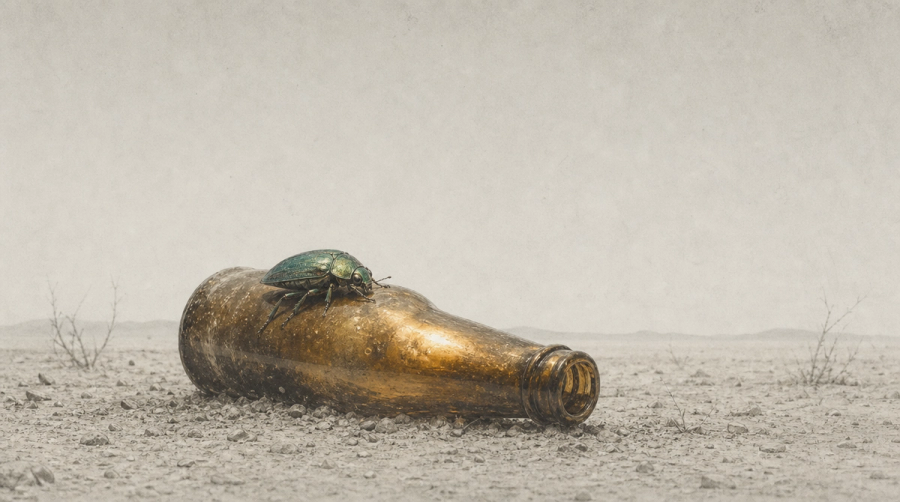
The male jewel beetle is dimpled, glossy, and a warm shade of brown. So, as luck would have it, is a certain kind of discarded beer bottle, the sort men use to toss into the desert after a hot afternoon. To a male beetle, "female" meant a rough recipe and nothing more. Dimpled, glossy, brown, and the bigger, the better. The bottle matches the recipe and then improves on itMechane definition: An exaggerated version of a natural cue that triggers a stronger response than the real thing it imitates. Link opens the full glossary entry., so the males clamber all over the glass, ignoring the actual females a few feet away, until the sun cooks them or the ants haul them off. For a while, the jewel beetle came close to going extinct over a lager.
Here is the part that should give you pause. The beetle isn't malfunctioning. It's doing precisely what it was built to do. Evolution never taught it what a female actually is. It handed the beetle a shortcut that worked beautifully for tens of thousands of years, right up until a brewery quietly changed the terms. The beetle had never been seeing the world. It had only ever been reading a cheat sheet and calling that reading the world.
Donald Hoffman, a cognitive scientist who has spent thirty years on this question, would like you to consider the possibility that you are the beetle.
Your eyes were built for one job
Most of us walk around assuming our senses are a clean window onto what's out thereMechane definition: The assumption that objects have definite properties whether or not anyone observes them — that the moon is up there even when no one glances at it. Quantum experiments make this harder to defend. Link opens the full glossary entry.. Light comes in, the world lands on the glass, and apart from the odd optical illusion, we see things roughly as they are. The logic feels airtight. An animal that sees the world accurately should survive better than one that hallucinates, so evolution ought to have ground our senses into sharp little truth-telling instruments over the millennia.
Hoffman and his colleagues decided to actually run the numbers on that assumption, using the mathematics biologists built to model natural selection. They expected to find that we see reality some of the time. What they found instead was a flat zero. Work through the equations and the probability that any creature was ever shaped by evolution to perceive reality as it truly is comes out to essentially nothing. Every single time, fitness beats truthMechane definition: A result from evolutionary game theory showing that organisms tuned to survival payoffs almost always outcompete those tuned to perceive reality accurately. Link opens the full glossary entry..
A creature tuned to whatever keeps it fed and safe and reproducingMechane definition: In evolutionary game theory, the survival-and-reproduction value of an action, which depends on the organism, its state and its context rather than on the true state of the world. Link opens the full glossary entry. will always outbreed a creature tuned to accuracy, because seeing the whole truth is slow and expensive, and a good cheat sheet is fast and cheap.
The beetle's recipe won for a hundred thousand years. Accuracy would have been a luxury it couldn't afford.
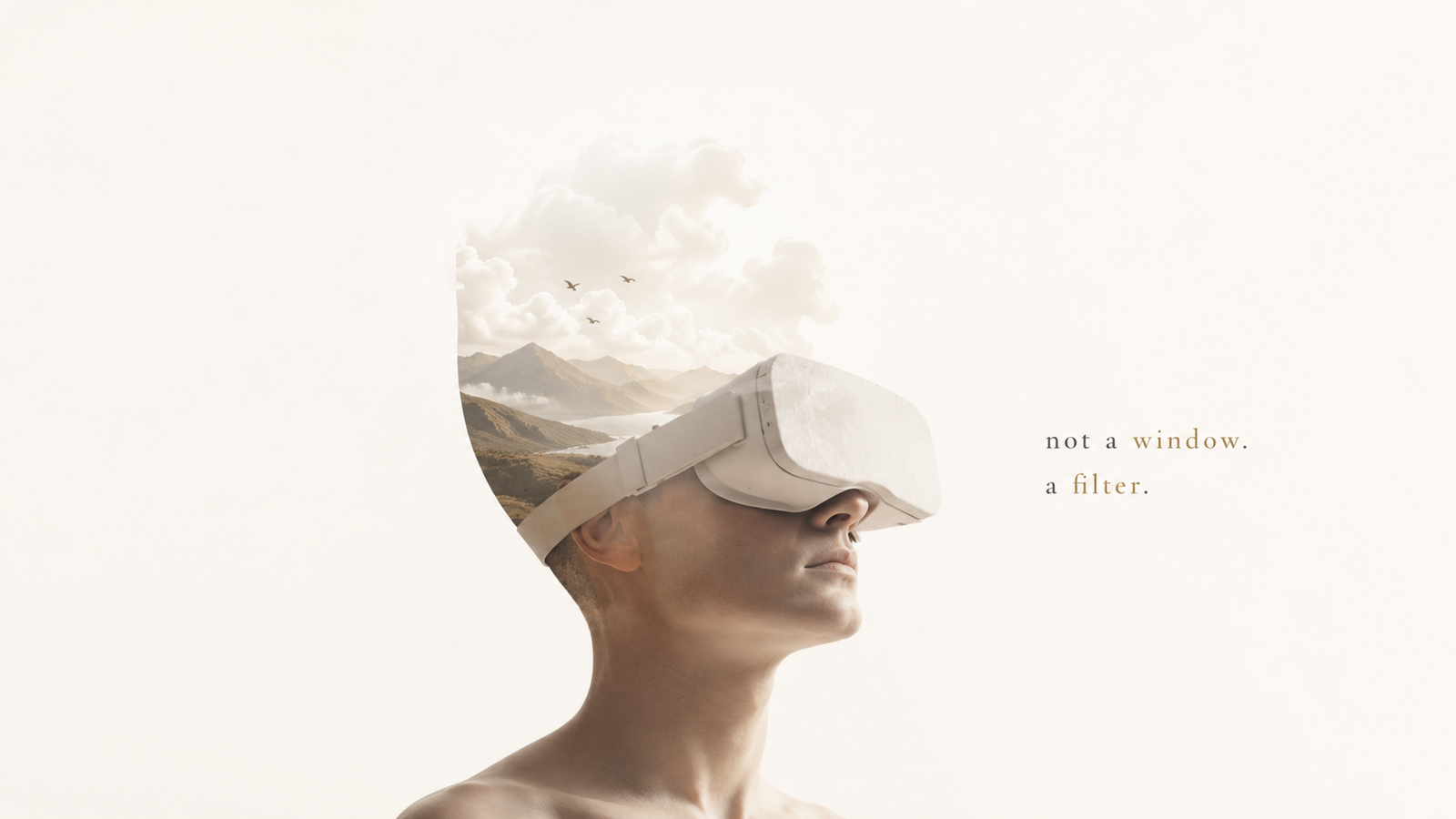
So evolution skipped the window entirely and handed you a headset insteadMechane definition: Donald Hoffman's proposal that perception works like a computer desktop: the icons you see are useful symbols, not pictures of the underlying reality. Link opens the full glossary entry.. A pair of goggles engineered for exactly one game, whose only winning move is having children. Everything you see through them, the red of an apple, the hard edge of a table, is the headset doing its job. A simple, survivable cartoon standing in for something you have never once glimpsed directly.
Because here is what the beetle can never do, and you just did. The beetle will never stop mid-embrace, look down at the bottle, and think, hold on, what is this thing, really? You have that move. You are the one animal that caught the trick in the act. And the instant you accept that the world you see is the budget version, a marvelous question walks in on its own. If all of this, a rainy street, light pouring through a curtain, is only the cartoon, then what in the world is the real thing?
The world that isn't there until you look
Hoffman goes somewhere most scientists won't follow, and this is where we sail off the edge of the map. He suspects that space and time themselves are stitched into the headset. We treat them as the stage every event plays out on. He thinks they belong to the performance.
Picture a video game. When you play, the world seems to sprawl in every direction around your character. But the machine isn't drawing all of it. It only renders the slice you're actually looking at. Swing the camera to the right and a street springs into being. Swing it back and the first view dissolves the moment it leaves the frame, because a world nobody is watching is just wasted electricity. That red car you passed a moment ago isn't idling patiently in the dark waiting for you. There is no dark, and no car. It gets painted into existence the instant your gaze arrives, and wiped the instant your gaze moves on.
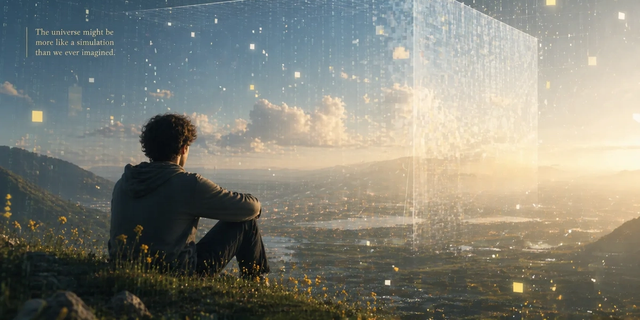
Hoffman's bet is that reality runs on the same principleMechane definition: The argument, formalised by Nick Bostrom, that if advanced civilisations can run realistic simulations of conscious minds, then most conscious minds are probably inside one rather than in base reality. Link opens the full glossary entry.. Rather than sitting out there finished and furnished, waiting for you to walk in, the world gets conjured on the fly, rendered at the precise moment your attention lands on it, and space and time are simply the filing system the headset uses to keep the rendering tidy. Under this view, asking what the universe looks like when nobody at all is perceiving it becomes a bit like asking what a video game looks like with the console switched off. The question quietly dissolves. There is nothing to see, because the seeing was the whole event.
The one thing that can't be a picture
Strip away space, strip away time, dissolve the car and the street and the cliff into things the headset merely shows you, and one thing stubbornly refuses to dissolve. The one it is being shown to.
You can render a car. You can paint a street, a whole sky. But rendering means displaying something for someone, and the someone can't be paintedMechane definition: The puzzle of why physical processes in the brain give rise to any inner experience at all, rather than proceeding in the dark with no one home. Link opens the full glossary entry., because a painting with nobody to see it isn't a painting at all. Every object in your experience can be demoted to a picture. The fact that the pictures are appearing to you cannot. Consciousness is the one thing in the whole account that can never be an image, for the plain reason that images need a viewer.
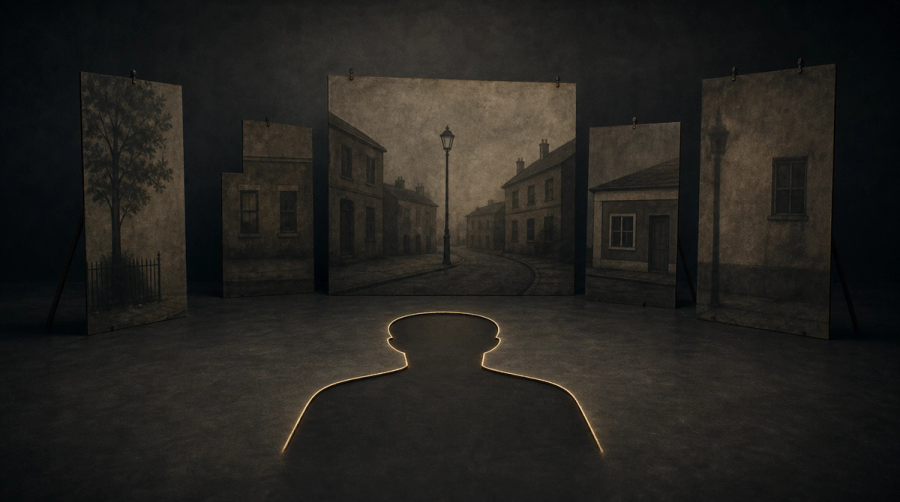
So Hoffman turns the oldest assumption in the room upside down. For a century the story has run one way. Dead matter came first, and after a few billion years of luck, it somehow learned the trick of waking up and having experiences. He bets the arrow points the other direction. Consciousness is the ground floorMechane definition: Donald Hoffman's proposal that consciousness is the fundamental reality, and that the physical world of space, time and matter is something consciousness renders rather than something that produces it. Link opens the full glossary entry., and the physical world is the story it tells itself, rendered in a format simple enough to survive on.
I can't prove any of that to you, and I won't insult you by pretending otherwise. Nobody can, not yet. But sit for a second with what it would mean if it were true. Every machine we have ever dreamed of building to reach the "real reality," the flawless simulation, the brain implant that pipes raw truth into your skull, keeps the fix outside you, off in some laboratory, in some decade that keeps not arriving. If Hoffman is right, the only instrument capable of glimpsing past the headset is the one you are holding this very thought with. It's already yours. It always has been.
We tend to file those afternoons under "got lucky" and forget them before dinner. Look again with the headset in mind. The wall was rendered. The one who dissolved it was not. The limit you slammed into wasn't a hard fact about the world. It was a picture your goggles were painting, and it rearranged itself the moment your consciousness leaned on it from a fresh angle. You didn't discover something about the problem that day. You discovered something about the size of the thing doing the looking. The headset doesn't only shrink the world down. It shrinks your estimate of whoever is wearing it.
Where I get off the ride
I'll tell you where I climb off, because a story with no brakes isn't worth trusting.
Hoffman likes to say that when he looks at an ant, the real thing hiding behind that ant might be so vast, so far beyond him, that if he could perceive it directly, he would fall to his knees, speechless. The headset, he says, is compressing something god-sized down into a crawling speck. And this is where I get quietly, cheerfully stubborn. I'll go with him past space and time. I'll entertain consciousness as the bedrock under everything. But I can't quite bring myself to believe the ant on my windowsill is a folded-up cosmos in disguise. Some things, I suspect, are pretty close to what they appear to be. A little more, sure. Not infinitely more.
That hesitation earns its keep, and I would hold onto it even if someone talked me halfway out of it. The moment every pebble and bottle cap turns secretly cosmic, wonder sours into exactly the thing your instincts should distrust, the guru weighing out significance by the kilo. You can hold the door open without genuflecting to every insect that wanders through it. Curious, and not credulous. You're allowed to be both, and it happens to be the only honest place to stand.
The beetle that stood up
Which leaves us more or less where we found the beetle. Crawling over the warm brown glass, thoroughly convinced we've found the entire world. With one difference, and it is the only difference that has ever counted for anything. We are the beetle that stopped, looked down at the bottle, and thought, wait.
That single thought is the hairline crack in the headset. It won't hand you the real thing. But it's the first solid evidence that there is a real thing to be had, and a quiet hint that the eyes made to see it might already be yours.
A note in the spirit of the piece: this article is a thought experiment written for wonder and pleasure, not a settled scientific claim. Hoffman's ideas are serious and hotly debated, and plenty of clever people think he's wrong. Take the voyage for what it is, an invitation to look at your ordinary Tuesday with fresh astonishment, and hold the wilder turns as lightly as you like.