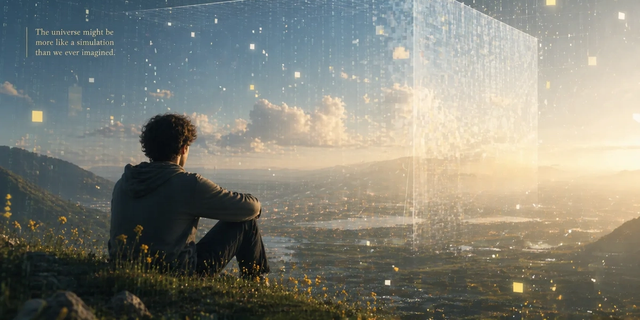
Realism is the belief that things exist in a definite state independent of observation. The chair in the empty room is still a chair. A particle has a real position and a real speed whether or not anyone measures them. The world is already there, fully specified, and looking at it merely reveals what was true all along.
Quantum mechanics complicates this. Before measurement, a particle doesn't appear to have a single definite state that observation uncovers — it exists as a spread of possibilities, and the act of measuring is what forces one outcome into being. The property isn't read off; it's resolved.
Paired with locality, realism is one of the two assumptions the Nobel-winning experiments ruled out. The universe cannot be both locally causal and definite-before-measurement. At least one must give, and the experiments suggest both do. This is what "not locally real" actually names.
The human discomfort here is real and worth sitting with. Realism is close to a synonym for common sense — the conviction that the world doesn't depend on you to exist. Quantum physics doesn't say the moon vanishes when unobserved. It says that at the finest grain, definiteness and observation are tangled together in a way our intuitions never prepared us for.