The Singularity refers to a hypothetical future event: the point at which artificial intelligence becomes sufficiently advanced to improve itself recursively, producing ever-smarter systems at an ever-faster pace until the rate of change outstrips anything human minds can follow. The concept, popularised by the futurist and inventor Ray Kurzweil, borrows the term from physics, where a singularity describes a point at which the normal rules break down — like the centre of a black hole, where the equations stop making sense. In AI discourse, the singularity is the moment the future becomes, in principle, unreadable from the present.
The appeal of the idea is partly its dramatic clarity. It offers a clean story: AI gets good, then better, then impossibly better, and then everything changes at once. Versions of this story animate both the most optimistic visions of the future — an intelligence explosion that solves every human problem — and the most alarming ones, in which a sufficiently intelligent system concludes that humans are an obstacle and acts accordingly. Both camps share the singularity's core premise: that there exists a threshold beyond which all bets are off.
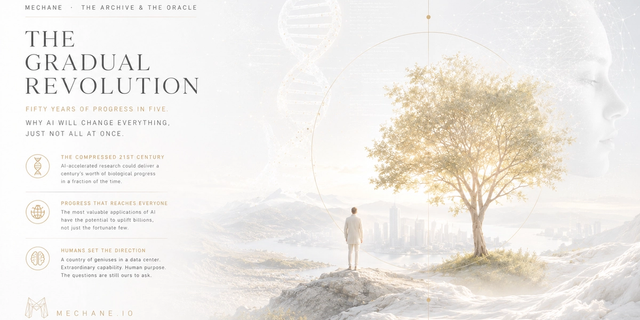
Critics of the singularity thesis point to a persistent gap between the theory and how technological transitions have actually unfolded in history. Transformative technologies — electricity, the internet, antibiotics — did not arrive as overnight events. They spread unevenly, over years and decades, through infrastructure constraints, regulatory delays, economic friction, and the simple stubbornness of human habit. The tools being developed today are genuinely powerful, but power and deployment are not the same thing, and deployment and impact are not the same thing either. The singularity assumes that capability translates instantly into consequence, and that assumption has rarely held for any technology that came before.
For readers encountering AI coverage, the singularity functions less as a precise prediction and more as a rhetorical mood — a way of signalling that things are different this time, that normal reasoning doesn't apply. That mood can be deployed in service of excitement or fear, but either way it tends to short-circuit careful thinking. Understanding where the concept comes from, and what it actually claims, makes it easier to assess when someone is using it as an argument and when they are simply using it as an atmosphere.