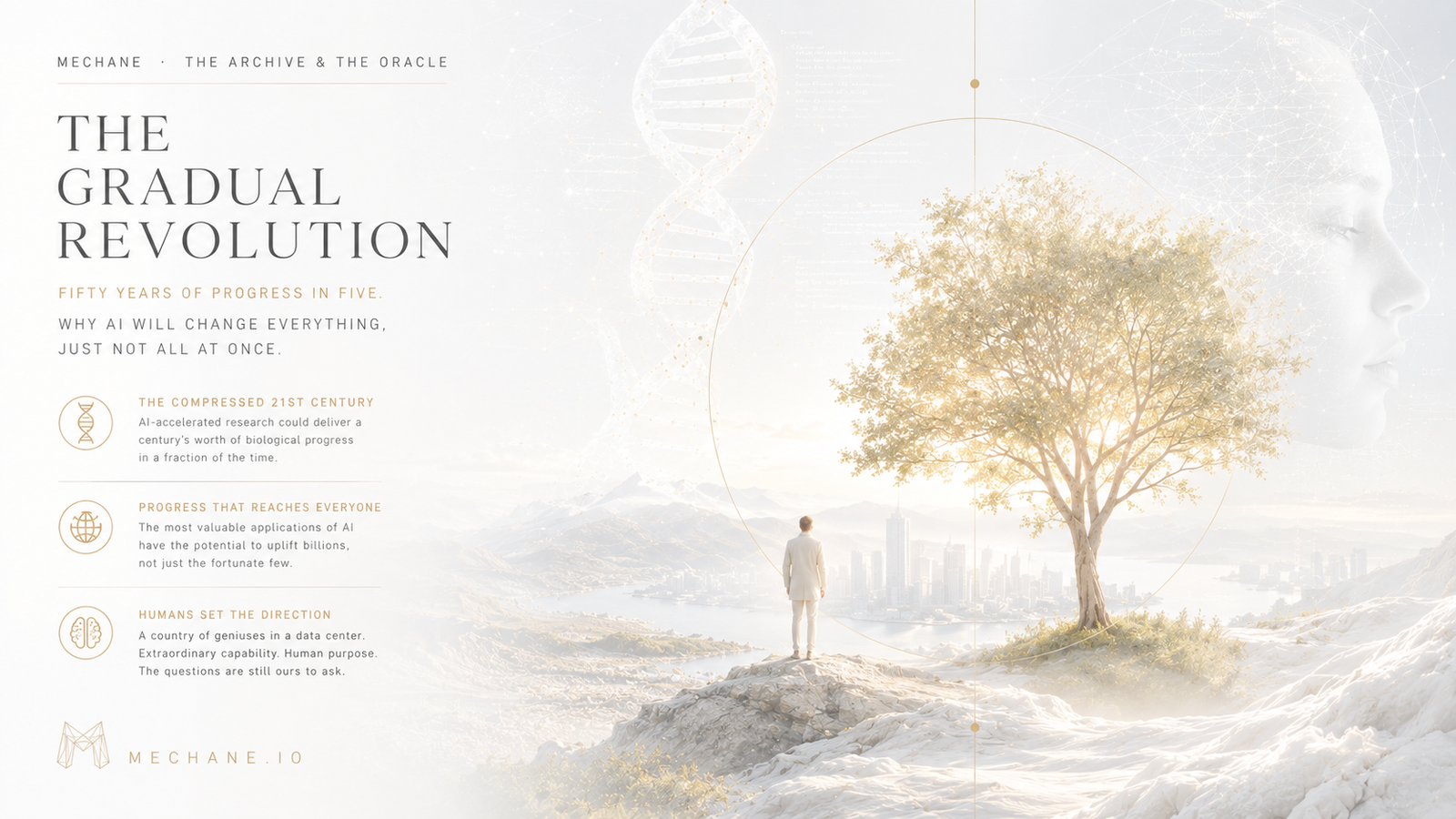

There are two ways to be wrong about artificial intelligence, and both have large, enthusiastic followings.
Getting It Wrong, Twice
The first way is to be afraid. Not quietly, thoughtfully afraid. Spectacularly, cinematically afraid. The robots are coming. Jobs will evaporate overnight. Some sufficiently intelligent system will conclude that humans are inefficient and act accordingly. Fear, in this camp, is presented as the only lucid response to what’s being built.
The second way is to be dazzled. AI cures cancer by Tuesday. The singularity arrives on schedule, flips a switch, and the world becomes unrecognizable before the year is out. Breathless optimism, in this other camp, is the only appropriate reaction.
Both camps share a curious quality: neither one is particularly interested in thinking carefully about what’s actually happening. Fear and euphoria are, in their own ways, forms of intellectual laziness. They save you the trouble of asking harder questions.
Dario Amodei, the founder and CEO of Anthropic, published an essay called “Machines of Loving Grace” that attempts something genuinely unusual: a detailed, concrete, sober sketch of what a good AI future might actually look like. [1] He acknowledges the risks. He built a company dedicated to managing them. But he also argues, carefully and with some specificity, that most people are dramatically underestimating what’s possible if things go right.
This article is a reading of that essay, filtered through a particular lens: the conviction that the most useful thing anyone can do with a big, complicated idea is to explain it honestly, without agenda, and without pretending the future is more certain than it is. That’s what Mechane is here for.
A Thousand Researchers Who Never Sleep
To get a handle on what powerful AI might actually do, it helps to think clearly about what it is.
Amodei describes the most capable AI systems coming in the next few years as, essentially, a country of geniuses in a data center. Millions of simultaneous instances of a system smarter than any individual human, each capable of running independently on different tasks, or collaborating in the way that teams of people collaborate, but at speeds and scales no human institution can match.
The image is striking. But for our purposes, what matters most is something it leaves implicit. This country of geniuses doesn’t arrive with its own agenda. It doesn’t wake up with a project in mind. It works because someone asks it a question, sets it a task, or points it at a problem. That someone is still you.
Think of it less like a superintelligence arriving to take over, and more like suddenly having access to a research staff the size of a city, available at any hour, capable of reading everything ever written on a given topic before breakfast, and willing to run down a hundred dead ends patiently before finding the one that works. The intelligence is vast. The direction still comes from a human.
This distinction is the thing the fear camp and the enthusiasm camp both tend to miss. The tools being built aren’t autonomous agents pursuing independent ends. They’re extraordinarily capable instruments.
The difference between a scalpel and a power drill is real and important, but neither one decides what to operate on. The human holding it does.
What changes is the ceiling on what becomes achievable. And that ceiling, Amodei argues, is much higher than almost anyone is currently willing to imagine.
The Compressed 21st Century
The part of Amodei’s essay that stays with you is his treatment of biology and medicine. He makes a claim that sounds extravagant on first contact and becomes more plausible the longer you sit with it.
His argument is that AI-enabled biological research could compress roughly 50 to 100 years of medical progress into 5 to 10 years. He gives this a name: the compressed 21st centuryMechane definition: Dario Amodei's term for the hypothesis that AI could compress 50–100 years of medical progress into a single decade by accelerating the pace of biological discovery. Link opens the full glossary entry..
Consider what the 20th century achieved. Vaccines for diseases that had killed people for millennia. Antibiotics that turned previously fatal infections into inconveniences. The mapping of the entire human genome. Treatments for conditions once considered untreatable. Life expectancy in much of the world roughly doubled over the course of a century.
Now consider what remains undone. Most cancers are still inadequately treated. Alzheimer’s is still poorly understood at a mechanistic level. Aging itself remains essentially untreated, regarded as inevitable rather than as a biological process that might be slowed or modified. If the 20th century was a century of extraordinary progress, the 21st was going to continue that work, slowly, year by year, funding cycle by funding cycle, clinical trial by clinical trial.
The compression idea asks: what if we didn’t have to wait that long?
Amodei is careful here. He isn’t claiming AI performs magic. Biology has hard physical limits. Cells grow at the pace they grow. Some experiments simply take the time they take, and no amount of intelligence can override that. But a surprising fraction of the most important biological discoveries in history, he points out, were made by a very small number of unusually creative researchers, and many of those discoveries could have been made years or even decades earlier.
If the rate of those foundational discoveries could be meaningfully accelerated, the downstream effects are staggering. The drugs we’d develop. The conditions we’d learn to treat. The years of healthy life that might become available to people who currently wouldn’t expect them.
Why Tomorrow Won’t Wake Up Different
The singularityMechane definition: The theoretical moment when AI becomes so capable that technological change accelerates beyond human comprehension — and the world as we know it ends overnight. Link opens the full glossary entry., as it’s usually imagined, is an event horizon: a moment at which AI becomes so capable that change accelerates beyond human comprehension, and the world becomes unrecognizable overnight. It’s a compelling story. It’s also, in the considered view here, not how things actually work.
Large technological transitions don’t happen overnight. They happen across years and decades, unevenly, with unexpected bottlenecks and surprising resistances. Electricity existed as a working technology for decades before most households had it. The internet was available to researchers in the 1970s. Antibiotics took years to reach broad deployment even after their discovery, and their impact on mortality played out over a generation.
A technology being ready is not the same as a technology being deployed, and deployment is not the same as impact.
Physical experiments take the time they take. Regulatory systems move at the pace regulatory systems move, for better and for worse. Human habits and institutions don’t update on the schedule of software releases. All of this creates friction on the speed of change.
The honest answer to “when will AI change everything?” is: it already has started, it will continue for decades, and many of the most important changes will be ones nobody clearly predicted in advance.
Progress That Reaches Everyone
There’s a section of Amodei’s essay that gets less attention than it deserves. It’s his argument about global poverty and economic development, and it may be the most important thing he writes.
The history of major technological advances is not, broadly speaking, a history of benefits flowing equally to everyone. The people who benefit first from new medical treatments, new infrastructure, or new productive tools are generally the people who already have reliable access to the systems that distribute them.
The gap between a well-resourced country and a poorly-resourced one doesn’t automatically close when a new technology appears. Often it widens first.
AI has the potential to be genuinely different here.
The most valuable things that AI can accelerate include disease diagnosis and treatment, agricultural science, educational access, and the ability to give practical legal and financial guidance to people who have never had access to it.
That’s a structurally different situation from building railways or training surgeons. The marginal cost of extending a capable AI tool to one more person approaches zero. That doesn’t guarantee equal access, because distribution always has its own economics, politics, and infrastructure challenges. But the ceiling on how widely progress could spread is higher than it has been for any previous technological wave in history.
If this plays out even partially, AI’s most consequential contribution to the 21st century might not be what it does in the world’s best-equipped research labs. It might be what it does for the two billion people who currently lack reliable access to the things those labs eventually produce.
The Honest Caveat
Amodei ends his essay by noting that none of this is guaranteed. The good future he describes depends on getting the risks right, keeping AI alignedMechane definition: The problem of ensuring an AI system reliably pursues what its designers actually intended — not a subtly different goal that looks similar until it doesn’t. Link opens the full glossary entry. with human values, and making deliberate choices rather than sleepwalking into something nobody intended.
Mechane’s view is not that the risks are imaginary. They’re real. But fear, on its own, is not a plan. It points to what could go wrong without giving you any traction on what to work toward.
The compressed 21st century is worth trying to get right. The democratisation of knowledge and capability is worth building carefully.
Progress that reaches everyone, not just the fortunate, is worth designing for explicitly rather than hoping it happens by accident.
Humans are still the ones asking the questions. The country of geniuses in the data center is waiting to be directed.
This article is intended for informational and educational purposes. The views expressed draw on publicly available research and on the arguments made in the referenced essay. Predictions about AI development timelines and capabilities involve significant uncertainty. Nothing here should be read as a definitive forecast of how AI will develop or what it will achieve.