
Something remarkable is unfolding right now. Not the kind of remarkable that fills a Monday morning news feed and is forgotten by Tuesday, but the slow, ground-shifting kind that only becomes obvious when you look back from a few decades away. We are alive at the precise moment when the tools humanity has dreamed about for centuries are arriving all at once. Want to build a company from scratch? Describe your idea to an AI and watch it write the software. Need a medical opinion at two in the morning? An AI can review your test results before your doctor has finished breakfast. Curious about how black holes form? Ask, and receive an explanation better than most textbooks can offer.
For the first time in human history, the most powerful problem-solving tools on the planet are available to anyone with a phone. And here is the part that should really make your jaw drop: there are now more phones on the planet than there are people.
The Great Split Is Already Happening
Powerful technology does not just change what people can do. It changes what they choose to do. And a growing wave of scientists, entrepreneurs, and researchers who study these shifts believe we are heading for a remarkable fork in the road of human civilisation.
On one side of that fork: people who use AI as an extraordinary comfort blanket. They will enjoy personalised entertainment, food and goods delivered by robots, and leisure experiences so immersive that reality itself will need to rebrand. Comfort is a reasonable human preference, and the technology is being designed to make this life genuinely wonderful.
On the other side: people who pick up these same tools and run with them. People who use AI to build companies, cure diseases, create art, explore space, and push human civilisation into territory it has never visited before. These are the people who will build the real-life equivalent of Star Trek.
The Skeptics Are Right About the Wrong Things
Spend ten minutes in the comment section of any YouTube video about AI and abundanceMechane definition: The idea that technology progressively drives the cost of once-scarce things toward zero, turning what used to be rationed by price into something widely available — with AI as the current accelerant. Link opens the full glossary entry., and a familiar pattern emerges. The tone is weary, suspicious, and more than a little angry. “Easy for a billionaire to say.” “Where is my flying car from 1964?” “This is just the wealthy talking to the wealthy while the rest of us figure out rent.”
These concerns are not trivial. They come from real places: jobs that disappear without warning, wages that have not kept pace with the cost of living, and a long history of technological disruption that has sometimes left ordinary people holding the tab while investors pocket the gains. The frustration is legitimate. The anger is completely understandable.
But here is where the sceptics, in their entirely reasonable suspicion, miss the wider picture. They are making predictions about the future based almost entirely on patterns from the past, at the exact moment when the past has very little left to teach us.
“The scribes who copied manuscripts by hand viewed the printing press as a threat to their craft. They were right. What they could not see was the explosion of literacy, science, and storytelling that followed.”
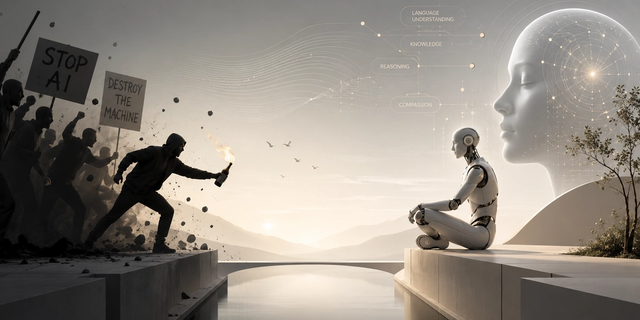
The LudditesMechane definition: The mistaken belief that because a new technology destroys particular jobs, it must reduce the total amount of work available — confusing the loss of specific roles with permanent net loss. Link opens the full glossary entry. who smashed weaving machines in early 19th-century England were not foolish people. They were skilled workers who could see their livelihoods disappearing and could not yet see the world that would grow on the other side of the disruption. Their anger made perfect sense. Their conclusion, however, that the machines should be stopped, was wrong. Not because machines are always good, but because the direction of history was simply too strong.
The pattern has repeated itself at every major technological turning point. People feared electricity, automobiles, the telephone, antibiotics, and the internet. Each time, the fear was understandable. Each time, the world that arrived on the far side was vastly better for more people than the world that came before.
History’s doubters were not unintelligent. They simply could not imagine what they had never seen before. That is a very human limitation, and it is not a character flaw. But it is worth recognising in the current moment, when the people who see a catastrophe coming are looking at a present-day snapshot and trying to use it to predict a future that will be almost unrecognisably different.
The End of the Career Ladder
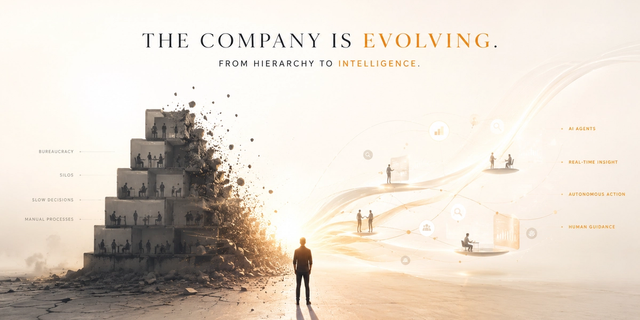
Here is one shift that genuinely deserves some acknowledgement: the traditional career path, as most people understood it, is dissolving. Go to school, get a degree, join a company, rise through the ranks, collect a pension. That model worked well for generations. It provided stability and a sense of direction. But it is becoming the exception rather than the rule, and no amount of wishing will reverse the trend.
The good news is that something more interesting is taking its place. With AI acting as a co-founder, researcher, coder, marketer, and strategist all rolled into one, building a business from scratch has never required less capital or prior expertise. A person with a clear idea and a genuine understanding of the problem they want to solve now has more firepower at their disposal than a fully staffed startup had just ten years ago.
A simple thought experiment: You have an idea for a business. Ten years ago, you needed funding, a technical co-founder, a marketing team, and probably several years of runway. Today, you can describe the idea to an AI, have it build a prototype, draft the pitch, and identify your first customers. The gate that used to require a village now opens with a key that fits in your pocket.
The shift is not small. The primary unit of economic life is gradually moving from “employee at a company” to “person with an idea and the tools to execute it.” The transition will be bumpy, and the discomfort is real. But the destination is worth picturing: a world where your economic future is shaped by your curiosity and your creativity rather than by who happens to be hiring in your postcode.
The Bumpy Years Are Real. So Is What Comes After.
Let us be honest about something. The next few years are going to be uncomfortable for a lot of people. Jobs that existed last year will not exist next year.Mechane definition: The theory that technology permanently destroys more jobs than it creates — a prediction made confidently before every major technological wave, and wrong every time so far. Link opens the full glossary entry. Industries that seemed permanent are being reshaped by software that becomes more capable every few months. This will cause real hardship for real people, and anyone who waves that away with a breezy “but technology always works out” is not taking the situation seriously enough.
That said, uncomfortable transitions are not new. The industrial revolution caused enormous disruption before it lifted living standards across the world. The internet eliminated entire categories of employment before creating far more than it destroyedMechane definition: The mistaken belief that there is a fixed amount of work in an economy — so if a machine does more of it, humans must do less. Link opens the full glossary entry.. The pattern is historically consistent: short-term pain followed by long-term gains that were unimaginable at the start of the disruption.
The difference this time is the speed. The gap between disruption and recovery is likely to be shorter than it was during the industrial era, not longer. AI tools are becoming available faster, more cheaply, and more broadly than any technology in history. The rough patch is probably two to eight years. What emerges on the far side of it, according to researchers across fields ranging from medicine to energy to education, is something we genuinely cannot picture from where we are standing now.
Medicine designed specifically for your biology, not just your diagnosis. Energy so abundant and cheap that fuel poverty stops being a meaningful concept. The aging process not just slowed but potentially reversedMechane definition: The point at which medical progress adds more than a year of life expectancy for each year lived — after which ageing stops being the thing that ends you. Link opens the full glossary entry. through breakthroughs in genetic science that are already in human trials. Companies built by individuals in days rather than years. Educational tools that adapt to each learner as a unique human being rather than a seat in a classroom. Problems that stumped humanity for centuries, solved in years because AI can process data at a scale no team of researchers ever could.
An Homage
This is for the builders and the believers. For every person who looked at a blank horizon and decided to sail into it anyway. For Columbus, who trusted his calculations over the fear of falling off the edge. For Darwin, who published his ideas knowing they would upset centuries of comfortable certainty. For Edison, who failed spectacularly and repeatedly and considered each failure a lesson worth paying for.
For the Wright brothers, who were laughed at by serious engineers right up to the moment their plane lifted off the ground. For Alan Turing, who imagined a thinking machine at a time when the concept sounded more like poetry than science. For Tim Berners-Lee, who gave the World Wide Web away for free because he understood that an open network was more powerful than a controlled one.
Not one of them waited for universal permission. Not one of them let collective doubt be the final word. They saw what was possible, decided it was worth pursuing, and pulled the future forward through sheer curiosity and a refusal to accept the world as a fixed object.
The sceptics of every era were not stupid. They were simply looking at the present and trying to use it as a map for a territory that did not yet exist. Progress has never been charted by people who demanded to see the full map before they moved. It has always been led by people who drew the map as they walked.
AI is the next great walk. The people who lace up their boots and step into it will shape the centuries that follow. And when that time arrives, and the world looks back at this precise moment, the builders and the believers will be the ones history remembers.
The couch will always be comfortable. The future, however, belongs to whoever decides to stand up.
Disclaimer: This article is intended for general informational and editorial purposes only. The views expressed represent an editorial perspective on broad technological and societal trends. Statements about future developments in medicine, AI capabilities, or scientific breakthroughs are speculative and reflect publicly discussed possibilities rather than guaranteed outcomes. Readers are encouraged to consult relevant professionals before making decisions based on any of the topics discussed.