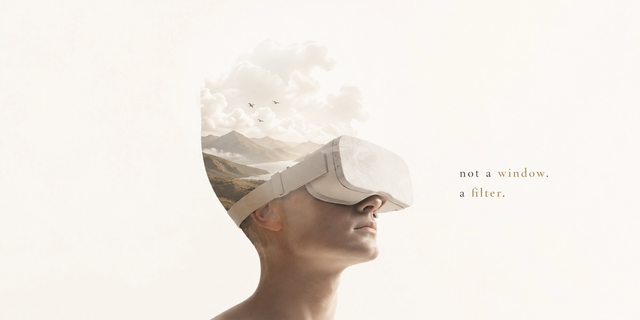
For most of modern science the order has been settled. Matter came first, and after billions of years it arranged itself into brains, and brains somehow produced consciousness. Conscious realism turns that arrow around. It proposes that consciousness is the ground floor, the thing that was there first, and that space, time and physical objects are how consciousness represents itself to itself. Matter does not produce mind on this view. Mind renders matter.
The move is not mysticism for its own sake. It comes from a corner the interface theory paints you into. If every object you perceive is an icon rather than the reality beneath, then matter itself, examined closely, dissolves into one more thing that appears to a perceiver. The one item that cannot be dissolved into an appearance is the perceiver, because an appearance with nobody to appear to is not an appearance at all. Consciousness is the one thing that resists being demoted to a picture.
Hoffman goes further than the negative point and tries to build a positive theory, in which reality is a vast network of interacting "conscious agents", and space, time and matter emerge from their interactions the way a coastline emerges from countless smaller details. This is the most speculative part of his programme and the least tested. Even sympathetic readers tend to treat it as a research direction rather than an established account.
Conscious realism is best held the way this whole territory should be, seriously and loosely. It is a minority position among scientists and philosophers, and the burden of proof sits squarely on it. What makes it worth knowing is less the answer than the pressure it applies to the default story. The claim that matter obviously comes first is itself an assumption, and conscious realism is what it looks like to take the opposite assumption seriously.