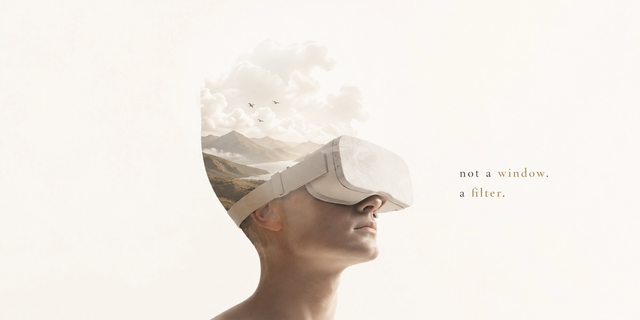
Think about the file icon on a computer desktop. It is a small blue rectangle in the corner of the screen, and nothing about it resembles the file it stands for, which is really a pattern of voltages spread across a chip. The icon is not lying to you. It is helping you by hiding a reality far too complex to act on directly. Hoffman's interface theory says your senses do exactly this. What you see is a desktop, and the objects in it are icons.
On this view, space and time are the desktop itself, and physical objects are icons arranged on it. The point of the interface is not to show you the truth of what lies beneath. It is to let you act well enough to survive without ever needing that truth. An icon you can drag, open and delete is more useful than a schematic of the transistors, and evolution, Hoffman argues, cares only about the usefulness.
The theory grows uncomfortable when you push it. If the objects of perception are icons, then the apple, the table and the mountain are not the world as it is but the format your senses render it in. This does not mean nothing is there. It means that what is there is related to what you see the way a file is related to its icon: reliably, functionally, and not at all pictorially.
Interface theory is a serious and contested idea, not a settled finding. It rests on the fitness-beats-truth result and pushes it further than many scientists will follow, especially when Hoffman extends it to consciousness. The desktop metaphor, though, has earned its keep on its own. It is the clearest available way to hold the strange thought that perception can be extraordinarily useful and not remotely a copy of the world.