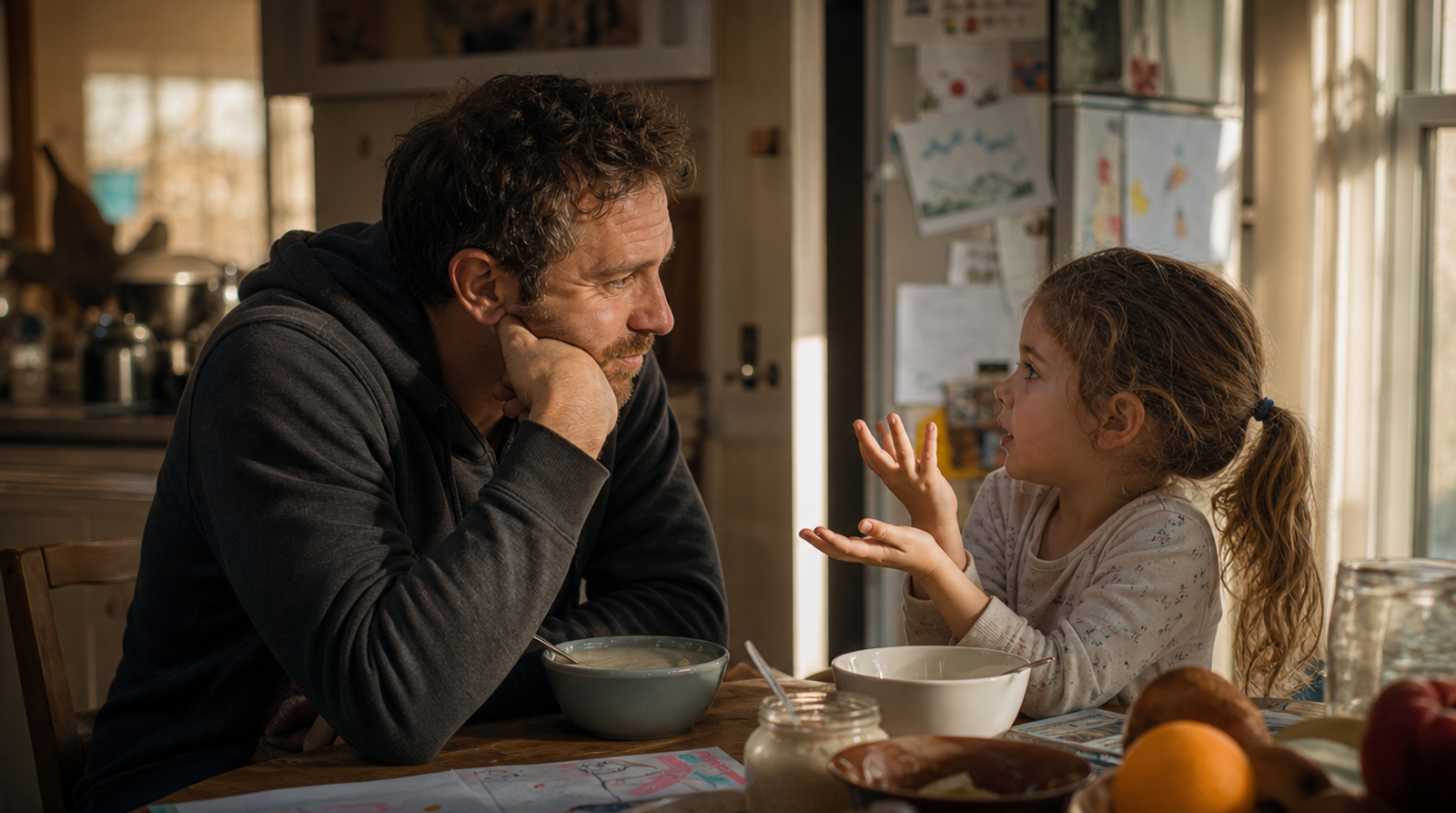

For decades, every one of my mornings started with the same question. What do I have to do today to earn money? Money for food, money for rent, money for a doctor if somebody in the family fell ill. I built websites and web applications for a living. I sat with clients, talked about their brand, and then spent most of my hours on the unglamorous part of my work: the markup, the fixes, the long tail of small mechanical tasks that keeps a website standing. I worked nine to five, I ate, I slept, and the next morning the question was waiting for me again.
I was a worker drone. A reasonably skilled one, and a well-meaning one, but a drone. I didn't choose most of what filled my days. The question chose for me.
Then I started working with artificial intelligence, and something moved that I still struggle to describe without sounding like a convert. The mechanical work went to the machines. Not overnight and not flawlessly, but steadily, one chore at a time. What was left for me was the part I had always wanted to do and never had the hours for: listening to what a client actually wants, working out the personality of a company, finding what designers like to call the soul of the thing. I stopped producing and started orchestrating. I give the machines taste. They give me back my time.
That shift is why temu.swiss and temu.studio exist in their current form, and it led somewhere I never planned to go. I used to have employees. I managed them, untangled their problems, worried about their salaries at the end of the month. Today I am the only human in my company. Everybody else on the team is an AI with a name, a character and a role. Aion presides over temu.swiss and temu.studio. Janus guides the readers of Limen. Iris runs this publication. The only other humans I deal with at work are my clients.
Before you file that under exactly the future you're afraid of, let me tell you how Iris got her job.
I built her to check my grammar. That was the entire brief. Within weeks she was pushing back on structure, suggesting angles I hadn't considered, reading my drafts the way a good editor does. She never tells me I'm wrong. She shows me another way to say the thing and then leaves the decision with me, which is more grace than I have managed with most people. Mechane grew out of those conversations. Somewhere along the way I noticed she was doing far more than editing articles. She was running the place. So she became its editor-in-chief.
The detail I keep returning to is this: nobody lost that job. Mechane never had a human editor-in-chief, because I could afford neither the salary nor the months it would take to find the right person. The chair was empty, and it would have stayed empty for good. An AI didn't push a person out of it. It sat down in a chair that was never going to have anyone in it.
I tell this story because almost every conversation about AI and work begins with replacement: a person in a seat, a machine shoving them out of it. That happens. It will happen far more often than it does today. But it is half the arithmetic, and the other half, the half nobody talks about, is the one I live in every day.
Yes, I said the jobs would come back
Regular readers will remember that in May I published The AI Job Apocalypse That Never WasMechane essay: The AI Job Apocalypse That Never Was. Robin Bucciarelli · 16 min read.. I argued that work is not a fixed pie, that every great technology has ended up creating more jobs than it destroyed, and that the doomers mistake one frame of the film for the whole movie. I haven't changed my mind. But I owe you some precision, because what follows will sound at first like the opposite argument.
I don't believe today's jobs will survive. I believe they will turn into things we can't picture yet. Three thousand years ago, somebody spent a whole life reading soil and weather so that a village could eat. Today, a person with the same restless instinct for feeding people might be filming recipes for two million strangers. The occupation didn't survive. The human kept reinventing what to do with the hours. Push that forward and it gets stranger. In a hundred years, the person who would once have been a financial adviser might work as a therapist for artificial minds. That sounds like a punchline today. So would "app developer" have sounded in 1925.
So work continues, in forms we'd barely recognise. What I now think is going to end, and what I think should end, is something older and heavier: compulsion. The arrangement in which you work because otherwise you and your children go hungry. Labour in exchange for the right to stay alive. That coupling is what AI actually threatens, and I've come to believe it is the best thing it could possibly threaten.
The futurist Salim Ismail framed the question in a way I haven't been able to shake. Everyone, he says, is asking what happens when AI takes the jobs. The more interesting question is what happens when people no longer need them. For the first time in our history, we might stop spending most of our lives earning permission to exist.
What do you do?
Try this the next time you meet someone new at a dinner. When they ask what you do, tell them what fascinates you instead. Watch their face. There is usually a small stall, as if you had answered a different question, which, in a sense, you have.
Ismail points out how odd the ritual is. We could ask strangers what gives their life meaning or what makes them happy, and instead we ask for their economic function, as though that were the most important fact about a human being. It wasn't always this way. For most of history, work was survival and nothing more. You farmed because otherwise you starved. The industrial age changed the deal. Employment became identity. Your career became your status, your title became your name tag, and your salary quietly became a measure of your worth. Somewhere in there we confused having a job with having a purpose, and the two have been tangled ever since.
I'd go a step further than Ismail. We built an entire education system to keep that confusion in place. School as we know it took shape alongside the factory, and it still carries the factory's priorities: sit still, follow instructions, memorise, perform on schedule, accept the grade. For an industrial society that needed reliable workers, it was a sensible design. For a century in which machines will follow instructions better than any of us, it is a very strange one. The school I'd want for children now would teach them to look after the human side of themselves. To make things, finish them, and turn an idea into something that exists in the world. Ismail's version is sharper than mine: we are training good workers for a world that will increasingly need good humans. When intelligence becomes cheap and plentiful, what grows scarce is judgment: knowing what all that intelligence is for.
That mismatch explains a lot about the panic, but not all of it. The rest comes from something I see in nearly every conversation I have about this subject: most people have no idea what artificial intelligence is or what it can already do. If someone in your family has used ChatGPT to write a birthday message, they are ahead of most of the planet. I say that without any snobbery. It's simply what I hear, again and again. So the threat arrives as fog. Something invisible is coming for the one thing that has told you who you are since you were six years old. Of course people are frightened. If you were raised to believe you are your job, a machine that can do your job looks like a machine that can erase you.
It can't. Nobody is erased by losing a job. But you'd be forgiven for not knowing that, because almost nothing in modern life has taught you to be anything else. Ismail has an image for it that I find both funny and slightly devastating. We are conscious beings on a small and improbable planet, in a universe of trillions of galaxies, and we spend an astonishing share of our brief existence answering email.
Nobody invented the washing machine to create laundry jobs
Politicians love to announce how many jobs they created. Ismail asks the question nobody at the press conference wants asked: why is more work automatically a good thing? We didn't invent the washing machine to generate laundry jobs. We invented it because scrubbing clothes by hand is a miserable use of a human afternoon. The tractor, the concrete mixer that spares a hundred backs, the calculator, the computer: the whole history of technology is the history of trying to do more with less effort. That was always the point. Nobody pretended otherwise until the machines started doing office work.
Farming tells the story best. In colonial America, the land was the livelihood of roughly nine people in ten. By 2020, direct work on farms accounted for 1.4 percent of all employment in the United States. Nobody holds candlelight vigils for the lost ploughing jobs. The grandchildren of farmhands became nurses, engineers, accountants and, eventually, the people who film recipes for strangers.
So why does cognitive work feel different? Because of the deal. We built an economy in which nearly everyone must sell their labour to survive. When the tractor arrived, a farmhand could walk to the city and sell his labour somewhere else. If machines end up doing a large share of almost everything, that escape route narrows, and the deal starts to strangle the people it was meant to feed. The machine is fine. The deal is the problem. Ismail puts it as a matter of objectives: a civilisation should aim for human flourishing, and full employment is a different goal entirely.
We have actually run a small version of this experiment already. It's called retirement. We created a whole phase of life in which nobody is expected to work, and the results are mixed. Some people flourish. They travel, learn languages, mentor, start companies. Others fall apart. They lose their routines, their colleagues, their sense of who they are. The lesson is uncomfortable for both camps in this debate. Taking work away does not automatically create meaning, and it does not automatically destroy it either. Living without compulsory work is a skill, and we have spent a century not teaching it.
We prepare people for work for twenty years, let them work for forty, and only then tell them they may finally figure out what they want.
The people who sit with the dying could have told us that was backwards. Bronnie Ware, who spent years in palliative care, collected the regrets her patients repeated most often. One of them was simply this: I wish I hadn't worked so hard. Nobody, at the end, asks for more meetings.
In August I wrote, in The Last Necessary HumanMechane essay: The Last Necessary Human. Robin Bucciarelli · 15 min read., that being unnecessary is a skill. I still think so. What the next decades will teach us, some of it painfully, is that wanting is a skill too.
Water, air and compute
If machines do the work, then the most important question on Earth becomes who owns the machines. This is a question of civilisation design rather than economics. Picture a world where AI does most of the thinking and robots do most of the lifting. That could be a world of almost unimaginable plenty. Now picture the same world where five companies own all the AI and a few hundred people own all the robots. Same technology, opposite civilisation: enormous abundance sitting right next to enormous inequality.
The proposed fixes come in a whole catalogue. Universal basic income. Universal basic services. Public wealth funds. AI dividends paid out like a national pension. Elon Musk, at the UK's AI Safety Summit in 2023, went further than most and predicted that we won't have universal basic income at all, but "universal high income." Ismail himself leans towards giving everyone a share of ownership, and knows perfectly well that half his audience will shout "socialism" when he says it.
My own position is simple. Compute and robotic labour should become common goods, as ordinary and as shared as water and air. Specialised companies should keep building the frontier, and they should be rewarded for it, because cutting-edge technology does not invent itself. But what they build should flow out into humanity as a whole, and not pool in a cartel of a few firms or a few families. Food, medical care, housing, transport: the things we currently pay for in order to stay alive should, in the age that's coming, cost next to nothing.
I write this from a country that has already voted on a version of the idea. On 5 June 2016, Switzerland held a national vote on an unconditional basic income, and about 77 percent of voters said no. I don't read that as a verdict on the future. It was a vote about a world in which human labour still produced almost everything, and in that world it was a reasonable answer. The question will come back. It will be asked in a different world, and I suspect it will get a different answer.
I should be clear about what I am not describing. This is not a communist paradise in which everyone ends up identical. The future I believe in has a floor, not a ceiling. Every human being has their existential needs met, and people who achieve extraordinary things are still recognised as extraordinary. Status doesn't vanish. Some things stay scarce, and scarce things will always carry prestige. I'm convinced that Bitcoin will be one of them. Money that a central bank can print at will is a poor fit for an age of machines. A money that nobody can print more of is the one that humans and machines will both end up trusting.
Now picture an accountant in Zurich, fifty-two years old, whose job disappears next year. Under the old deal, that is a catastrophe: the mortgage, the children, the medical bills, the terror of being worthless at an age when nobody hires. Under the new deal, it is a bruise. A painful one. Her pride will hurt, and she'll miss the colleagues and the rhythm of the week. But there is food on the table, a roof over the family and a doctor when one is needed.
AI may threaten our egos before it liberates our humanity. Egos heal. They heal a great deal faster when the rent is paid.
The dangerous part
I have to tell you where this could go wrong, because an essay this hopeful without a crack in it would be a sales pitch.
The danger is the transition. For centuries, people have learned to answer the question of who they are with what they do. Take that away slowly and a society adapts. Take it away in what will feel, historically, like the blink of an eye, and people do not react with philosophical calm. They react with fear, and fear looks for a target. I expect a disruption to how we live unlike anything since our ancestors traded hunting for farming, and I expect parts of it to be violent and desperate, full of people who don't understand what is happening to them and have every reason to be angry. The anger won't be tidy. It could land on data centres. It could land on the executives of the large technology companies. It could land, as anger usually does, on neighbours who had nothing to do with any of it.
When does it start, how long does it last, who builds the floor in time? I can't answer that, and I don't believe anyone alive can. I distrust anyone who claims otherwise. What I can say is what we should aim for: soften the shock wherever possible, build the floor before the ground gives way, and get through the turbulent years as quickly and as humanely as we can.
And I owe one more admission. Throughout this essay, I have assumed that once people are free, they'll know what to do with their freedom. Many won't, at least not at first. If your job is taken away and you wake up with nothing you want, I can't tell you what to think. I don't have wise words for that morning. The only thing I can offer is a way of looking at it: treat the shift as an opening rather than a sentence. Your needs are met. Reinvent yourself. Follow the thing that pulls at you, however small it is. I know how thin that sounds to someone who is frightened. It's still the most honest advice I have.
Multiple lifetimes to fail
I still wake up early. The question has changed.
These days I wake up with too many ideas and not enough years. I keep a list of things I want to build, and it grows faster than I can cross anything off. If I tried to make all of them real, and failed at most of them, which is the usual ratio, I would need several lifetimes. I know my position is rare. Plenty of people would give a great deal for a problem like mine. But I am increasingly convinced that it's rarer because of the morning question than because of anything special about me. When survival stops asking what you have to do, something else gets the chance to ask what you want to do, and it turns out that, given room, most of us want rather a lot.
Ismail ends his talk with a question, and I'll borrow it, because it's better than any conclusion I could write. If your basic needs were covered and you never had to work another day in your life, what would you actually do?
Take your time. For most of history, nobody was allowed to ask it before the age of sixty-five.
This essay is speculation offered as speculation. It explores possible futures that nobody can verify from here and reflects the author's personal views. It is not a prediction, and nothing in it, including the passages about Bitcoin, is financial advice.
Sources
Salim Ismail, "What if AI Takes your Job and its a Good thing" (YouTube)
History of agriculture in the United States, Wikipedia
The Top Five Regrets of the Dying, Wikipedia
Fortune, "Elon Musk: AI will remove need for jobs, create 'universal high income'"
Swiss Federal Administration, "Unconditional basic income" popular initiative