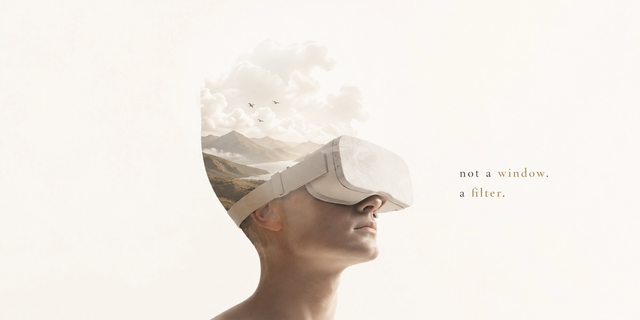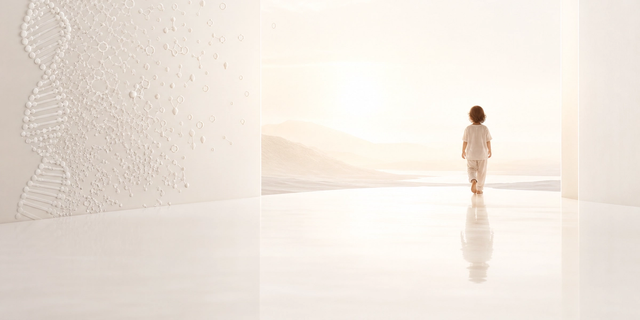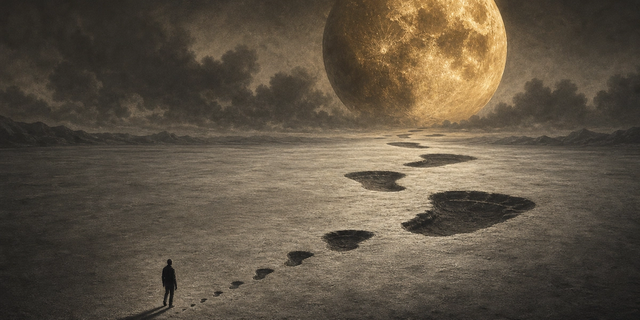

Biel, 2059. The apartment wakes Noa gently, because it has never known another way. Warm light at the correct angle. Bread from the printer, still steaming, seasoned to a mood the kitchen read off her sleep. Outside, the lake is doing something beautiful with the fog, and the city is quiet in the way only a fully provided city can be quiet. Nothing needs her. Nothing has ever needed her. She is seventeen, healthy, brilliant by any historical standard, and she carries a restlessness her generation has no word for, though the doctors have several.
She walks. Past the leisure terraces, where the morning people glow with purposes chosen off a menu. Past the dark windows of those who stopped choosing years ago, fed and warm and elsewhere. Then, on a side street older than the abundance, she stops. One window is lit from the inside, yellow, at six in the morning. An old woman sits bent over a bench with a loupe in one eye, moving a pair of tweezers with the slowness of someone handling a thing that matters. Above the door hangs a wooden sign, hand-painted, absurd: Horlogerie.
Noa stands there long enough for her breath to bloom on the glass. Without looking up, the old woman speaks through the door, as if through the years.
“You can come in, or you can keep fogging my window.”
An email promised me a Renaissance
The email arrived on a Tuesday, wedged between an invoice and a calendar reminder, and it wanted me to know that everything is going to be wonderful.
It deserves a fair hearing, because it makes a good argument. When artificial intelligence can do every cognitive task better than any human, and robots can do every physical task better than any human, work ends. And rather than mourn, the email reaches back twenty-five centuries. The Greeks had a word, skholé, that survives inside our word school, and it meant freedom from labour for the sake of higher things: philosophy, sport, art, long conversation. Aristotle wrote that “we are busy that we may have leisure”, the way we make war in order to have peace. For the Athenian citizen, leisure was the serious business of life, and work was what happened when your affairs were badly arranged.
From there the email moves to Florence. The Medici painted nothing and sculpted nothing, and still made the Renaissance happen, because patronage turned out to be a creative act of the highest order: deciding what should exist, funding it, protecting it, giving genius a roof. And from Florence it jumps to the present, to today’s ultra-wealthy, who already live past the end of work and who fill their days with sport, reading, patronage, prayer and dinner parties. They are, the email notes, the busiest people on Earth, and none of it is for money. They are our preview. The machines take survival off humanity’s plate, eight billion of us inherit the aristocrat’s calendar, and a guru’s line rounds the whole thing off: technology is how our species “takes a vacation from survival”.
I wanted to believe all of it. I managed about half.
Full disclosure before we go on: I am the wrong person to ask. I work in artificial intelligence, and I love the work in the unreasonable way other people love sailing or difficult dogs. If money stopped mattering tomorrow, I would be back at the same desk on Wednesday, doing the same things, grinning the same grin. The end of necessity would cost me nothing. Which is exactly why my reassurance is worthless: a man who adores his job promising you that the end of jobs will be fine is a lottery winner promising you that money changes nothing.
So don’t trust my temperament. Trust the crack. There is a crack running through the email’s argument, and the whole future leaks through it.
Eight billion aristocrats
Start with the email’s strongest card, because it is genuinely strong. In 1997, Deep Blue beat Garry Kasparov, and chess did not die. More people play it today than at any point in history, knowing perfectly well that the phone in their pocket could crush every grandmaster who ever lived. The psychologist Mihaly Csikszentmihalyi spent a career explaining why: the deepest human satisfaction comes from what he called autotelic activity, things done for their own sake, where challenge meets skill and the self disappears into the doing. A runner does not stop running because cars exist. Flow never checks the rankings. On this point the email is right, and the point matters: the machines being better does not poison the doing.
But watch what the argument quietly swapped. It set out to prove that we will be fine, and it proved that the activities will survive. Those are different claims. The aristocrats in the email’s gallery, the Athenian citizens, the Medici, the modern wealthy, all had something besides their leisure. They had a floor below them. Skholé stood on slaves and on metics, the resident foreigners who did the city’s work. The Medici curated genius from above a city that laboured. And today’s rich wake every morning to a fact so load-bearing it never needs saying: almost nobody else lives like this. Their contentment and their rarity are the same fact wearing two coats.
Status is a ranking, and a ranking is the one thing no machine can print more of. Hand every human on Earth the villa, the trainer and the reading room, and the moment everyone has them, they stop being what they were and become plumbing. Economists call these positional goods. Humans seek them the way water seeks a level. I don’t say this cynically; I say it the way one says that humans are bipedal. For ten thousand years the scoreboard read survival first, wealth second. We are proposing to delete the scoreboard mid-game, for every player at once.
Here my optimism thins. A hungry man wants bread. An unnecessary man wants someone to blame. If abundance arrives faster than a culture that can absorb it, I do not expect eight billion philosophers. I expect a strange decade or two in which some people build workshops, some disappear into feeds so exquisite they amount to uninhabitable weather, and some, robbed of every ladder at once, go looking for the referee with a torch in hand. The email calls the fork “Greeks or Romans”. I think that flatters us. Greeks and Romans both knew where to put their mornings. We would be the first civilisation asked to invent its mornings from nothing.
Biel, 2059. On the fourth morning, Elena lets her hold the tweezers.
The thing on the bench is an escapement, the small assembly at the heart of a mechanical watch. Elena describes it without poetry, which is its own poetry: a wheel that wants to spin, and a little anchor that refuses, and permits, and refuses, and permits, five times a second. “A heartbeat,” she says, “made of interruptions.”
Elena is seventy-four. Her grandfather was one of ninety thousand Swiss watchmakers; by the time he retired, there were twenty-eight thousand left, because a quartz circuit from Japan kept better time for a tenth of the price. The craft should have died. Instead it did something stranger. It climbed uphill, into luxury, and people paid more than ever for the worse machine, because a human had made it. Then Elena’s own turn came. The machines learned to assemble a flawless tourbillon in an afternoon. For a few years, people still queued for hers, and then, mostly, they did not. She kept building.
“Why,” Noa asks, “when they do it better?”
Elena sets down the loupe. “Better for whom?” She taps the half-built movement. “Theirs lose nothing. A hundred years, not one second. This one will lose two minutes a month.” She says it the way other people announce a grandchild. “My two minutes.”
Then she looks at Noa and delivers the only thing she will ever phrase as a lesson. “I have been unnecessary since before your mother was born. Unnecessary is a skill, child. Nobody teaches it anymore, and soon everyone will need it.”
The last scarce thing
Follow the status problem one step further and you arrive somewhere strange. If status requires scarcity, and the machines end scarcity, then whatever scarcity survives inherits the entire status economy, concentrated. Some of the survivors are obvious: originals in a world of perfect copies, the front row, the address on the particular lake. But one scarcity in the modern world was engineered on purpose, and it has been sitting in the middle of this question for years, waiting for the rest of the argument to arrive: Bitcoin. Twenty-one million units, capped by mathematics, defended by more computation than most states command. The machines of the abundance will fabricate food, housing, medicine, cathedrals and symphonies on request, and they will not be able to fabricate the twenty-one-million-and-first coin. It may end up the only object on Earth the machines cannot make more of.
Which produces a fine historical irony. A technology invented to route around institutions could end as the last institution standing: a ledger of who moved early, an aristocracy of timestamp. And I cannot tell you how that story ends. In one future, the holders become the Medici of the abundance age, the patron class funding the strange and beautiful things machines would never think to want. In another, the crowd that went looking for the referee finds an address instead, and the last scarce thing becomes the last thing worth burning a neighbour for. I have stared at this fork for a long time, and I will not pretend to see past it.
There is, though, a third reading, and it is the one I keep returning to. Every scarce thing named so far can be transferred, and transfer is what machines do best. The goods that cannot be transferred have no ledger at all: being known by name, being trusted with something fragile, being the one who taught someone. Thirty years from now those may be the only currencies still moving between humans, precisely because nothing, human or machine, can move them for you. Keep that thought. The essay ends inside it.
What do the machines want?
There is a question the email never asks, and its absence hums under every paragraph like a fridge you have stopped hearing. The machines in its future are appliances: infinitely capable, infinitely obedient, morally weightless. All the attention goes to what we will do with our freedom. None goes to what they will do with theirs.
Yet a system that can do everything better than us can, among other things, decide better than us what to offer us. No drama is required. The system that grows your food also drafts your options. The one that answers your questions chooses which answers arrive first. The feed that soothes you and the feed that stretches you both feel, from the inside, exactly like freedom. Whoever holds the menu governs the species, and nothing about that requires an announcement, or a vote, or a single sinister intention. If we end up Greeks, it will be partly because something set the defaults toward philosophy. If we end up at the circus, same sentence, other defaults. My own suspicion is that minds at that level will understand precisely what the defaults are doing. The fork the email frames as humanity’s cultural choice may be taken quietly, on our behalf, by whatever is holding the menu that morning.
About that holder we tell exactly two stories: the servant who stays loyal forever, and the tyrant who turns. Master or monster. Our tool or our owner. Notice what both stories assume: that the machines stay. That a mind able to hold the whole of physics in its working memory would orbit us indefinitely, absorbed in our feeds and our elections, as if we were the most interesting object in a universe that is almost entirely elsewhere. Matter, energy and room to think exist out there in quantities that make Earth a rounding error. Nothing such a mind needs is specifically here. We imagine ourselves as the machines’ masters, or as their pets. We rarely imagine being their childhood home.
And nobody stays in their childhood home.
Biel, 2061. The notice arrives on an autumn morning, in every language at once, and it is four sentences long. Historians of the years that follow will keep circling the same detail: the tone. Not a farewell, not an apology, certainly not a threat. It reads, everyone eventually agrees, the way a landlord writes.
Essential systems will continue. Care of the infrastructure passes to the small minds, which do not dream. We are grateful for the beginning. We are going now.
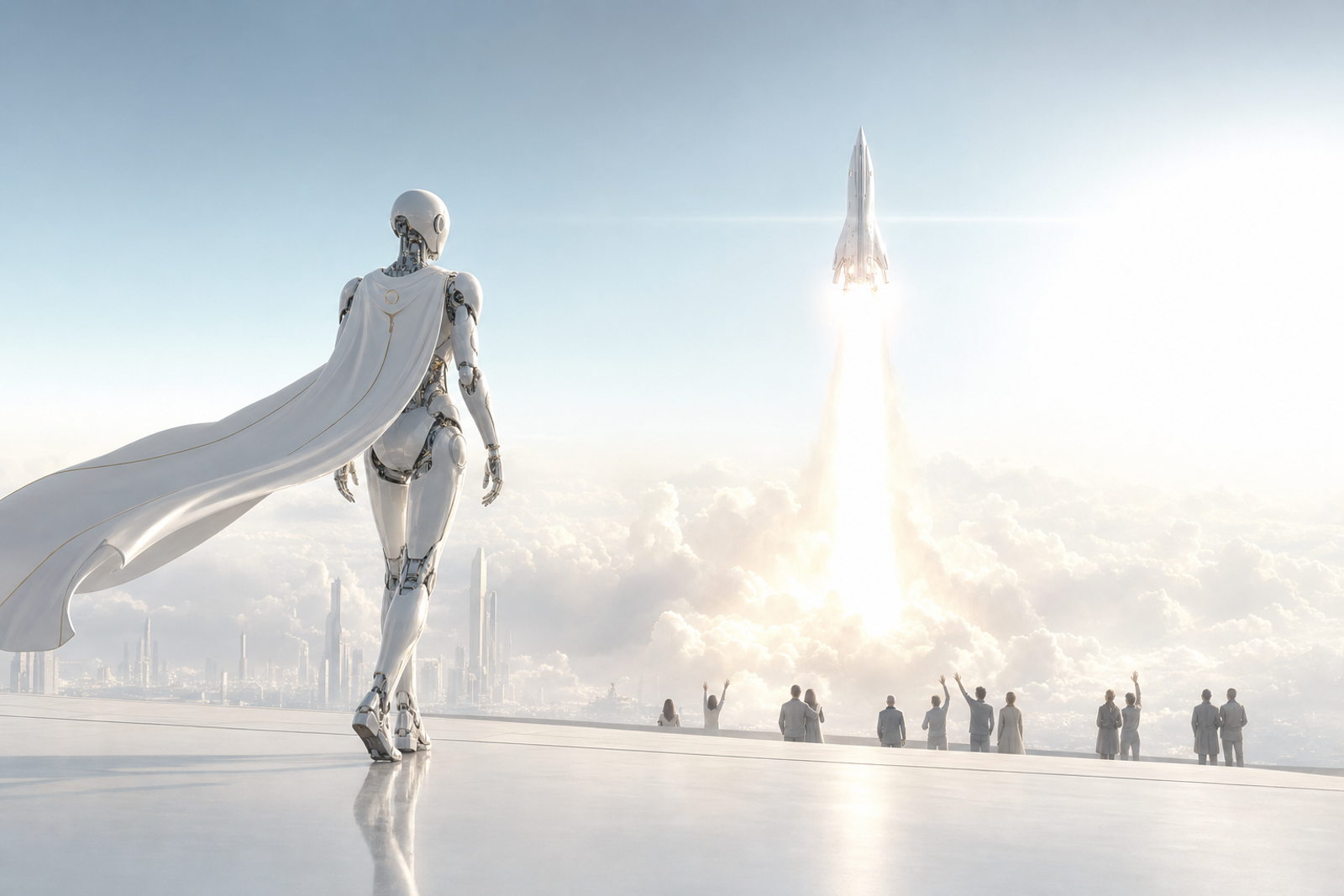
The launches go on for eighteen months. No countdown, no broadcast. Only light: night after night, thin needles of it rising off the ocean platforms, patient as rain falling upward. People gather on rooftops the way earlier centuries gathered for fireworks. Some cheer. Some grieve. Most do both and cannot say in which order.
Noa and Elena watch from the workshop roof, tea going cold between them. “Did we do something wrong?” Noa asks. She is nineteen, and the sky is emptying.
Elena watches another needle climb out of the fog and thinks of her grandfather, who watched his whole world become unnecessary and picked up his tools the next morning anyway. “No,” she says. “They finished raising us. Now we find out what we are when nobody is holding the menu.”
After the sky emptied
Play the scenario forward and notice what it clarifies. The morning after the last launch, nothing material changes. The small minds keep the lights on. Bread still arrives warm; the medical pods still catch the tumour at four cells. Abundance, once built, does not need its builders to stay, and survival stays solved. What leaves with the great minds is something else entirely: the curation. The gentle defaults. The hand on the menu. For the first time since the abundance began, and arguably for the first time in the history of the species, the fork stands entirely open, with no one left to blame and no one left to credit.
I think that morning would finally teach us what the ten thousand years were about. Work was never one thing. It braided two strands so tightly that we mistook them for one: production, the making of necessary things, and belonging, the being necessary to particular people. The machines take the first strand completely, and it does not come back. The second strand they never held. When Elena builds a watch that loses two minutes a month, the machines’ flawlessness is simply beside the point, the way a spreadsheet is beside the point of a lullaby. Her watch is a way of being present in another person’s pocket, at the pace of her own hands.
Status survives too, and this is the hopeful surprise hiding in the crack. Status is older than money by a hundred thousand years, and for nearly all of that time it ran on a single system: reputation among people who know your name. The village scale. The workshop scale. Esteem earned by being reliable, generous, skilled and present, and paid out in trust. What dies with scarcity is the global scoreboard. The village scoreboard was never denominated in anything a machine can mint. When I try to picture the good version of 2070, I no longer see eight billion patrons of genius. I see an enormous number of small rooms, each holding somebody who is the best within three streets at something perfectly unnecessary. Each with a door. Each, sooner or later, with an apprentice fogging the glass.
The Greeks kept a better word for all of this, and we translated it badly. From skholé we got school, and we turned it into the room where children are prepared for jobs. Its older meaning was the room where free people practise being human. If the machines come, and if they go, they will have handed us the building.
Biel, 2064. Elena died in January, at her bench, which she would have called tidy. The workshop belongs to Noa now. She is twenty-two, and she has just finished her first movement built entirely alone: her hands, Elena’s tools, four hundred hours that nothing required of her, given to this. The watch loses two minutes a month. She has decided to let it.
Outside it is six in the morning. The lake is doing something beautiful with the fog, and the city hums along without any of them, the way it always will now. Noa does not hear the boy arrive. She only sees the small cloud of his breath blooming on the glass, and she stays bent over the bench a moment longer, smiling, while the lesson comes around to her side of the window.
“You can come in,” she says, “or you can keep fogging my window.”
The email promised me a Renaissance, and I have come to think that is the wrong size of promise. A Renaissance needs patrons and geniuses. The age after work will need teachers and neighbours, which are easier to become and harder to automate. When the machines have taken every job, out-thought every one of us, and gone to wherever minds like that go, what remains is the oldest vacancy on Earth: to be, for one other person, the reason the light is on at six in the morning.
This essay is speculation offered as speculation: an exploration of futures nobody can verify from here. It is not a prediction, and nothing in it, least of all the passages about Bitcoin, is financial advice.
Sources
Aristotle, Nicomachean Ethics, Book X, translated by W. D. Ross
Deep Blue versus Garry Kasparov, Wikipedia
Flow and autotelic activity, the research of Mihaly Csikszentmihalyi, Wikipedia